New international data shows Australia is among the world's leading migration destinations, at the same time as experts and politicians are calling for a national migration summit to sort out debate on the topic.
One in three people living in Australia was an immigrant in 2025, compared to 12 per cent across the 38 countries in the Organisation for Economic Co-operation and Development (OECD), new data shows.
The highest migrant shares were in Luxembourg at 52 per cent, Switzerland (33), New Zealand (29), Ireland (24) and Austria (23). Six developed countries had populations where less than five per cent of people were foreign-born: Mexico, Poland, Japan, Türkiye, Korea and the Slovak Republic.
The fresh figures come as One Nation pledged on Wednesday to cut the refugee intake by 90 per cent and scrap parent visas because they say Australia can't afford to support migrants or fund humanitarian programs during a cost of living crisis.
Your trusted source for staying up-to-date with the world around you. Get free daily news updates and analysis, straight to your inbox.
Liberal Senator Andrew McLoughlin told SBS News the "shameless bidding war" to bring the lowest number of migrants into Australia is both economically destructive and "culturally corrosive".
"These divisive debates should never be allowed to occur. Migrants must never be demonised. They are Australians."
He joined Independent, Greens, and Liberal MPs along with more than 60 business and civil society organisations calling for a national migration summit focused on long-term planning to design and implement a better system, convened by non-profit Settlement Services International.
University of Sydney Public Law Professor Mary Crock told SBS News Australia it's "just beyond nonsense" to ban onshore asylum applications because that breaches Australia's international legal obligations and would force us to withdraw from the Refugee Convention.
"The One Nation [policy] story is making a complete nonsense of the difference between a [refugee] convention obligation to give protection to people who are on our territory who can be seen and recognised as refugees and a humanitarian program, which is entirely voluntary," Crock, who has worked in the migration area for over 40 years, said.
University of Canberra social democratic political researcher Dr Emily Foley told SBS News Labor is in a "very sticky situation" on migration because One Nation and the Coalition have linked migration to cost of living and housing pressures.
"It's been really difficult for Labor to construct a policy that is both able to appease the progressive flank, who are accepting of refugees, while also managing significant public concerns about migration, and balancing the concerns of businesses and universities, who need migrants," Foley said.
She said that so far this century the Coalition's polling has been boosted by connecting issues of migration with national security.
Labor wants to bring Net Overseas Migration down from 245,000 this financial year to 225,000 next year, while the Coalition would see it cut to 100,000.
Australia, the United States, and Canada have consistently resettled more than 90 per cent of all refugees since 1975. Two in three went to the US, 17 per cent to Canada and Australia re-homed 11 per cent, Sweden was fourth taking 2 per cent.
Australia is one of the most welcoming nations in the world when it comes to the intake of humanitarian migrants, Crock said.
"That is because there's such a tiny percentage of countries that have a humanitarian program," she said. "The vast majority of the 42 million plus refugees don't come through any programs; they are being housed by the poorest, often proximate countries to the disasters that are unfolding around the world, like Pakistan, Iran, even Türkiye."
One Nation plans to ban all refugees from these countries and anyone in a "no-go" zone as defined by the Department of Foreign Affairs.
Australia accepted 19,000 refugees in 2025, 9 per cent more than 2024, and ranked second in the OECD after Canada's 39,000. Australia took about 700 refugees per million people, behind Canada’s 970 but above New Zealand (280), Norway (120) and Finland (110). The OECD average was 68.
If every OECD country resettled as many refugees per capita as Canada, the 2025 total would have been about 1.2 million, more than 40 per cent of the global resettlement needs estimated by the UNHCR at 2.9 million.
Across developed countries, resettlement arrivals fell 57 per cent in 2025, mostly because US President Donald Trump's executive order, starting in January 2025, suspended the US Refugee Admissions Program and halted refugee application decisions, citing national security, public safety, and strain on U.S. communities.
The overnight removal of USAID and the closure of all of their programmes has put an enormous amount of pressure on UN agencies like UNHCR, Crock said.
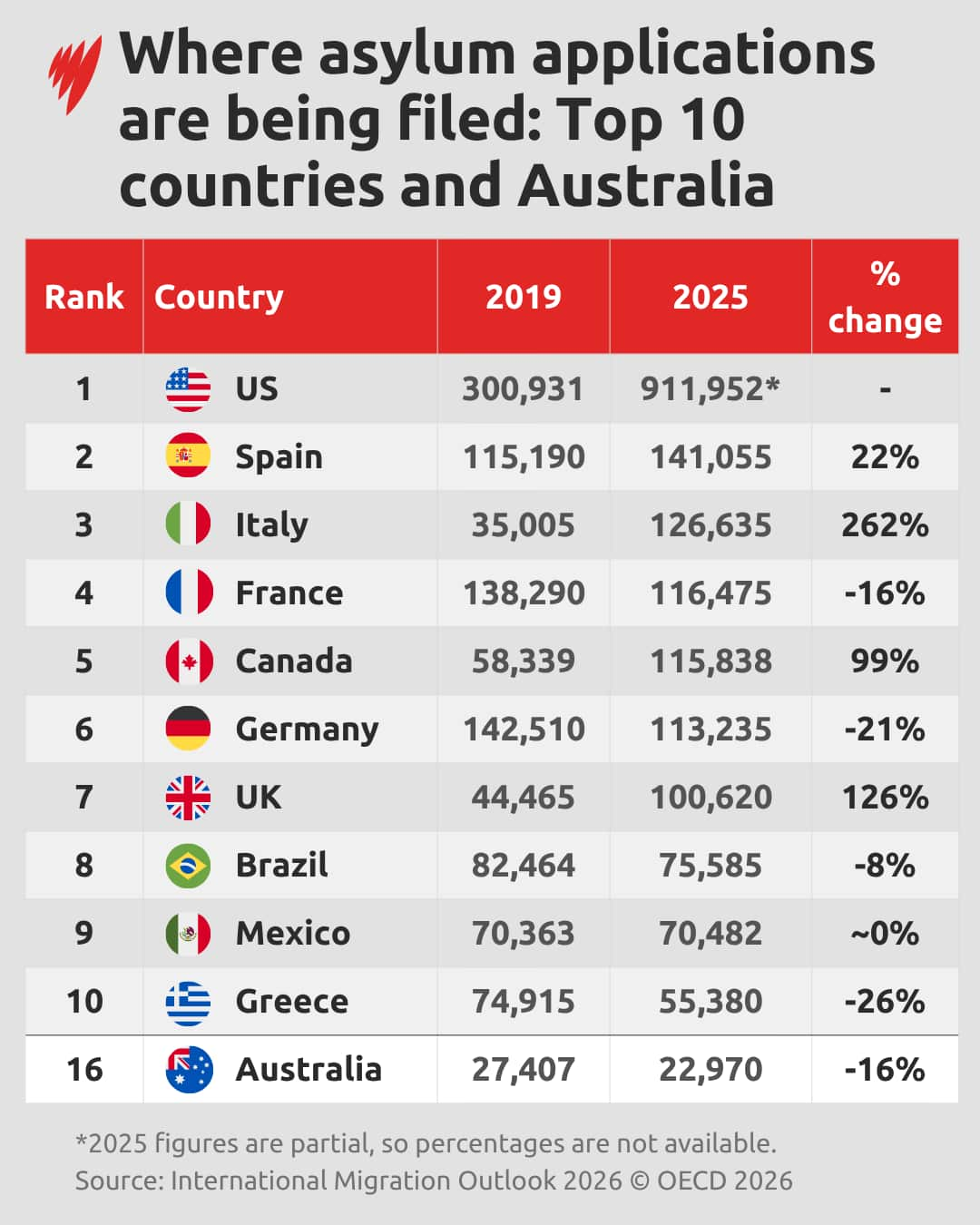
The OECD also counts asylum requests, which are applications for protection, not people already granted refugee status. In 2025 Australia recorded 22,970 new requests. The US figure was 911,952, but the OECD marks it as partial; Spain recorded 141,055, Canada 115,840 and Germany 113,235. These figures shouldn’t be treated as refugee admissions.
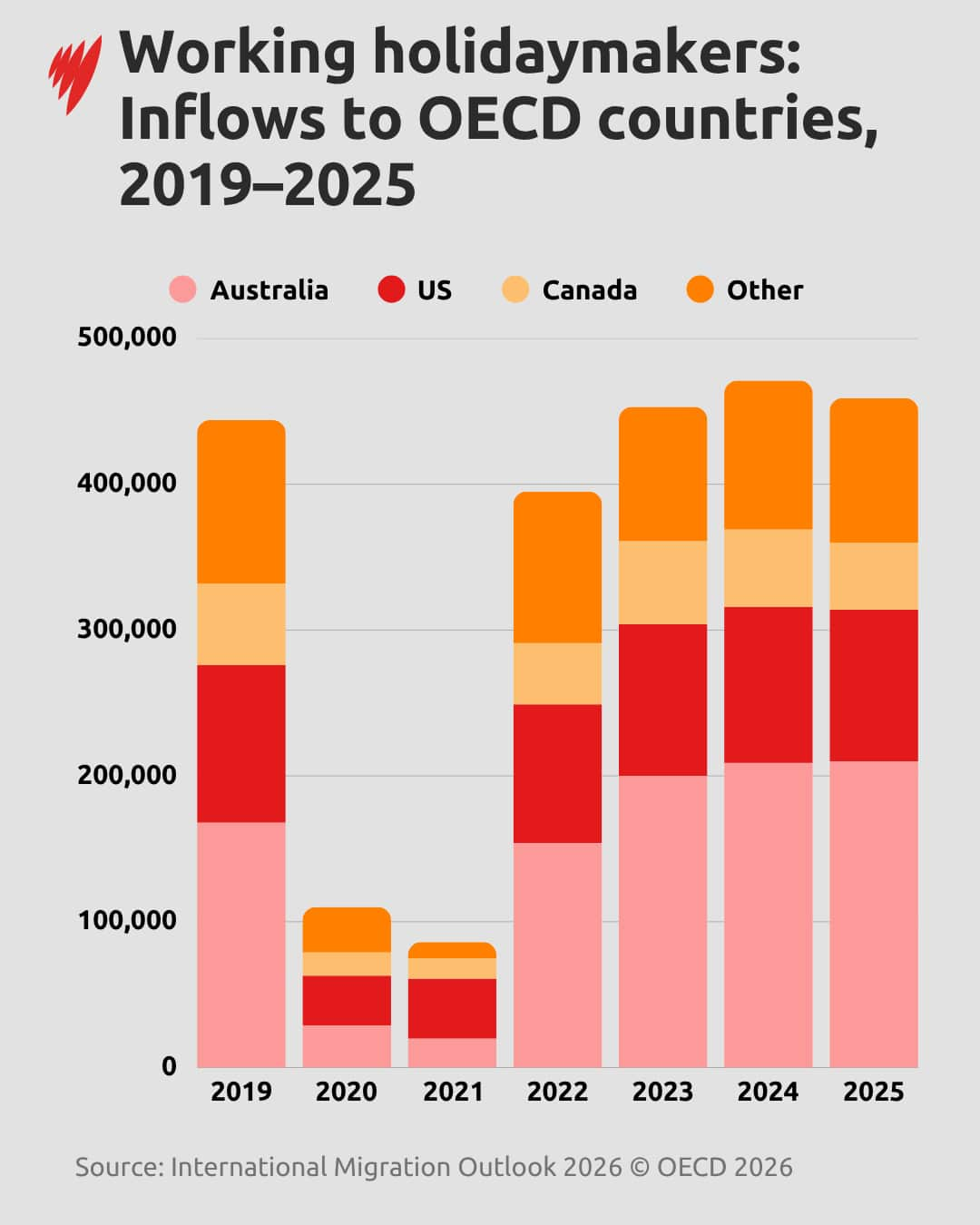
Australia stands out for working holiday makers, hosting almost half (46 per cent) of the OECD total. The next largest destinations were the US with 104,600, Canada (45,400) and New Zealand (44,600). Australia’s intake was almost unchanged from 2024 but 25 per cent higher than in 2019. At the low end, Finland and Italy each recorded about 200 backpacker workers.
The Australian government this week back-flipped on its policy to cut 20,000 working holiday maker visas because they support agriculture, tourism and hospitality.
From March 2027, applicants seeking a second or third year will need an invitation through a new regional-work guarantee process. The government has set 45,000 second-year and 25,000 third-year visa places for 2026–27. That policy is designed to manage demand while directing workers to regional areas.
Australia’s 2025 permanent inflow included 60,500 working migrants, 71,700 accompanying family members, 52,500 family migrants, 29,200 people moving under Trans-Tasman arrangements and 20,000 humanitarian migrants. Family members were the largest component, though labour migration was a comparatively large share by OECD standards.
The US was the largest OECD destination for permanent migration in 2025, with 1.2 million people. Germany received 538,300, Spain 460,500 and Canada 393,800. Australia took 234,200, ninth overall, a fall of 2 per cent from 2024, but 20 per cent above 2019.
Australia’s annual government planning level is 185,000 permanent migration places, with an approximate 70:30 split between skilled and family streams.
The OECD’s 234,200 figure is higher because it measures actual flows and includes status changes and free movement, rather than just places in the planned migration program. The government also expects about 70 per cent of 2026–27 program places to go to people already in Australia.