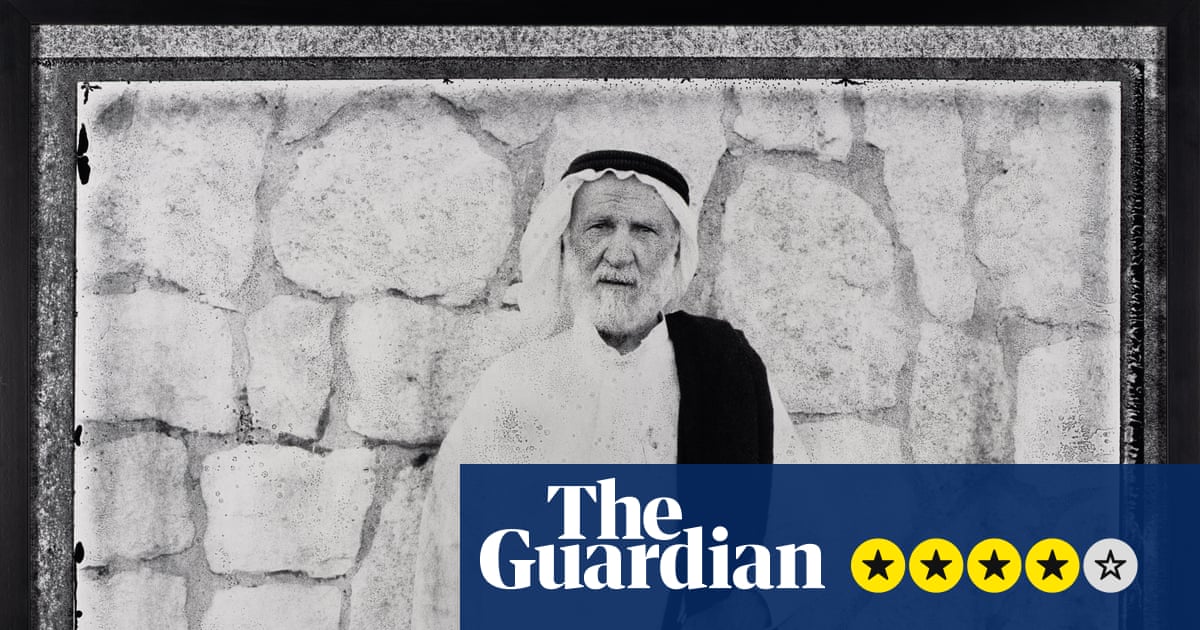


I n 2006, Simone Fattal painted on to basalt slabs the names of places indelibly associated with massacres in the Levant since 1948: Deir Yassin; Jenin; Qana; Sabra. Through the names, in the same Arabic script, runs a line of poetry by Etel Adnan: “In our lands of drought the rain forever is made of bullets.”
Fattal’s work, which documents atrocities on a material that burst from the earth as lava before settling into stone, introduces a show that likewise combines the recording of history with anger both hot and cold. The last named of those massacres, perpetrated by a Lebanese Christian phalangist militia during Beirut’s occupation by Israeli forces in 1982, also inspired the poem Praise for the High Shadow by Mahmoud Darwish, a line from which this show takes as its title. Writing in exile in Beirut, Darwish riffed on the sea as a symbol of Palestinian displacement and memory, connecting people dispersed around the eastern Mediterranean to each other and to their homeland. The angry, melancholy, defiant work of these (mostly) Palestinian artists also weaves a traumatic national history into the cosmopolitan culture of the Levant and the interlinked world in which we now live.
It is one lesson of their work that to live in exile is to be waiting. On the floor beside Fattal’s monument stands the suitcase that Hazem Harb carried out of Gaza in 2006; above it are two framed photocollages alluding to the international airport that was bulldozed by the IDF four years earlier. These artefacts beg the question of when, and if, the artist will be able to return to his home, and who will make that decision. That powerlessness and apprehension is etched into the faces of the people photographed by Rula Halawani at Palestinian checkpoints.
Tarek Al-Ghoussein never set foot in his own country. Born in Kuwait to Palestinian parents, he explored his fragmented identity in a troubling series of photographs displayed here on glowing lightboxes. The self in these self-portraits emerges in the unsettling combination of symbols (notably the black-and-white keffiyeh that covers his face) with settings (an airport runway, a target range, an abattoir). A picture of the artist, who died in 2022, looking out to sea like Caspar David Friedrich’s wanderer does not inspire awe at the grandeur of the native landscape so much as indignation at the subject’s separation from his own.
Those who cannot see their own homeland are forced to invent it, which might be why so many storytellers are exiles. Also born in the Gulf to Palestinian émigrés, Basma Al-Sharif set out to tell a conventional “love story” set in the Levant. But she got caught up in the networks of nationalism and identity that must govern her characters’ lives, and so her elaborate fiction instead bears witness – through video, photographs, and botanical drawings of “native” and “invasive” species – to the impossibility of disentangling any individual story from the social and political conditions that frame it. That fact is especially obvious in this charged historical context. It reminds us that to make art for its own sake is a privilege of the few, made possible by injustices that are no less real for being out of sight.
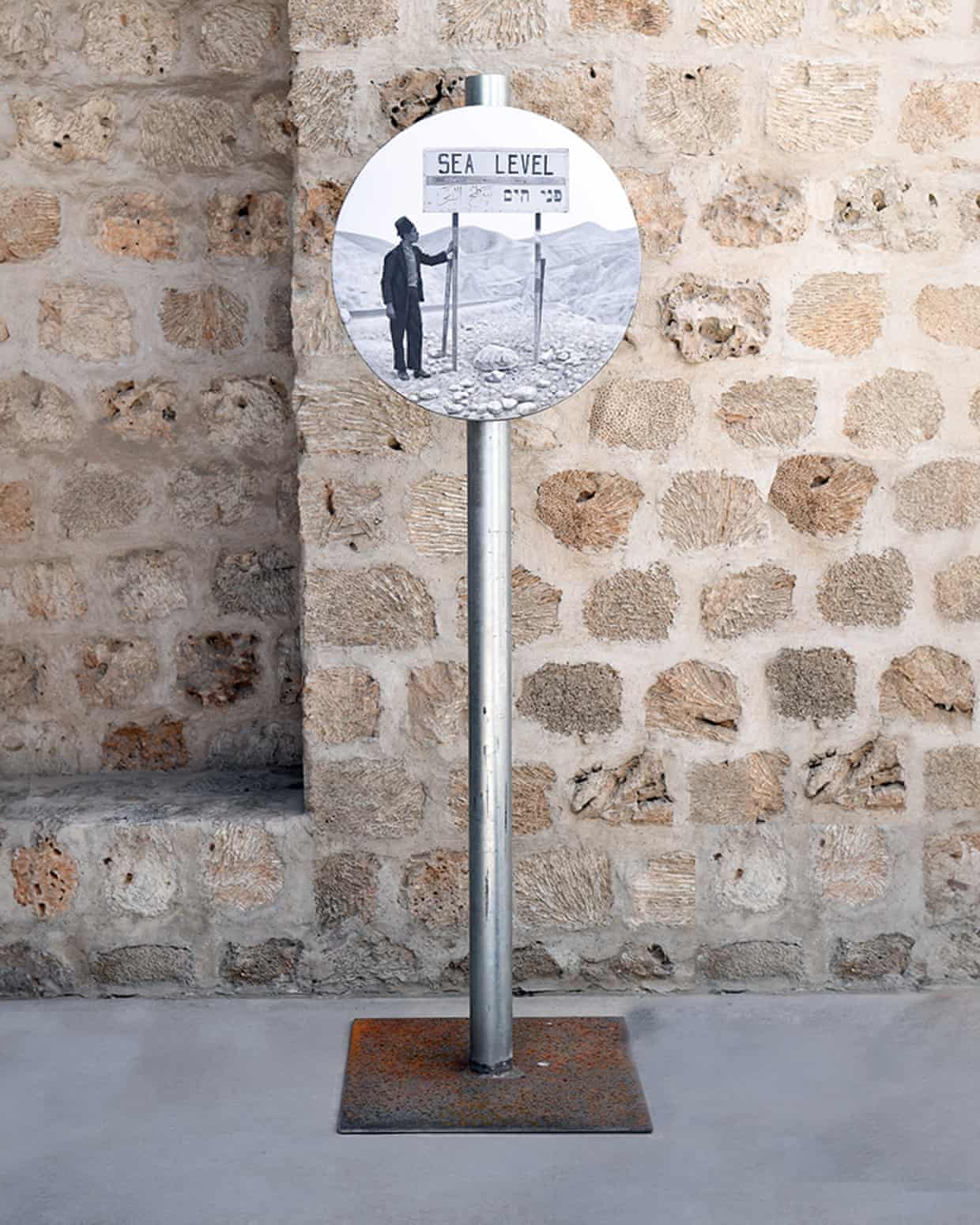
Not only is it a cliche that Palestine is the “land of milk and honey”, as the ironic title of an installation furnished with artificial grass and potted plants suggests, but it is no longer true. At least not in the telling of Khalil Rabah, whose sardonic paintings of road signs indicating bodies of water in parched landscapes offer a reminder that destruction of the natural environment is a strategy of occupation going back at least as far as the Romans (“they make it a desert and call it peace” was Tacitus’s phrase originally). The images of rain, drought, water and sea that recur through the show – and in a neighbouring exhibition of paintings by the Gazan art collective Eltiqa – are not merely poetic metaphors.
For all that this is a show presenting Palestinian histories from Palestinian perspectives, using works from the collection of a UAE-based foundation with a longstanding commitment to that cause, it is only in giving three rooms to the work of Abdul Hay Mosallam Zarara that it slips into agitprop. That these painted reliefs of Palestinian heroes battling imperialist dogs are propaganda does not automatically disqualify them as art – think of John Heartfield’s anti-Nazi photocollages, El Lissitzky’s revolutionary posters, or the vast majority of historical paintings of state leaders and religious icons – but the show would have been better served by a smaller selection, especially if that made space for artists such as Emily Jacir and Mona Hatoum, both of whom are represented in the collection of the Sharjah Art Foundation but surprisingly absent here.
Yet Abdul Hay’s work does serve to connect the Palestinian story to anti-imperialist struggles from Pinochet’s Chile to apartheid-era South Africa. Most notable in the context of this ex-military hospital is a painting commemorating the hunger strikers who died in the Maze in 1981, affirming a link between Irish republicanism and Palestinian independence that endures to this day and informs (and makes possible) such a forthright exhibition in a state-funded institution. Here is a final reminder that art can never entirely be separated from the systems – political, economic, migratory – that produce the societies in which we live, at least until we achieve a collective utopia. Until that time arrives, this timely spotlight on Palestinian artists meets the function ascribed to art by the great critic John Berger, who was born 100 years ago this month: to show the future “what the past has suffered” and thereby to serve as “a meeting place for the invisible, the irreducible, and the enduring”.