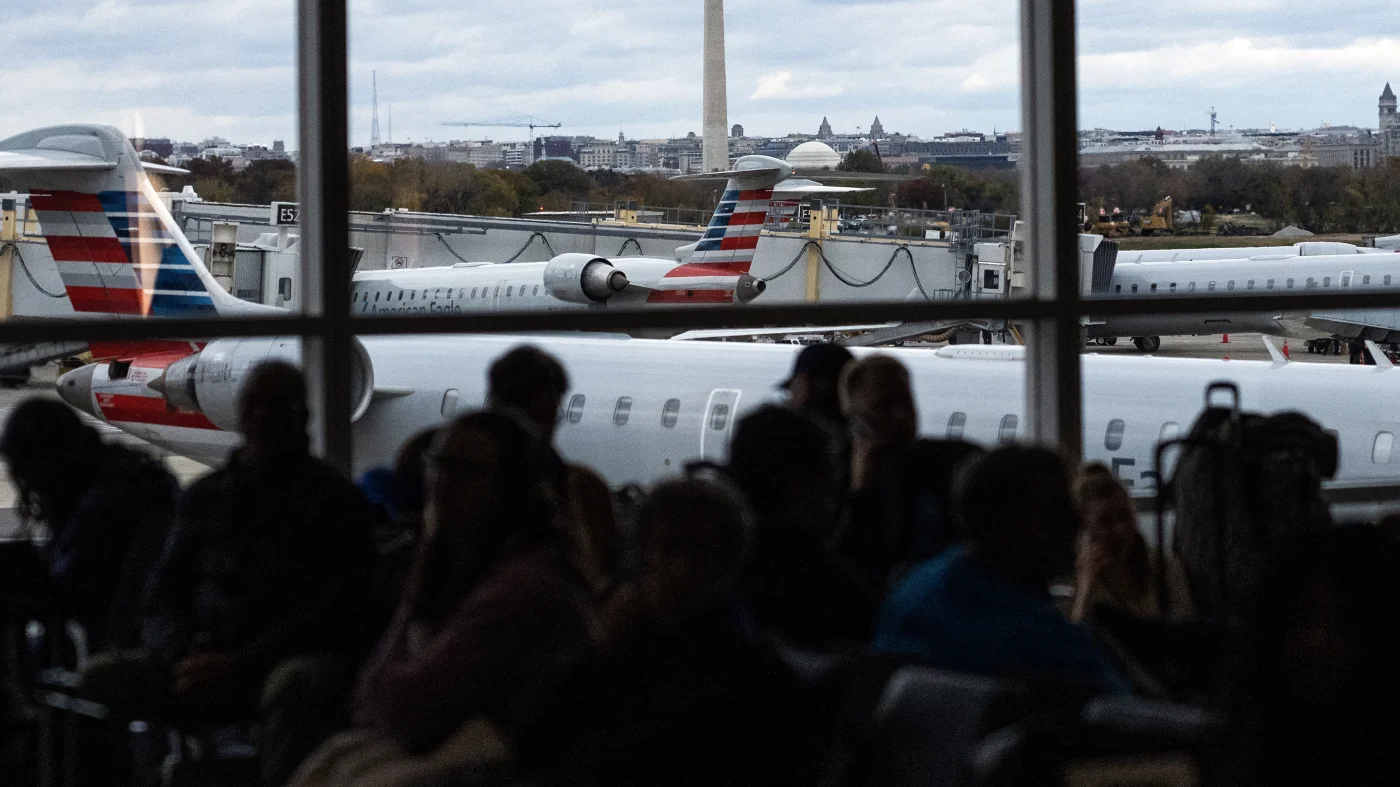
By Wednesday of this week—six days after a 4.5-hour nationwide ground stop that panicked onlookers and scrambled air travel —US transportation secretary Sean Duffy said he still wasn’t quite sure what led to the Friday meltdown. “The root cause of what happened, we don’t have clarity yet,” he said after a meeting with lawmakers.
Still, the Federal Aviation Administration has revealed that a few things did go wrong on Friday afternoon. It involved routine infrastructure replacement, a faulty router, data overload, and disruption in some regions in the radio communications that air traffic controllers use to speak to each other and pilots.
The agency has since described the ground stop as something executed “out of an abundance of caution.” On Wednesday, FAA administrator Bryan Bedford appeared to downplay the incident even as he took blame for it, calling the outage “a knee scrape, and I’m sorry.”
While aviation industry workers maintain that flyers were safe throughout the ground stop, some felt government officials downplayed the event, which left air traffic controllers scrambling to backup frequencies even as they tried to figure out what was going on.
“That was the hairiest 90 minutes of my career,” one air traffic controller told WIRED.
Contacted for comment, FAA spokesperson Steve Kulm didn't answer questions but referred WIRED to the agency’s ground stop Q&A web page , where the agency writes it has “clear, established, standard procedures to ensure safety during incidents such as this.” It says that some radio frequencies and radar feeds remained online during the communication issues, “allowing air traffic controllers to maintain communication with and track aircraft.”
Here’s what we know about the ground stop so far.
To understand the communications issues that led to the ground stop, here’s a quick overview on how air traffic control works.
Most flyers are familiar with the towers near airports, officially called the Airport Traffic Control Towers (ATCT). The controllers who work here manage aircraft ground movements, including takeoffs and landings. Once an aircraft gets up into the sky, around 10,000 feet, it’s passed to controllers in a Terminal Radar Approach Control (TRACON) center, who manage airport arrivals and departures. Then, once a flight is really underway, an aircraft is passed to Air Route Traffic Control Centers, often just called Centers. There are 22 of these in the US, and controllers there guide airplanes for most of their flight, passing off the aircraft as they move between regions.
The communication radios used at Centers have a range of around 150 miles—a problem when the areas they have to manage are more than 100,000 square miles each. So phone lines at the Centers lead to networks of transmitters, each installed remotely.
For decades, this network has been connected by copper telecommunications lines—outdated and sometimes brittle tech. So in 2025’s GOP-led Big Beautiful Bill , the Transportation Department received the billions of dollars in funding needed to upgrade that copper to fiber-optic cables. The upgrade swaps the system, the private communications backbone of Air Traffic Control , from one of mechanical switches to a digital system built on internet-based protocols. A contractor called L3Harris—the network owner—manages the transition, and as of last week, the project was about 70 percent complete. This was where the FAA ran into problems.
The trouble began in El Dorado, Arkansas, the site of one of those remote communications facilities, which is part of the larger Center based in Memphis, Tennessee. There, the FAA says a contractor with L3Harris was making on Friday what is now a routine switch from that legacy copper system to a fiber-optic one. But something, it appears, went wrong when the worker plugged in a new router as part of that transition, and the FAA still doesn’t know why.
Data began to flood the network, making 1,000 connection attempts every 4 to 5 seconds, according to the FAA. The agency says another remote site, a radar-based facility in Amarillo, Texas, may have also flooded the network with data. To compensate, the network tried to recruit other nodes, and they got overloaded, too, taking down several radio frequencies on the network.
At first, the issue manifested as intermittent dropouts on radio frequencies at Centers in the region, from Kansas City to Chicago, according to two people familiar with the matter who spoke to WIRED under the condition of anonymity because they are not authorized to speak to the press. This made it difficult, if not impossible, for air traffic controllers to talk between Centers and with pilots through normal channels. From there, though, the issues seem to have cascaded to other regions, including the areas around Washington, DC, and New York.
In control rooms—mostly Centers dealing with en route flights—air traffic controllers first noticed some “dropouts” on their radio transmissions, according to two sources. On their own, these sorts of communication disruptions aren’t unheard of. But when they began to spread to multiple regions, FAA officials really began to pay attention.
Because officials didn’t understand why the radio frequencies were unstable, the agency called a nationwide ground stop.
One person who spoke with WIRED said they still had access to a backup frequency during the network instability. The FAA said “some frequencies and radar feeds remained reliable.”
Then, according to the FAA, contractors from L3 Harris blocked data from the remote Arkansas and Texas locations from the wider network. That restabilized the system, restoring radio contact between everyone in the airspace.
In a statement Friday, a spokesperson for the National Air Traffic Controllers Association, a union that represents almost 20,000 controllers, wrote that “air traffic controllers were on the job, carrying out their responsibilities and working to ensure the safety of the National Airspace System.”
While the technical issues led to several uncomfortable hours for aviation professionals, midair passengers remained safe during the ground stop, says Scott Miller, an airline pilot and a lecturer in the Aviation and Technology program at San Jose State University in California. “It was certainly an abnormal situation, but it wasn’t an emergency, because we’ve trained for it,” he says. “It was not dangerous, but it was highly inconveniencing, and it was not normal.”
It helped that the radio outage did not seem to have affected all Centers, and even fewer TRACONs and local towers. That means pilots were generally in contact with controllers, especially as they circled airports and landed their planes.
It also helped that pilots don’t actually need air traffic control to fly their planes, Miller says. “Talking to a controller is not what keeps an airplane in the sky,” he says. Pilots have plenty of systems onboard that allow them to “see” what’s going on around them.
Despite the lack of clarity on what exactly happened with the newly installed router to make it malfunction, Duffy has settled on a solution: more money. On Wednesday, he officially asked Congress for $50 billion, with $30 billion of that dedicated to air traffic control modernization.
In your inbox: Inside WIRED’s newsroom with Katie Drummond
Nvidia employees want Jensen Huang back
The Big Interview: Zohran Mamdani on data centers, AI in schools, and the Democrats
Stephen Miller wants a “servant class, not a working class”
Introducing the app: More ways to make the most of WIRED
10% Off Canon Promo Code + Up to 30% Off
Up to 20% Off Multi-Quantity Orders with VistaPrint Coupon
Squarespace Discount Code 50% Off Advanced Plan
LegalZoom Promo Code 10% Off Sitewide