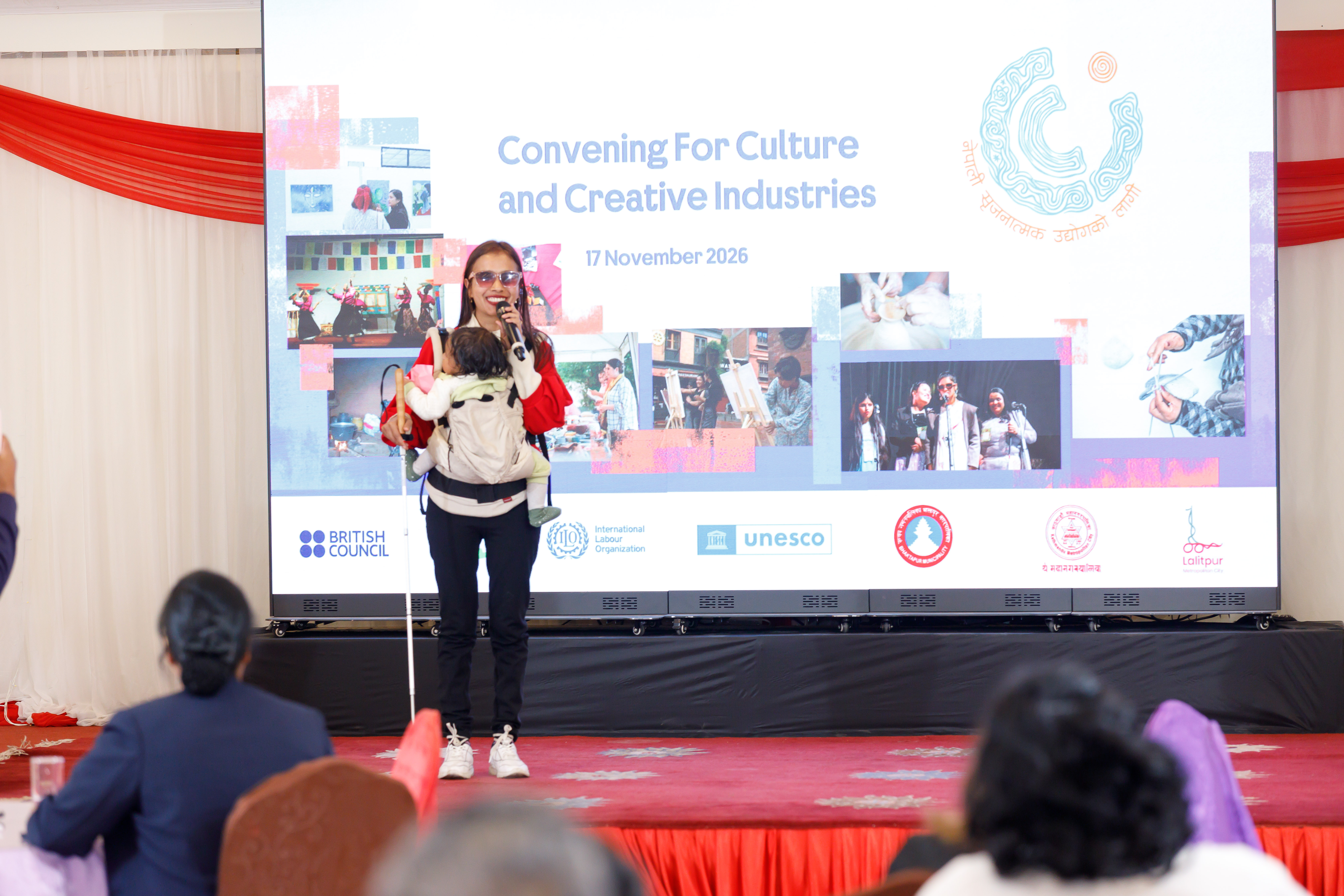
At the fourth convening of the Culture and Creative Industries forum, held in Kathmandu on Tuesday, artists, advocates and cultural practitioners called for a more inclusive creative sector, highlighting gaps in recognition, representation, access and institutional support.
The CCI group was formed by UNESCO, FCA Nepal, the International Labour Organization (ILO) and the British Council, in collaboration with Bhaktapur Municipality, Lalitpur Metropolitan City and Kathmandu Metropolitan City, aiming to strengthen Nepal’s creative and cultural industries.
The group aims to make the sector more inclusive and sustainable by creating greater opportunities and a supportive environment for individuals, institutions and communities working in it.
The convening also incorporated self-descriptions, with speakers briefly describing their clothing and appearance, tying the practice to the event’s theme of culture and creativity.
The host and facilitator, Mandira Maharjan, outlined the group’s objectives and the event’s focus on addressing challenges facing Nepal’s creative sector.
British Council Country Director Rustom Mody said Nepal’s creative industries, ranging from artisanship and gastronomy to literature, music and filmmaking, are rich in cultural value but are under-recognised for their economic potential.
Much of Nepal’s creative sector operates informally, leaving some workers without adequate economic and labour rights, he said.
The programme also featured a screening of the film ‘Rediscovering Community Art’, which documented the British designer Ellen Rock’s collaboration with women artisans at the Janakpur Women’s Development Centre. The film featured Mithila artists , and showed how the collaboration brought together Mithila art and contemporary print design to a collection titled ‘Her Hands’.
“It was not necessarily my art being interpreted through a craft,” Rock said. “It was a collaboration.”
Following the film screening, UNESCO Representative to Nepal Jaco du Toit presented findings from the baseline assessment of the Kathmandu Valley’s cultural and creative industries and outlined the group’s objectives.
He also highlighted ongoing policy and institutional initiatives, with five of the 29 recommendations from the assessment currently underway.
The National Cultural Policy, 2067 identifies cultural and creative industries as a priority, while Kathmandu Metropolitan City has approved a Cultural and Creative City Policy. Du Toit also mentioned that Lalitpur Metropolitan City has incorporated the UNESCO creative City of Music Four-Year Action into its 2083/84 municipal budget . FCA Nepal is also establishing a Creative Hub through the EU-funded ‘Voices of Change’ project.
“[Nepal’s] culture is recognised but under-measured,” Du Toit said.
He also presented the UNESCO Culture 2030 Indicators as a framework for measuring culture’s contribution to sustainable development and identifying gaps in the sector, covering four dimensions—environment and resilience, prosperity and livelihoods, knowledge and skills, and inclusion and participation.
Sristi KC, founder of the non-profit Blind Rocks that works with visually-impaired people, was also in attendance. In her case presentation titled ‘Surviving as a Disabled Woman Artist’, KC spoke about the barriers disabled artists face, from limited representation in films and cultural spaces to a lack of accessible opportunities. Introducing her infant daughter as her co-presenter, KC spoke about the comments she faces as a blind working mother, including being told to stay home and look after her child.
“At a time when we are imagining the future through art, I want my daughter to see that future too,” she said. “And to show her that, I do not need my eyesight. I need the vision that I have.”
KC said disabled people are often viewed with pity rather than recognised for their abilities. She called for authentic representation in films through casting disabled actors and involving them in scriptwriting and production, and stressed the need for accessibility measures such as audio description, sign-language interpretation and accessible infrastructure. She argued that these should be treated as necessary costs rather than additional expenses.
In an interactive session, gender and youth advocate Sanjana Chhantyal invited participants to imagine what Nepal’s creative and cultural industries could look like in 2036 through “futures-thinking”, which she described as “structured imagination with a clear purpose”.
Participants at each table were given theme cards reflecting current realities of creative industries. They discussed what they wanted to change, explored ideas through the lens of inclusion and intersectionality, and envisioned a future for Nepal in 2036.
Later, Ffion Wyn Bowen, artistic director of Cwmni Theatr Arad Goch , shared a case study from Wales on the Opening Doors Festival, established in 1996, an international theatre festival for young audiences that brings productions to children and young people, particularly in rural communities.
Closing the convening, Joint Secretary at the Ministry of Culture, Tourism and Civil Aviation Saubhagya Pradhananga spoke about the need to reconsider how cultural policies could better address the needs of creative practitioners. She mentioned that policies had largely focused on preservation but they also needed to address inclusion, access and participation as well.
She also pointed to the revision of the Culture Policy 2067 BS , saying existing government efforts were not enough. Pradhananga pledged to work towards more inclusive policies and take the feedback from the convening’s futures-thinking exercise into consideration in future plans.
British Council Country Director Rustom Mody said that the most important thing is to recognise what Nepal already has. “We have a fantastically rich culture,” he said. “But we also need to understand what more can be done and what kind of support is needed.”
Shrestha is an intern at the Post's Culture and Arts desk. She is studying journalism and English literature at St. Xavier's College.