



You have reached your maximum number of saved items.
Remove items from your saved list to add more.
You've used all of your gift articles. 3 more will become available on the 1st of every month.
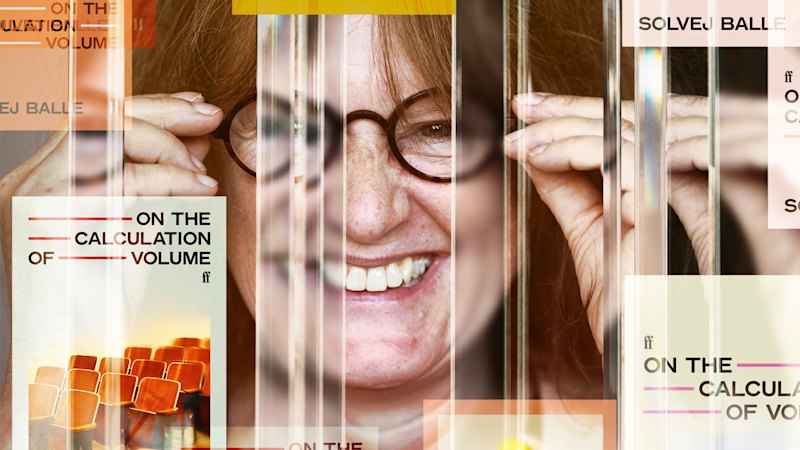
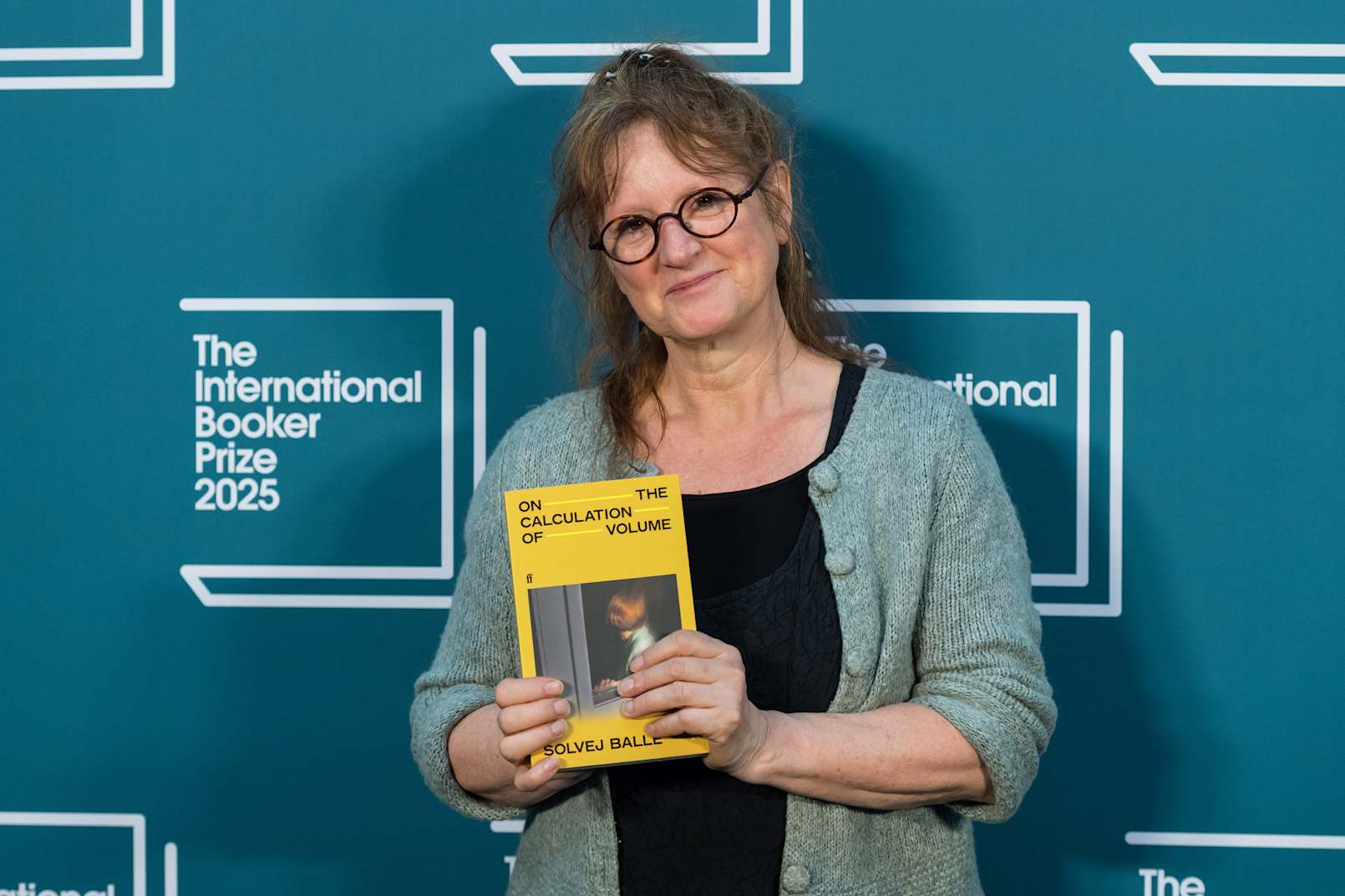
Solvej Balle arrives for our interview right on schedule. I guess you’d hope so, given the Danish novelist has spent nearly four decades thinking about time. Or, more specifically, about a single day.
Now she has more time on her hands than she knows quite what to do with. A week ago Balle sent the final instalment of her monumental seven-part series, On the Calculation of Volume , off to the printers. And having finally finished her life’s work – what one critic called “our century’s answer to Proust” – she seems to have gone off the idea of being a novelist altogether.
“My dream is never to write fiction again,” Balle says. “From the day I realised this was how I was going to spend a lot of my time, I’ve thought, oh goodness, I don’t want to be a writer.”
I’d – unfairly, I quickly realise – expected the author of such painstakingly considered, philosophical books to be quite serious company. Someone who might hold forth on Kant’s theories of time, punctuated by long, existentially loaded pauses. But Balle doesn’t let the weight of all those big ideas get in the way of being rather good fun, drolly describing her grand literary experiment as a “stupid idea”.
“Of course, the idea is ridiculous. If you think enough about any stupid idea you can probably get something out of it,” she says. “It is a stupid idea. Just the idea of cooking so much soup on a thing like that. Who does that, honestly?”
On the Calculation of Volume follows Tara Selter, a rare-book seller who wakes one morning to find herself reliving the day before, November 18. “I was looking at a world which had returned to its starting point during the night, it had jumped back a day, to unfold again in exactly the same way as the day before,” she writes. Her husband Thomas follows the same path to the kettle and his swivel chair rolls the same way across the floor, the neighbour makes the same journey down the street and the rain begins to fall at the same time. Only Tara knows that any of it has happened before. The novel is her diary, which we pick up on her 121st November 18.
But time hasn’t stopped altogether. Tara’s body is her sole clock in a motionless universe – she continues to age, and a burn on her skin heals each day, even as everyone around her remains unchanged. Some objects stay with her from one November 18 to the next, while others disappear or return to their original state. What she takes from the world leaves its mark. She has to widen where she shops, as a trail of empty supermarket shelves follows her.
There are patterns, but also inconsistencies. Much of Tara’s existence, and the novels, become an exercise in discovering them, testing them and learning to live with them. The result is a mix of philosophical inquiry and the practical absurdities of being stuck in a loop. What becomes of love when only one person remembers a shared past? Can you have a future if tomorrow never comes? And don’t even start on the logistical conundrums. How do you check into a hotel without waking up in bed beside the room’s previous occupant?
English-language readers have only the first five volumes, the latest published this month, with two more still to come. The seventh and final volume, expected to reveal whether Tara ever escapes November 18, is due to be published in Denmark on ... November 19. So, Balle has finally escaped her own writerly loop. How does it feel to have a life outside of November 18? She’s not entirely sure yet. It’s liberating, in one way, but also alienating.
“I have a world like everybody else now, you know, just one world to live in,” she says.
For years, the series has acted as a kind of shield between her and the world. It was always the priority. Suddenly, there’s time for other things, including eight hours of sleep the night before our interview – and getting reacquainted with the vacuum cleaner.
“The thought that when I finish this work, I can just, if I see a corner that’s dirty, I can actually just take the hoover instead of saying, ‘Oh, but if I take the hoover, I won’t...’ Things like I’ll start to make real coffee again or start to sleep again,” she says.
This attention to the everyday is a big part of On the Calculation of Volume , too. The novels would be easy for the uninitiated to dismiss as one of those books “where nothing happens”, perhaps bringing to mind Karl Ove Knausgaard’s famously exhaustive accounts of everyday existence in My Struggle . An egg is fried over several pages; a snowstorm is observed in minute detail; vegetable beds are tended to with extraordinary care.
But there’s more going on here than an exceptionally long account of making a cup of tea. The smallest moments are examined with an almost obsessive care, as they might be if you were condemned to witness them again and again and again. These are books that teach you how to read them – and reward, fittingly enough, the time you invest in them.
Tara’s world expands. She travels searching for an explanation for her predicament, encounters others who have become unstuck in time and forms a community with them. What begins as one woman’s isolated predicament becomes a more populated world, and the novel too expands to explore how we organise our lives, maintain our relationships and our place in the world.
Balle originally thought she would write “a perfectly ordinary-sized novel” but the files on her computer kept expanding. She knew her heroine would grow old – she starts the series at 29, and by the fifth volume is in her early 40s. The trouble was that Balle herself was only in her mid-20s, and her understanding of ageing didn’t extend much beyond “strange cliched ideas about getting varicose veins”.
“I sometimes say that the reason it took so long was that I had to get to her age before I could write it,” she says. “But I don’t know if that’s true either because I think it just had to be slow, and I think I just had to give it time.”
Balle first had the idea in 1987, a year after publishing her debut novel, Lyrebird . (Australia, incidentally, has played a surprisingly large part in Balle’s literary life. She spent six months here in the mid-1980s, finishing the Lyrebird manuscript in a youth hostel.) The concept loitered in notebooks and fragments, and an early draft she wrote and rewrote in an attempt to get it out of her system. Meanwhile, Balle got on with other things, including writing According to the Law , a collection of four linked stories that became one of the most acclaimed Danish works of the 1990s. Later, she retreated from the literary spotlight to Aero, a tiny island in the Baltic Sea, south of the Danish mainland, with a population of about 6000.
Still, there was no getting rid of the thing, and the first volume of On the Calculation of Volume appeared in Danish in 2020. Balle wouldn’t have struggled to find a publisher but she liked the idea of doing things her own way. She started small, ordering just 600 copies of her first volume, from a family-run printer within bicycling distance on Aero.
“I could see that there was absolutely no way this would fit into a traditional publishing programme. The way they think is, oh, if it doesn’t sell after a couple of years it’s going to be thrown out and I don’t write for the bin somehow. I write for the books to survive.”
Well, they’ve certainly managed to survive. The first three books won the Nordic Council Literature Prize in 2022, and the first volume, published in English in 2024, was shortlisted for the International Booker Prize the following year. The books have since been translated around the world, and Balle, who spent years quietly working away on her island, now finds herself a literary darling, very much in demand – which is not entirely what she had in mind.
She’s wary of all the fuss that comes with literary success. Awards, publicity, writerly competition, people wanting a piece of your time – she’s not entirely sure it’s good for her writing. Publishing, she says, has become “a shouting game” and it all makes it quite difficult to disappear into your work.
“Visibility is probably … good for your ego or it might be good for your bank but it’s not good for your work,” she says.
“The idea that there’s somebody actually looking over your shoulder is not fruitful for me. So I have to kind of make this bubble and be in it … pretend that I was this person who had written this book and then go back in and try to be the insecure person who doesn’t know what they’re doing.
“Here in my little place I’m protected against the world. It’s actually quite difficult to explain because people think that all you want is to be seen, but I mean what you do want is to be read.”
Her relationship with social media is similarly enthusiastic. She has posted on Facebook exactly once, with her son’s help, some years ago, and she is now considering a second post to announce that she is leaving.
Perhaps one of the strangest consequences of the books’ success is what has happened to November 18 itself. It took nearly a decade for her to land on the date so pivotal to her series. Her first choice was October 17, but something about it didn’t feel right. Too crisp, too bright, she thinks now. November 18, with its drearier northern European weather, was more like it. Every November 18, Balle would find herself paying particular attention to what was happening in the world.
What was once a private fixation has become a sort of unofficial literary holiday. Readers send Balle messages wishing her luck making it through to the 19th, and others gather to celebrate the occasion.
“Then suddenly, you know, I was not alone in that day,” she says. “It’s almost as if … you can conquer some kind of weirdness that you have yourself and then suddenly you share it with other people.”
But perhaps escaping the clutches of fiction might prove even harder than getting out of the November 18 time loop.
“The other morning I got an idea for a novel,” she says. “And I just think, no. I mean, I want to get rid of it again because I don’t want to have a project. I would like to be, you know, a free person who’s not stuck with an idea just for a little bit.”
On the Calculation of Volume V by Solvej Balle, translated by Sophia Hersi Smith and Jennifer Russell, is published by Faber ($30).
The Booklist is a weekly newsletter for book lovers from Jason Steger. Get it delivered every Friday .