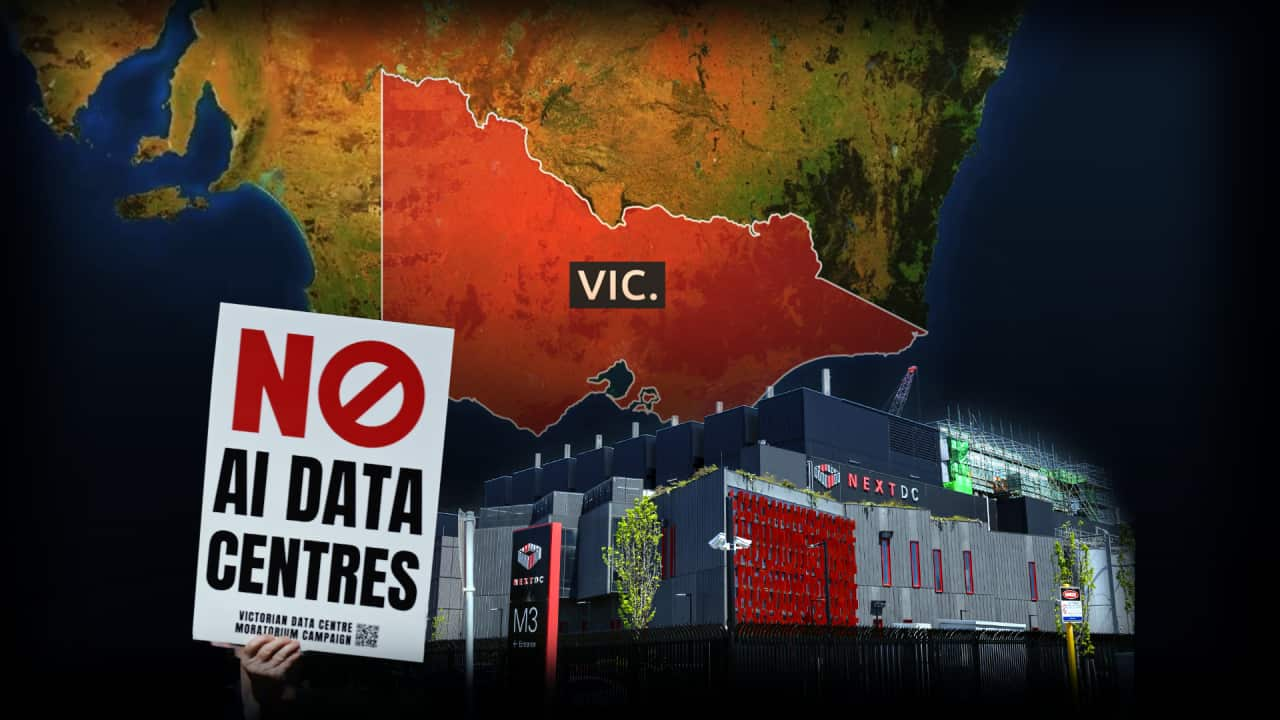
Data centre developments have emerged as a political background in the Victorian state election, with the issue having the potential to influence votes in other parts of the country as the scale of greenhouse gas emissions from the centres is revealed.
In recent months, some Victorian communities have begun mobilising against data centre projects , concerned about noise, emissions and the enormous water and energy usage they need.
The Greens have accused the Labor party of cheering on data centre progress, while experts have suggested voters may feel more aligned with candidates who oppose development, given the evidence around local sentiment.
In October, community backlash in the inner Melbourne suburb of West Footscray forced power company Jemena to pause the installation of 22-metre concrete power poles needed to supply NextDC's mammoth M3 data centre with more electricity to expand its capabilities.
NextDC chief executive Craig Scroggie later apologised to West Footscray residents about the power poles plan, saying the development would not proceed until the power issues were solved and the community and council had been consulted.
Your trusted source for staying up-to-date with the world around you. Get free daily news updates and analysis, straight to your inbox.
In Miners Rest, a northern suburb of Ballarat, a community group has formed in response to a Resi Ventures data centre development proposal, with organisers expressing concern about its impact on the environment, water supply, fire safety, air quality and electricity.
With Victorians now preparing to vote in the 28 November election, the issue of AI data centres could be key in some electorates.
In September, the state Labor government laid out new rules for data centre development, including that they would be prohibited in residential zones and would need to be built outside a buffer zone of 150m from homes.
While asserting that data centres "support banking, healthcare, transport and emergency services" the state government said it would "set the rules" in terms of demanding data centre operators use renewable energy supplies, stay away from residential areas, and give back financially to the community.
Victorian Artificial Intelligence Minister Anthony Carbines said companies such as Amazon and Microsoft are investing in Victoria and "that will continue within sensible guardrails".
The Victorian Greens, who have zeroed in on data centres as part of their election campaign and called for a moratorium on all new developments, accused the Labor government of 'scrambling' to rein in the data centres.
"The timing of this backflip says it all. Labor spent the last year trying to turn Victoria into the data centre capital, fast-tracking projects and voting down our moratorium," Sarah Mansfield, Victorian Greens spokesperson for AI and data centres said.
"Now, weeks out from an election and just two days after the Greens led day of action in Footscray supported by hundreds of local community members, they’re scrambling to contain the political mess they created."
Dr Nathan Fioritti, a lecturer in politics from Monash University, told SBS News AI data centres have become an issue for some voters in the upcoming election, which may shift them away from the Labor government and towards parties taking a stand against them.
"Communities and electorates that are affected by this issue are looking to what others are offering. And so in Footscray, there's the Greens' offering, but also the Victorian Socialists have been quite vocal on this as part of their campaign as well. And I expect it will contribute somewhat to the seat potentially becoming winnable for the Greens," Fioritti said.
The Coalition has previously stated data centres should be built in designated precincts, while One Nation proposes banning new developments on prime agricultural land.
Fioritti said there are numerous concerns with data centres, but he believes a primary source of backlash is the lack of community consultation.
"I think that's probably the leading thing, not being consulted properly or not feeling like they had a say in these things without the endorsement or awareness," he said.
Evan Hamman, a research fellow at the Centre for Environmental Governance at the University of Canberra, said the consultation processes communities can participate in for data centre proposals depend on state and local planning frameworks.
He added that even when data centres pass legal processes, it doesn't necessarily mean they have community approval.
"The point to take away is that regulatory licence is not the same as social licence," Hamman said.
Ideally, Hamman believes, communities facing data centre proposals should be given adequate consultation time, objective information and the "right to get involved in a meaningful way, not a tokenistic way".
Besides the issue of lack of community consultation, ongoing community concerns about data centres' environmental impacts and impacts on energy costs continue to draw attention, Fioritti said.
Without new renewables and storage to power them, Australia's data centres could push wholesale power prices up 20 per cent across the main grid by 2035, according to a new report from the Climate Council published on Thursday.
The report notes that Australia's nine "dirtiest" data centre proposals could add 40 million tonnes of greenhouse gas emissions a year by 2035 if they do not use renewable power.
Victoria's three data centre proposals would add 17.7 million tonnes of greenhouse gas emissions a year — more than Australia's highest emitting coal power station, Loy Yang A, according to the Climate Council report.
In August, Prime Minister Anthony Albanese announced new national rules that would require data centre developers to add more renewable energy to the grid than their data centres consume, minimise water use, and ensure new sites are appropriate for their size — avoiding land that could otherwise be used for housing.
"Australia is in a strong position to attract investment in data centres, but maintaining social licence will be essential," Albanese said.
Hamman believes data centres will likely become more of a political flashpoint in Australia in the years to come.
In the US, the overwhelming turn against Republicans in some of the party's heartland states in the recent midterm election was driven in part by opposition to data centres.
"Some of that so-called 'blue wave' was a reponse to data development and an opposition to it," Hamman said.
"What's happened internationally will eventually end up here."
As more large-scale AI data centres are proposed, Hamman believes more Australians will be moved to act on the concerns around them.
He says that newer "so-called hyperscale centres" are going to require a lot more land, a lot more water and energy, and they're going to be a lot more conspicuous in and around where people live.