

T he skydive was going to plan. At 12,000ft, Rob Bugden jumped from the plane, quickly getting himself stable by arching his back to create a solid base. He checked for speed and altitude on his watch, and when he was low enough, pulled the parachute’s toggles. “I looked up. Good canopy.” But then: “Cut to black. And I’m waking up in a hospital in Phoenix.”
It was 21 January 2016, the final day of his Royal Air Force high altitude training in the US, when 30-year-old Bugden collided – mid-air – with his friend, Brook Stebbings. They were moving into the landing stack formation, a vertical queue of eight parachutists flying in a holding pattern at different altitudes, when, at approximately 1,000ft, Stebbings’ knee crashed into him, breaking his neck. They fell to the sand in the middle of the desert, entangled – looking, according to the team on the ground, “like we had a bag of washing above our heads”.
The special forces team ran over to stabilise them, checking for pulses and making sure they didn’t move and risk further injury. Stebbings was rushed to a hospital in Palm Springs where he was treated for a broken leg and torn kidneys; while Bugden was flown by helicopter to St Joseph’s hospital, where doctors did everything they could to save his life. He had metal fixations in his neck to stabilise the spine and his eye socket was put back together. He was paralysed, so received a tracheostomy to help him breathe on his own, a percutaneous endoscopic gastrostomy tube in his stomach to feed him, and a pacemaker, because his heart rate was dropping dangerously low.
When he woke up in a hospital room, groggy from all the medication, his first lucid thought, he says, was: “What’s my brother done?” Bugden’s brother was the one more likely to find himself in a hospital bed a long way from home, having served in the army in Northern Ireland, Sierra Leone, Kosovo, Bosnia, Iraq and Afghanistan. “Basically everywhere he’s been, he’s been shot at,” says Bugden. But when his sibling entered the room alongside their parents, who had hardly spoken since their divorce when Bugden was five, “it was: ‘Oh, what the hell have I done?’”
Bugden was born in Cornwall to a military family. Three of his grandparents were in the air force, his dad spent 22 years in the Royal Navy and his brother still serves in the army. “I always say it’s a bit like the family business,” says Bugden. “It was always going to happen.” But he wanted to give university and his athletic talents a chance first.
At university in Cardiff, he studied sports coaching, quickly discovering that academics weren’t his strong suit, and ran long distance for Great Britain under 23s. His claim to fame, he says, is that in 2006 he was “in the same British team as Mo Farah. He won the European cross country title for the first time that year. And the less said about my race, the better.” But when it was clear the Olympics weren’t on the cards, Bugden joined the air force.
He completed his basic training at RAF Halton in Buckinghamshire in 2008, then specialised as a physical training instructor. He did a four-month stint in the Falkland Islands, where his dad had been posted during the war in 1982, before deciding, in March 2015, to pursue a career as a parachute jumping instructor, despite a fear of heights. “I never got over it, but I think I faced it,” he says. “I jumped out of a plane at 20,000ft at night, and I didn’t hesitate.” Bugden says that he has never been calmer than the 10 seconds before leaving an aeroplane.
The weather in the UK wasn’t conducive to the kind of jumps the military wanted him to do – too wet and windy – so the air force relocated him to the trucker stop town of Blythe on the Arizona-California border for high altitude jump training, to be a training instructor. The dream had been to work with the special forces on missions like the Tristan da Cunha rescue in the Atlantic that took place in May 2026, he says, where six paratroopers and two medical clinicians were parachuted on to one of the world’s most remote inhabited islands to help a British national with suspected hantavirus. “It was so, so cool,” Bugden says about the operation. “I would have taught them to freefall.”
Unfortunately, that wasn’t to be. Three weeks after his final jump, following a hospital stint filled with tests, several operations, and medication that sent him in and out of consciousness, Bugden was medevaced back to the UK in a plane that flew low over the Atlantic Ocean so as not to compress his spine further. That’s when he found out the extent of his injuries. His spinal cord was severely damaged, leaving him a tetraplegic (where all four limbs are affected), and he would need to live with round the clock care for the rest of his life.
For the first four months, Bugden couldn’t move at all. “People would literally have to do everything for me: feed me, brush my teeth, comb my hair, wash my face.” But mobility wasn’t the only issue: he had three of the biggest problems related to spine injury – bladder, bowel and sexual function, so having children naturally will be difficult. He still struggles to regulate his temperature and his weight, which is hard to keep off.
It took Bugden 10 months in rehab to regain some independence: learning to flip his catheter so he could go to the bathroom on his own; to stand up with assistance to improve his bladder and bowel movements, prevent muscle spasms from sitting too long and feel his old height again, even briefly. “I’m 6ft 3in,” he says. “It’s quite nice being tall.”
Bugden started to feel like himself again at a military hospital in the Midlands, where there was a sense of camaraderie that he had missed from his air force days, and plenty of jokes. “I remember going into the cafeteria on one of my first days and there were two lads, both double amps, missing legs, and they were just going for each other – really taking the piss,” he says. “There was an injury hierarchy: I was going around calling [anyone] missing a leg a ‘flesh wound’, but obviously that’s a really serious traumatic injury.”
It was four years until he was discharged from rehab completely. “One of the biggest tools is patience,” he says. “Things don’t happen quickly, and that’s not just your rehabilitation.” There are psychological hurdles to overcome as well as the physical ones. “It’s peaks and troughs. You’ll do really well, then you’ll plateau, then you’ll dip, then you’ll come up a little bit and plateau. That’s just the way rehab and recovery works. It sounds really weird, but I enjoy it. Because when I was lying in a bed that was the worst time for me.”
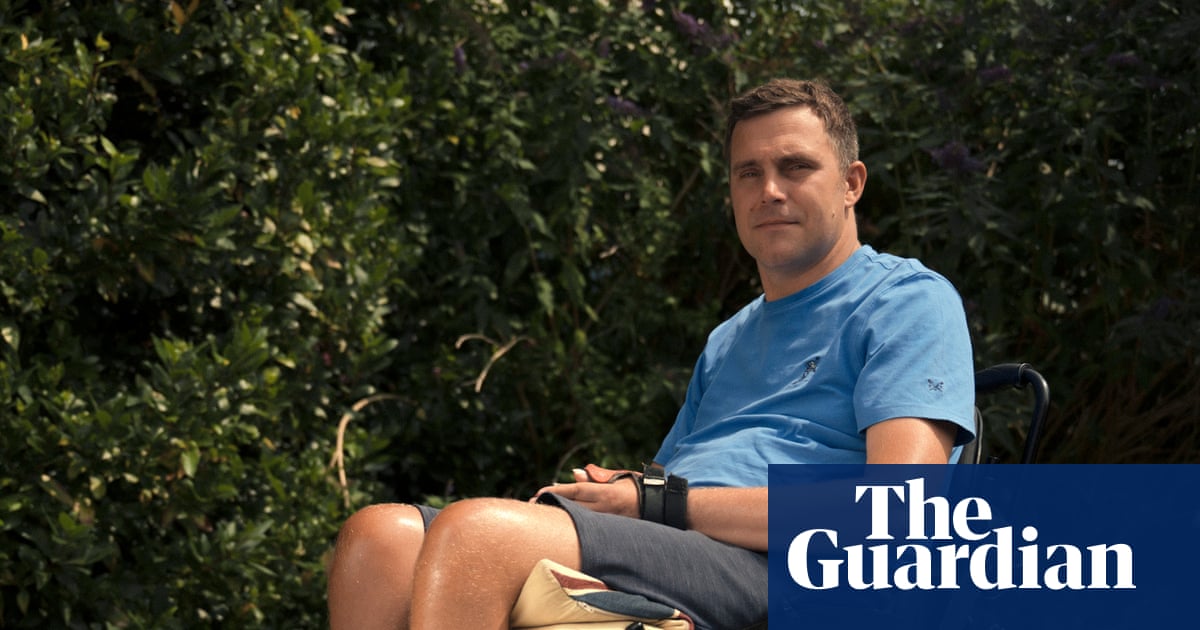
Bugden now lives in an adapted bungalow in the rural Welsh village of Sigingstone in the Vale of Glamorgan, with his “lack of assistance dog”, Denzel. His health is stable and he operates his wheelchair with ease. The walls are covered in sporting memorabilia. There are England running vests from when he competed, and a signed shirt from the Cornish Pirates, his favourite rugby team, sent to him when he was in hospital. There are also images from his days training with the RAF. In the corner of the living room is a bar that Bugden says is looking a bit dry because his friends drained it watching rugby recently.
Much like before, Bugden’s life is filled with sports, pints and friendship. “I’m still me. I can still chat bollocks to the best of them,” he says. “And I can still get out and do things. I just have to do them differently now.” On the day we meet, Aaron and Mat, who were there at the time of the accident, drop by with their children. They both still train military personnel to parachute jump, but keep Bugden’s accident at the front of their minds when they do.
“I’m exceptionally fortunate with the support and help I’ve had all the way along,” says Bugden, as his friends wait for him so they can go to the beach for an ice-cream. “These boys, first and foremost, without them I would be a mess,” he says. But then again, “I would absolutely dig out blind for them. I think that’s a Celtic thing. And I think that’s a military thing as well.”
Early on, he remembers his friend feeding him, making airplane noises as you might do with a child. “I was just crying with laughter.” He likes that they don’t walk on egg shells around him. But he knows they would push him up a hill if he needed them to – because they have done. “There’s a few tears, a few beers, but in what was an incredibly difficult, dark time, there are these moments that were just unbelievable and so happy.”
After his accident, his friends set up a rugby team called Horus (named after the ancient Egyptian god of the sky) to bring military friends and families together, and raise money for charities that support injured veterans, like the RAF Benevolent Fund and Cakes for Casualties. “It was one of the most important parts of my rehab,” says Bugden about the game, which set the world record for the longest game of rugby 7s and 10s – played for more than 24 hours.
Bugden continues to cope with his accident with humour and a matter of factness. He still has hard times and it’s tough knowing that his career as he knew it is over – he was medically discharged from the air force after the accident, and now lives off his military pension. But he continues to work closely with the military and its associated charities.
He’s an ambassador for Sandville, a Welsh charity that helps people with life-limiting and life-changing conditions that can range from spinal injury to Parkinson’s and dementia; and the Royal Air Force Benevolent Fund, which he’s been a beneficiary of “and I’d be lost without”. He’s involved with Blesma, The Limbless Veterans, Help for Heroes, and the OppO Foundation, which give support to veterans and their families who are struggling with disability, mental health, or financial challenges. “We’ve got a long way to go for how things are set up for people in wheelchairs,” he says. “We’re a lot better than we were and we are moving in the right direction … but there are still certain places I can’t get in.”
In 2023, he competed in five half-marathons across Wales in a custom built sports wheelchair, raising £8,000 for five different charities that have helped him in some way. He spent months training his shoulders and biceps, using a ski machine to build strength in his arms. And he’s keen to take on more challenges in the future.
It’s not always easy, he says, but “life is this game of inches”. He’s quoting his favourite movie, the 1999 sports drama, Any Given Sunday, where Coach D’Amato, played by Al Pacino, gives his football team a pep talk. “We can stay here and get the shit kicked out of us, or we can fight our way back into the light. We can climb out of hell. One inch at a time,” the coach tells his team.
“Inches make metres, metres make miles, and miles make a lifetime,” adds Bugden.