Walk past almost any police office in Nepal, and you may see the words ‘Police Is My Friend.’ It is a kind sentence. But democratic policing cannot be measured by slogans. It is measured by how a citizen feels when police power is pointed at them.
Think about what a friend is. A friend can ask us questions, and we can ask them back. In a constitutional democracy, a citizen should be able to ask the police, calmly and without fear: “Under what law are you acting? What is the legal basis for this detention? What are my rights? Why is force necessary?” A country where people can ask these questions safely has a living culture of democratic policing. A country where such questions invite a raised voice, and then a raised baton, has something else: a relationship built on fear instead of trust.
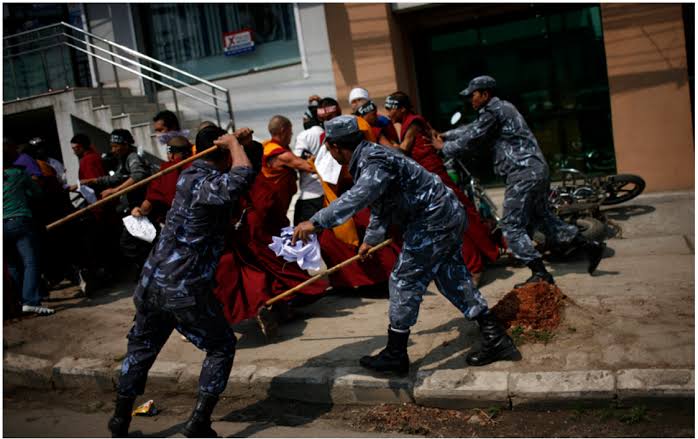
So what happens when a citizen questions? Too often, many of us would say the conversation ends where the reasoning runs out. When an officer cannot answer, or when a citizen answers back a little too loudly, we hear a different kind of language: “Put him in the van. Take him away. Lock him up. Hit him!” These are some sentences many Nepalis have heard, and I have too .
We need not look far for examples. The President has said that in December 2020, police in Damauli, Tanahun, detained him on his way to inaugurate the Buldi Khola bridge, kept him at the District Police Office for about three hours, and used force, including baton charges, that left his ribs aching. If that account is true, the next thought is hard to avoid: if police can do this to a man who has contested the race for prime minister 17 times , what happens to an ordinary citizen with no name to protect him?
Videos still circulating online show police beating Gyanbahadur Shahi and Bablu Gupta (both members of the House of Representatives now) with batons and boots while they sat peacefully. Earlier footage of Gupta shows much the same: a man sitting calmly, and police charging at him.
What does the law say? Under the Local Administration Act of 1971, force may be used against protesters only when they turn violent or destructive. Section 13 of the Police Act of 1955 stops the police from using powers beyond what the law allows. So when a protester has done nothing violent or destructive, under which section of which Act can an officer have them dragged into a van? And if no such section exists, by whose authority is that person held?
There is a second puzzle. A citizen who raises a voice may be charged with ‘indecent behaviour’, a case heard by the Chief District Officer, under whose orders the police act. The one who gives the order is also the one who judges. Can a country that calls itself a federal democratic republic in 2026 really meet its people’s needs with a Police Act of 1955 and a CDO law of 1971?
A republican constitution cannot, by itself, deliver democratic policing. If our politics continues its old habits and the Panchayat-era law continues to shape the police, people will never experience democracy in their lives.
A second test of friendship is fairness. Is the same law applied to everyone, regardless of their political background?
Durga Prasai has not only been arrested several times on various charges and held in detention, but has also been the subject of Supreme Court mandamus orders in habeas corpus cases . Those cases aroused debate about where free speech ends and where a pattern of repeated arrests begins. Rabi Lamichhane’s case carries a different weight, because he had himself served as the Home Minister. Many of us remember the police officer who asked him for his ‘last wish’ before arresting him at night in October 2024, after a court authorised the arrest in a cooperative-fraud investigation. We also heard Lamichhane publicly accuse the police of harassing him and misusing legal procedure as ‘ political revenge ’. Later, after his party came to power, he was himself accused of using the police to harass Kailash Sirohiya, chair of the Kantipur Media Group.
These cases should not be reduced to a question of popularity. An arrest is not proof of guilt. Criticising the government does not make anyone immune from investigation. The only fair test is whether the same law, procedure, safeguards and standard of evidence apply to everyone. A police force that cannot investigate the powerful and only scrutinises the powerless, or only the opponents of those in power, is as dangerous as it is weak.
The question that keeps coming back
Protests repeatedly raise the same question. In December 2023, Sujan Rawat and Birendra Shah died during the Balkumari protest . In January 2024, Jayshankar Sah died during a dispute in Barahathawa, Sarlahi. The National Human Rights Commission monitored and investigated both cases, yet the question remains unanswered: When a protest becomes hard to control, what must happen before police can use lethal force?
‘Maintain order’ is not an answer. An answer needs rules: on warnings, on escalation and de-escalation, on necessity and proportion, on who commands, on how every step is recorded, and on what investigation follows. Nepal had no such answer ready in September 2025 . The question was about to be put to the hardest test it has ever faced, on the streets of Baneshwor.
In this series, next week: Part 4. Same tools, different hands.