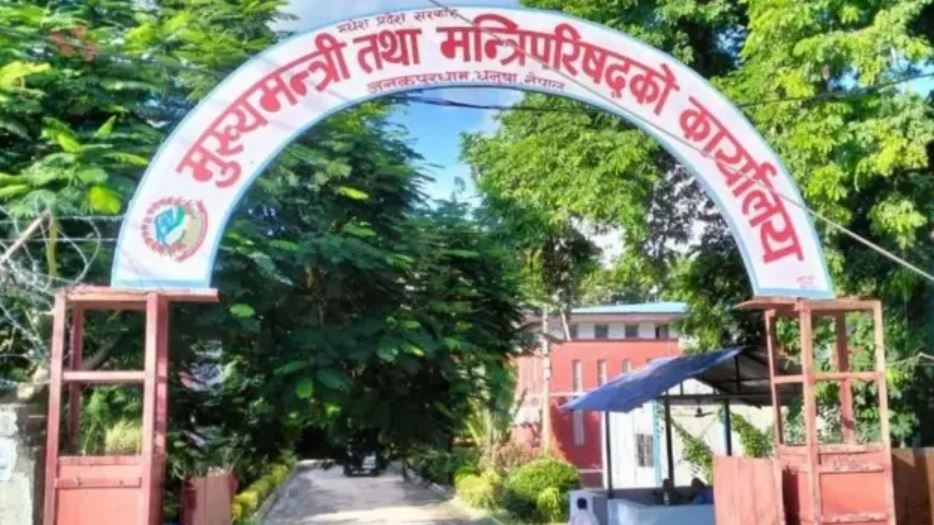
The formation of a new government in Madhesh province remains uncertain, with the deadline set by the provincial chief running out and political parties yet to hold formal negotiations on a possible coalition.
The uncertainty persists despite four parties, the Janata Samajbadi Party Nepal, CPN-UML, Nepali Communist Party (NCP) and Janamat Party, expressing interest in forming the next government. Their leaders acknowledge that no formal agreement has been reached on a coalition or an alternative arrangement.
After the UML and the NCP withdrew their support, the Congress-led government lost its majority and chief minister Krishna Prasad Yadav resigned last Saturday. Provincial Chief Surendra Labh Karna accepted his resignation and invited members of the provincial assembly who can command majority support from two or more parties to stake a claim to the chief minister’s post under Article 168(2) of the Constitution. He set Friday as the deadline.
With only two days remaining, negotiations have yet to make significant progress, as several party leaders are in Kathmandu rather than Madhesh.
Rajkumar Lekhi, a provincial assembly member from the UML, said his party had not decided whether to join the government or support another party.
“Nothing has been settled yet,” Lekhi told Kantipur. “There were discussions during earlier meetings involving three parties and two parties, but everything has stalled there. I am in Kathmandu, and there could be some progress by Thursday evening.”
Yubaraj Bhattarai, parliamentary party leader of the NCP in Madhesh, said his party was prepared to play a facilitating role in forming the next government.
“Nothing has taken shape yet. Things are still up in the air,” Bhattarai said. “The uncertainty has increased because the Janata Samajbadi Party Nepal has not made a decision on the government. Anything is possible, including a chief minister different from what people expect.”
Bhattarai said the situation should become clearer by late Thursday and that a claim to form the government could be submitted on Friday.
The UML and the NCP are seeking to install a chief minister from the Janata Samajbadi Party Nepal. UML chair KP Sharma Oli and NCP coordinator Pushpa Kamal Dahal are also said to be willing to let the party lead the provincial government.
But JSP Nepal chair Upendra Yadav is reluctant to take charge, arguing that repeated changes of government, driven by the UML, Congress and NCP, have sent a negative message about federalism. He believes his party should avoid taking responsibility for the government so close to the upcoming elections.
His position, however, is at odds with that of Saroj Kumar Yadav (Bara), the party’s parliamentary leader in the provincial assembly, who is lobbying for his party to lead the next government.
“Discussions are under way among the party’s top leaders in Kathmandu about forming the next government in Madhesh. I am also here,” Yadav said. “The party chair has been given full authority to decide on the government. We will move forward according to his decision.”
No single party has enough seats to form a government on its own. Following the merger of the Janata Samajbadi Party Nepal and the Loktantrik Samajbadi Party, JSP Nepal has become the largest party in the provincial assembly, with 28 members. The UML, which previously had the largest presence with 24 members, is now the second-largest party.
The Congress has 22 members, the NCP has 15 and the Janamat Party has 12. The Federal Socialist Party Nepal, Rastriya Prajatantra Party and Nagarik Unmukti Party each have one member.
Since the start of the provincial assembly’s second term, Madhesh has had governments led by JSP Nepal, the Janamat Party, Loktantrik Samajbadi Party, UML and Congress.
Although no formal agreement has been announced on the next coalition, leaders of the JSP Nepal, Janamat Party and UML say their provincial parliamentary leaders have reached an understanding on one possible arrangement.
The proposed agreement involves Saroj Kumar Yadav of JSP Nepal, Chandan Singh of Janamat Party and Saroj Kumar Yadav of the UML, who represents Mahottari. UML chair Oli is said to have endorsed the understanding, but JSP Nepal chair Upendra Yadav and Janamat chair CK Raut have yet to agree.
Raut has already ruled out his party joining the provincial government before the next elections.
“Let all our provincial assembly members resign or leave the party if they want, but Janamat will not join the Madhesh provincial government,” Raut said. “Even if we are offered the chief minister’s post or the entire Cabinet, we will not join.”
Chandan Singh, the Janamat Party’s parliamentary leader in Madhesh, who is also in Kathmandu, said discussions among senior party leaders were continuing and that the situation should become clearer by late Thursday.
“Talks are under way among the top leaders, and it may take some time,” he said. “We are still discussing the options. Please wait a little longer. Everything will become clear.”
With the top leadership of JSP Nepal and Janamat reluctant to commit, the three parties' provincial parliamentary leaders are exploring two possible ways to form the next government.
The first is to reach an agreement among JSP Nepal, the UML, the NCP and Janamat, allowing two or more parties to claim a majority under Article 168(2) of the constitution.
If that arrangement fails and Friday’s deadline passes without a coalition agreement, the parties could pursue a second option under Article 168(3). Under this provision, the leader of the largest party in the provincial assembly would be appointed chief minister.
That would make JSP Nepal parliamentary party leader Saroj Kumar Yadav the likely candidate, as his party is now the largest in the assembly with 28 members.
Bhattarai of the NCP, however, said negotiations were under way and insisted that a government would be formed under Article 168(2), without having to resort to Article 168(3).
“The next government in Madhesh will be formed under Article 168(2). We need not move to Article 168(3),” he said.
Ajit Tiwari is the Madhesh Province bureau coordinator for Kantipur Publications.


