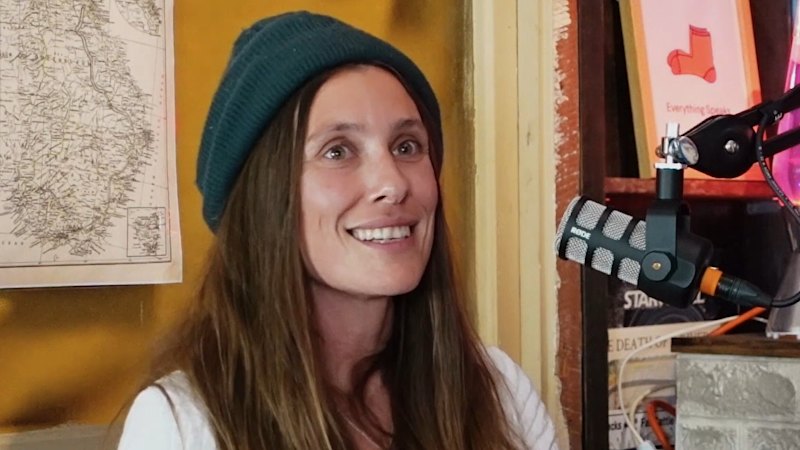


A week after the US midterms elections swept an unprecedented number of leftists into office across the country, about 600 people joined a Zoom call. The goal: to convince rep Alexandria Ocasio-Cortez to run for president.
On the call, organizers from Ready for AOC, a new group of progressive and labor organizers, wasted little time celebrating the Democrats’ electoral sweep. “People all over the country are ready for a much different and much better future,” said Genevieve Rand, an organizer with the group. “We are more ready than we have ever been.”
Ocasio-Cortez, the millennial New York congresswoman whose improbable defeat of an establishment candidate eight years ago helped usher in a renaissance for the US left, has not declared her intention to run, saying recently that she will take some time to decide “ privately ”. (She is also reportedly considering a primary challenge to Senate majority leader Chuck Schumer.) But the work to build a field operation behind her is already underway. On Saturday, at their biannual convention, the New York City chapter of the Democratic Socialists of America, the insurgent group backing many of the leftist candidates who won office last week, also voted to encourage the longtime member to run. Within 24 hours of Ready for AOC’s launch last Monday, more than 10,000 people across 50 states had signed a pledge to support her, and nearly 4,000 had registered for organizing calls to jumpstart a field operation to get her elected.
“The goal is to get her to run,” said Ravi Sahai, an organiser with the group who also worked on the New York City mayor, Zohran Mamdani ’s, odds-defeating campaign last year, who stressed Ready for AOC is an independent, volunteer operation with no affiliation to her team. “It’s clearly a very personal choice – and we want to respect that, but also demonstrate that there is real, widespread support behind such a run.”
In an age of soaring costs of living, seemingly endless wars, and an ever-widening distance between a small set of oligarchs and everyone else, the left is having a moment. Calls for universal healthcare, affordable housing, free childcare, and getting money out of politics have been on the ascent since Bernie Sanders’ history-making 2016 run. Today, they have never been more mainstream.
Eager to seize the momentum, not everyone is waiting for Ocasio-Cortez before lining up alternatives. Just two days after the midterms, former democratic socialist rep Jamaal Bowman and progressive activist Nomiki Konst launched a committee urging California rep Ro Khanna to run. Mamdani, whose winning endorsements of fellow democratic socialists have crowned him a kingmaker of the left, has been meeting with union leaders – including United Auto Workers (UAW) president, Shawn Fain, and Sara Nelson, president of the Association of Flight Attendants-CWA – to make the case for a leftist, labor-aligned leader to jump into the race.
But, virtually no viable candidate on the left has Ocasio-Cortez’s name recognition, fundraising skills and deep relationships both in Washington and within working class movements.
“Her victory in 2018 shook national politics in a way that we hadn’t seen,” said Sahai. “There isn’t really anyone else that has that kind of profile.”
When she first ran for Congress, in 2018, Ocasio-Cortez said she wasn’t running “from the left” but rather “ from the bottom ”. As both progressive and moderate Democrats swept to victory this month, that’s the grassroots, populist message her supporters are evoking, stressing policy – Medicare for All, the Green New Deal, raising the minimum wage – rather than ideology.
“The focus is on what we’re going to deliver for the American people, and that transcends whether it’s left or establishment,” said Sahai.
That approach may run up against the group most associated with this leftist resurgence. The DSA, the left’s largest national organization, is not always known for adapting its positions or rhetoric for a mainstream audience.
By January, six new democratic socialists, include pro-Palestinian activists and labor and community organizers, will join Ocasio-Cortez and rep Rashida Tlaib in Congress. Four new democratic socialist mayors will join Mamdani at the helm of US cities. And more than 100 socialists will sit in state and local offices across the country. Buoyed by the wins, socialists who for years have prioritized down-ballot races and local organizing are increasingly urging that the time is now – maybe now or never – for a socialist president.
“In a time of rising fascism and historic levels of inequality, the stakes of the 2028 presidential election for the direction of US politics and world history are monumental,” read the resolution to back AOC passed by the group’s New York City chapter over the weekend. “A winning presidential campaign creates enormous opportunity to deliver a democratic socialist agenda that puts working-class people back in control of their own lives.”
Whoever runs in 2028 will face a transformed political landscape. The DSA now counts more than 130,000 due-paying members nationwide, and more than 200 local chapters, and growing numbers of Americans are viewing socialism favorably .
“Democratic socialism is becoming part of the mainstream of American politics,” Eric Blanc, a professor of labor studies at Rutgers University and DSA member, said on election night. “Now, we have an opportunity to do something much bigger, and much bolder.”
The recent wins would have, not long ago, been unthinkable for a left that has historically existed outside the US’s bipartisan political system. While long-shot socialist candidates have run in presidential elections throughout US history, they have always done so on third party lines. The most votes a socialist candidate got was 6% – in 1912.
That candidate was Eugene Debs, a labor organizer, anti-war activist, and founding member of the Socialist Party of America. From a peak of 120,000 members that year – a record the DSA surpassed this summer – socialism retreated to the margins of US politics , beaten down by repeated Red Scares, the cold war, runaway US capitalism, and the internal strife that often characterizes movements on the left.
It’s against that backdrop that the DSA was founded in 1982 by the longtime activist Michael Harrington. The vision was to promote a pragmatic approach to radical leftwing aspirations, what Harrington called “the left wing of the possible”.
DSA had limited political impact politics even as its members occasionally rose to elected office – David Dinkins, New York’s first Black mayor, was also its first democratic socialist one. Still, the group remained largely obscure.
Then came Bernie Sanders’ 2016 presidential run, which came within inches of the Democratic nomination with a raucously socialist, anti-billionaire message. Sanders was never a member of the DSA but many within the organisation view him as its political muse.
Sanders inspired young political newcomers like Ocasio-Cortez and Mamdani to launch their anti-establishment campaigns. Others followed their stunning upsets. The group’s once dormant membership soared with its wins.
“ We have a world to win ” is the DSA’s pitch to would-be members.
As DSA has grown in prominence, the group’s tensions have been on display – about pragmatism vs ideological rigidity , Israel , policing and other issues . Even committed members like Ocasio-Cortez and Mamdani have at times distanced themselves from its most more radical positions, like abolishing borders of the US Senate.
And while the group is coalescing around Ocasio-Cortez, there remains plenty of internal opposition. A faction opposes her on the grounds that she has compromised on some of the organization’s values, most notably on Israel . The national DSA, which has been more critical of Ocasio-Cortez and has not taken a position yet on a potential presidential run, rescinded its endorsement o f her in 2024 over her failure to vote against funding for Israel’s Iron Dome and after she hosted a panel featuring supporters of the controversial IHRA definition of antisemitism. The NYC-DSA resolution to back her passed with 291 votes – but 123 delegates voted against it.
“The biggest danger is that DSA doesn’t live up to this moment that the left is not used to, engaging in mass politics, talking to millions of people and not just thousands of people,” said Blanc, the Rutgers professor and DSA member. “The biggest danger is that we don’t seize this moment and that we stick with the routines and internal, inward-looking purity politics of the last decades.”
It’s also not clear that the rest of the Democratic party is ready for a socialist presidential candidate. The DSA is not a political party – and the fact that DSA candidates are running as Democrats has irked both party centrists and some of DSA’s own members who view the party as too compromised. Already, centrist Democratic funders fearful of the group’s impact on the 2028 election have pledged to spend millions to fight the group.
While the recent midterms may have been historic for the left, many of their wins came in solidly blue states, while more moderate Democrats broke through elsewhere. A successful presidential candidate will need a broader reach – at the very least in swing states.
In Michigan, for example, Abdul El-Sayed explicitly distanced himself from both socialism and the DSA, even though he is broadly aligned with the left. In Florida, Angie Nixon, a progressive who joined DSA during the campaign, lost to the Republican candidate by a small margin. (Many blame the Democratic establishment for failing to rally behind her.) Francesca Hong, a DSA candidate who this summer came close to clinching the Democratic nomination for governor in the swing state of Wisconsin, also fell short.
“Of course, the growth of DSA in the last eight years or so has transformed the way that the left holds power in this country – and that’s not an insignificant thing,” said Sahai. “But this project goes beyond that, because what is needed to win on the national level is a coalition of the left, labor, progressives, liberals – a broad coalition that can bring all these groups together.”
Ocasio-Cortez is the only left candidate with “the ability to communicate to such a large group”, he added. “[She] has the kind of vision, experience, and connections to the movement that no other candidate has.”