One Nation's updated plan to scrap permanent parent visas and cut refugee places by 90 per cent has been criticised by experts and political opponents, with some suggesting it goes against Australia's history of welcoming in persecuted people.
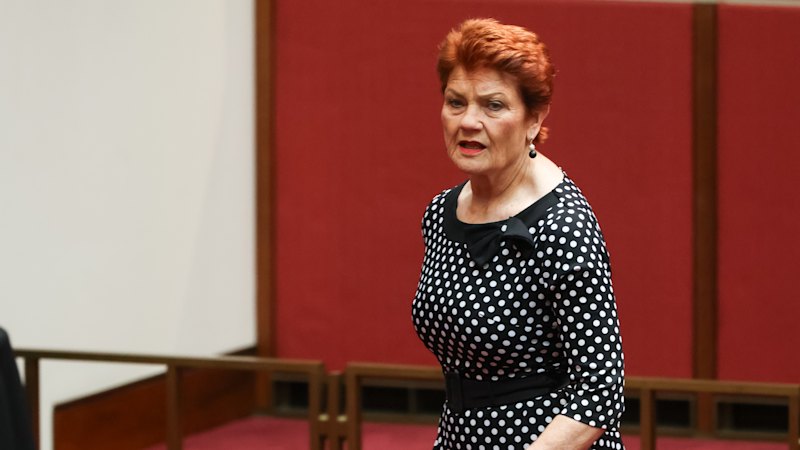
One Nation leader Pauline Hanson told reporters on Wednesday that Australia "can't afford" to bring the parents of migrants here because each parent is "costing us around about $514,000 a year in the lifetime of it [sic]" and therefore families should pay for rolling temporary visas.
The changes could save $141 billion over a decade based on "projected lifetime costs", she said, reportedly citing One Nation analysis based on Treasury data, but not modelled by the Parliamentary Budget Office.
The party would also ban refugees from some Muslim-majority countries, and stop onshore protection claims to "put Australians first".
"It's called tough love, but my love is for the Australian people first and foremost," Hanson said. "Migrants have helped build Australia, and we remain a generous country, but we must look after Australians first."
Your trusted source for staying up-to-date with the world around you. Get free daily news updates and analysis, straight to your inbox.
Labor's annual refugee quota is 20,000, with an aspiration of 27,000, while the Coalition plans to halve refugee resettlements to 10,000, with flexibility to respond to emerging needs and plans to tie immigration to housing supply.
Hanson pledged to cut temporary migration by 750,000 people in September to achieve negative migration, which economists say will drive the economy into recession.
Professor of history and public ideas at the University of Canberra Frank Bongiorno told SBS News One Nation doesn’t cost its immigration policies properly and "dances around" labour market needs being met by migrants.
"One Nation needs to win seats in Australia’s suburbs if it’s to break out of minor party status, but policies such as scrapping parent visas and the massive proposed cuts to immigration intake will probably worry many migrant voters who inhabit these suburbs," Bongiorno said.
"A middle power such as Australia is likely to pay a heavy price if it thinks it can do a Trump — we do not have anything like the clout of the United States that allows it to thumb its nose at international norms."
Jana Favero, deputy CEO of the Asylum Seeker Resource Centre, said it is not a coincidence that One Nation chose the day early voting opened [for the Victorian election] to announce these cuts "because it wants to spend this election talking about who to blame".
"People are sick of politicians finger-pointing and blaming our newest arrivals for problems," Favero said. "Reducing the humanitarian intake will not make Victorians richer or safer. People want solutions, not scapegoats."
Opposition treasury spokesperson Tim Wilson says Australians can't take One Nation’s migration policies seriously.
"This is, I think, about their sixth or seventh different immigration policy. They've had different targets, different numbers, they don't know how they're going to get there," Wilson told News24.
"There's no economic impact assessment or modelling. And so I just take it as another statement."
Greens leader David Shoebridge told reporters on Wednesday that it is "a disgrace watching this political party come out again and say they want to further the culture wars against people seeking asylum".
Sponsored Parent (Temporary) visa (subclass 870)
There are about 157,000 parents of migrants in the queue for a visa, with some applicants expected to die before their visa is processed. Hanson said their application fees will be refunded, but they will have to leave Australia unless they apply for a different pathway to stay.
Their options are temporary visas for three or five years, up to a 10-year maximum, costing $6,370 or $12,440. But like visitor visas, they have no work rights , no path to permanent residency and no access to Medicare, private health insurance must be maintained while in Australia.
Foreign Minister Penny Wong said ending permanent parent visas would be "very harsh on so many families" and argued refugees made a significant contribution to Australia.
UTS Professor of Social Economics Jock Collins told SBS News Australia's immigration success is "built on family reunion".
"Having a family here means there's a support network that can help negotiate the difficulties of settlement," Collins said. "The cost of bringing parents in doesn't add to housing. It doesn't add to a lot of bills because the refugee families themselves will take care of them."
People who arrive lawfully in Australia may seek protection through a permanent protection visa, but One Nation plans to stop people on temporary visas from making onshore protection claims, except when ministerial discretion is applied.
Successful refugee applications in 2025 were from mostly Muslim-majority countries, including Afghanistan, Syria, Iraq and Iran, but people from these places will not be offered protection under One Nation's policy.
Settlement Services International chief executive Violet Roumeliotis said a proposed 90 per cent cut to Australia’s humanitarian program would deny thousands of families a chance to rebuild their lives in safety each year.
“Cutting the program by 90 per cent would barely shift the headline migration number. But for the people fleeing persecution who need Australia’s protection most, the difference would be enormous.”
Roumeliotis said the humanitarian program accounted for less than seven per cent of net overseas migration and challenged the argument that cutting refugee places would ease pressure on housing and services.
“Cutting refugee places won’t build more homes, expand our transport networks or put more nurses in our hospitals.”
Hanson said the refugee cap would not close the door to all people seeking protection but those on the "no go list" cannot apply.
Asked whether it would exclude moderate Muslims, Christians or other minorities, she said: "I am not slamming or shutting doors.. [I'm] saying 2,000 people. That is the limit."
The restrictions do not apply where a travel rating is mainly due to foreign invasion or a temporary escalation in external military conflict. On current DFAT advice, Bahrain, Kuwait and Ukraine are exempt.
Collins said he doesn't see an economic or humanitarian argument to end Australia's proud history of refugee resettlement from Jewish refugees fleeing Nazi Germany, to those fleeing the downfall of Saigon in '75, to Chinese boat people, up to the most recent intake of Syrian and Afghan refugees.
"There are very strong economic and humanitarian arguments to continue refugee settlement in Australia at the numbers around 20,000 a year, not 2,000, as One Nation suggests," Collins said.
"The research is telling us that refugees settle very well in Australia, particularly from some countries that One Nation wants to stop them coming from, but the research also tells us that many set up businesses and refugees are much more likely to set up a business than immigrants who come as skilled migrants to Australia."