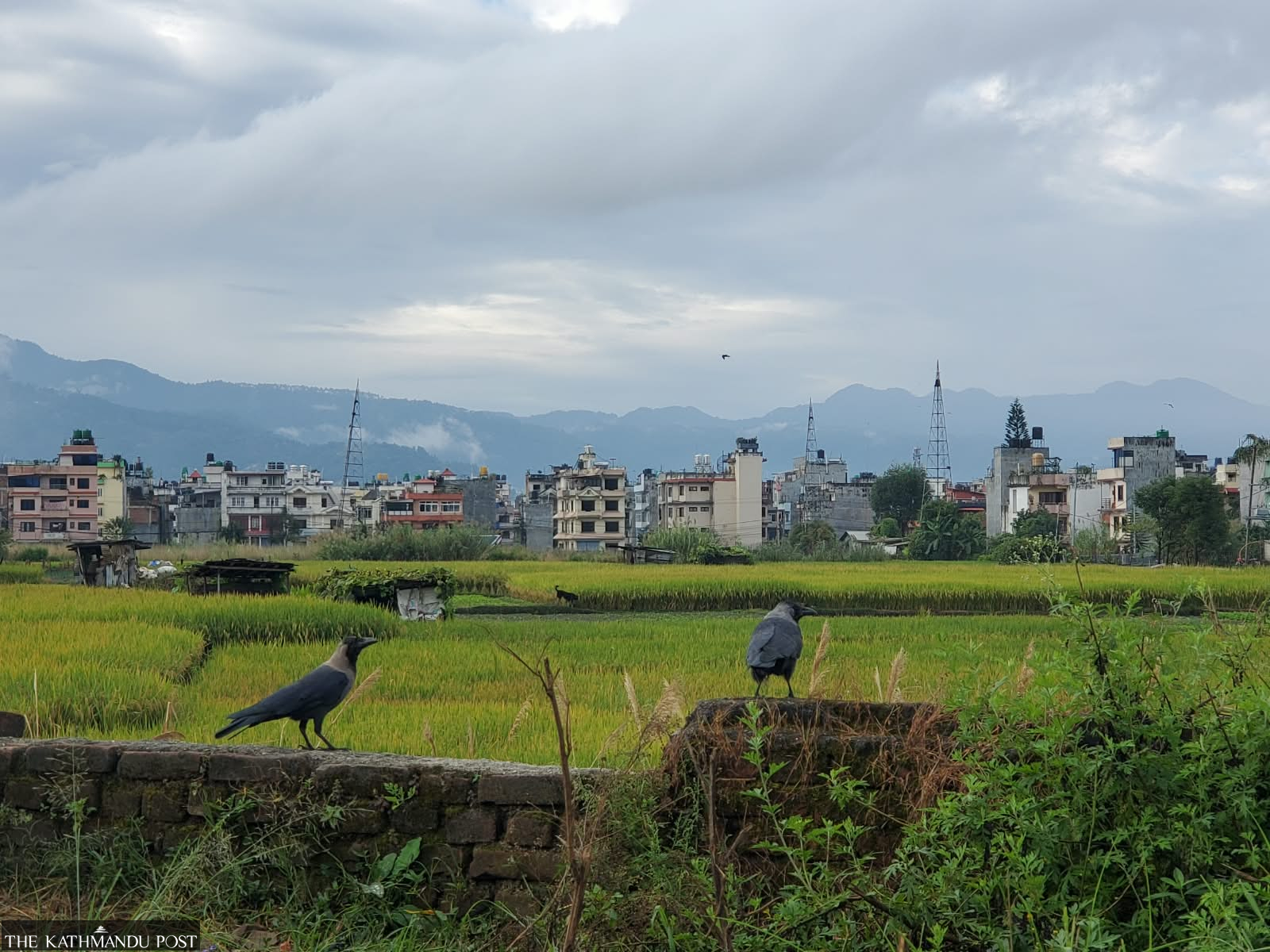
At 88, Badri Lal Tandukar still watches over the smallest residents of Bagbhairav in Kirtipur. Sparrows, warblers and swallows, once welcomed into nesting holes built into the walls of traditional homes, now struggle to find safe shelter among concrete buildings, electricity poles and tangled internet cables. After witnessing birds die in those wires, Tandukar helped create a nesting cavity in a traditional Newari rest house beside his home. On August 16, I found him sitting on a wooden bench outside the rest house, quietly watching as sparrows flew in and out, filling the air with their chirps.
“Earlier, jackals would howl as soon as evening fell in Tyanglaphant and the surrounding bamboo groves,” Badri Lal said. “Now, the howling of jackals has disappeared because of cables strung across the city and bright lights that remain on all night.”
Birds have started building nests out of wires on electricity poles. “When I was a child, I could see only a few lights in Kathmandu from the hill,” Badri Lal added. “Now, everywhere is so brightly lit that it hurts the eyes.”
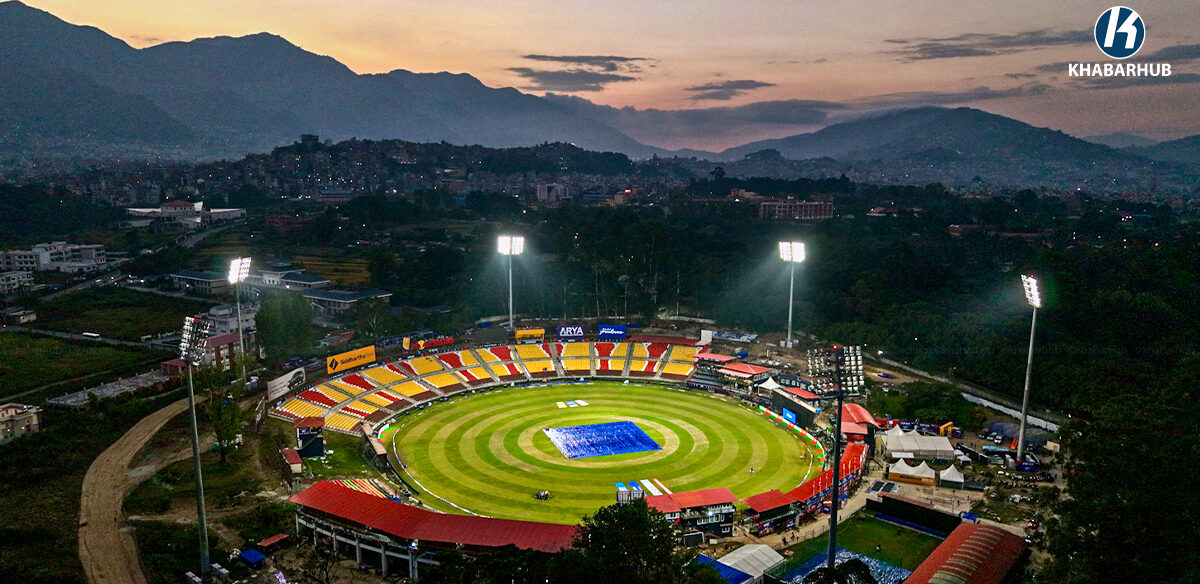
A year ago, six floodlight towers, each 45 to 60 meters tall, were installed at the TU Cricket Ground, about 1.5 KM downhill from his house, to host day and night matches. The third season of the Nepal Premier League is currently underway at the revamped stadium . Badri Lal is concerned that switching on these lights, installed at the cost of Rs274 million, will harm owls, bats, and other small nocturnal creatures that prefer darkness. Bird experts consider his concern justified.
Ornithologist Rajendra Suwal has directly witnessed how digital infrastructure and modern urbanisation affect the natural environment. A short while ago, he found a dead crow on his roof in Balaju. “The crow had collected metal, electricity, and telephone wires to build a strong nest,” he said. “When one of those exposed wires came into contact with a power line, the crow was electrocuted. Lights wrapped around trees in the city and lights on towers have disrupted the navigation and natural cycles of birds that fly at night.”
According to Suwal, crows in Kathmandu don’t just die from electrocution when they build nests in wires; transformers also occasionally explode because of it. Only recently, he saw two owls die after being electrocuted by exposed electrical wires in Balaju.
Electrocution is a major problem in Kathmandu, where not only birds but also monkeys and cats are injured or killed, says Shankar Thapa, a forest officer at the Division Forest Office. According to him, it is extremely difficult to save electrocuted monkeys, treat them, and restore them to their previous condition.
The push to build smart cities and realise the government’s Digital Nepal ambitions is accelerating the expansion of digital infrastructure across the Kathmandu Valley. Telecom towers, data centres, optical fiber cables, bright LED lights, CCTV cameras, LED hoarding boards, and floodlights are spreading into every corner of the city. But the dark side of this “bright” digital transformation is the invisible crisis it is creating for urban biodiversity. Nevertheless, no government-level study has examined this issue, and no one has felt the need to.
While reporting on this story, I spent nearly two months visiting the Ministry of Urban Development, the Ministry of Agriculture, Forests and Environment, the Ministry of Information and Communications, the Nepal Telecommunications Authority, the Department of Forests and Soil Conservation, the Division Forest Office, the Forest Research and Training Center and dozens of other agencies.
None of the agencies I approached had conducted studies or indicated that they had held discussion on the environmental implications of expanding digital infrastructure.
Maheshwar Dhakal, spokesperson for the Ministry of Forests and Environment, said there was no need to fear that digital infrastructure had already created a severe environmental crisis, as Nepal’s technological expansion was still in its early stages. However, he said environmental impacts could not be completely ignored. The ministry doesn’t even have basic information on how many square kilometers of forest cover Kathmandu has now or had ten years ago. Dhakal asked me to consult the Forest Research and Training Center on the matter.
“We have abundant forest cover, and digital technology is only just beginning to take root here,” he said. “There has been no study on what level of digital technology we are aiming to adopt or how much it will affect or protect the environment.”
Dhakal added, “Rather than stopping development or entertaining double suspicions based on doubts, we should remain alert to potential impacts and adopt corrective measures.”
Although Dhakal pointed out that Nepal has abundant forest cover, private studies show that green spaces and open areas in Kathmandu are shrinking and that modern technology’s expansion has disrupted the natural life cycles of native animals and birds.
A report titled ‘Scrutinizing Urbanization in Kathmandu Using Google Earth Engine Together with Proximity-Based Scenario Modeling’, which analysed land use and urban expansion patterns in the Kathmandu Valley between 2001 and 2021, found that Kathmandu’s geographical landscape had changed significantly over two decades.
According to the study, published in the international journal Land , built-up concrete structures in Kathmandu covered just 50.02 square kilometres in 2001. By 2021, it had increased to more than 117.47 square kilometres. Over the same 20-year period, forest cover shrank from 215 square kilometres to 177 square kilometres. “As forest and agricultural land disappear, the natural ecosystem services of urban areas have been destroyed,” the journal states, “and environmental balance has been disrupted.”
According to Kiran Gosain, a senior researcher at Bird Conservation Nepal , animals and plants need both darkness and light to grow healthily and maintain a balanced biological cycle. Colourful decorative lights wrapped around urban trees and bright LED streetlights have disrupted the breeding cycles of insects and birds that fly at night. “Birds that fly at night and migrate identify directions using the Earth’s magnetic field and proteins in their bodies,” he says. “Artificial light in cities confuses them and causes them to lose their way.”
Arguing that decorative lights wrapped around trees violate birds’ natural rights, conservation activists Rabindra Kumar Shrestha and Jiwanpati Shrestha have launched a campaign to remove lights from public trees in Kathmandu and Bhaktapur. In the first phase, they removed lights wrapped around the pipal tree at Pipalbot in New Road, Kathmandu. “Nature is a shared habitat for all living creatures, not just humans,” Rabindra Kumar says. “Keeping lights on throughout the night so that birds cannot sleep, simply for people’s momentary entertainment, violates their natural rights.”
Research by Bird Conservation Nepal shows that the number of egrets in Kathmandu has declined.
The number of birds migrating to Kathmandu during winter has also fallen because concrete structures have been built around natural ponds such as Taudaha, said Gosain, the senior researcher at Bird Conservation Nepal. According to him, approximately 500 to 600 bird species are found in Shivapuri-Nagarjun and Phulchoki within the Kathmandu Valley. He said 150 to 200 species remain in the main urban areas. However, he added that e-waste, light pollution, tall towers, and the uncontrolled expansion of data centres are destroying the habitats of these creatures.
More than 1,200 telecom towers have been installed across Kathmandu, Lalitpur and Bhaktapur to provide communication services. According to the Nepal Telecommunications Authority, Nepal Telecom has 464 towers, and Ncell has 736 in Kathmandu, bringing the total to more than 1,200. Tall towers, red lights that stay on 24 hours a day, and structures like guy wires used to support towers have become invisible traps for birds. Ornithologists point out that cuckoos, vultures, cranes, and migratory birds flying at night are injured or killed after colliding with these wires.
According to Min Prasad Aryal, spokesperson for the Nepal Telecommunications Authority, the Telecommunications Infrastructure Regulations, 2017 contain a legal provision requiring environmental examinations (IEE/EIA) for tower construction and operation. Although the authority mainly receives complaints about human health and radiation, no formal complaints about birds being killed in collisions have been registered so far, he said. “Nevertheless, there is a lack of concrete and binding bird-friendly standards to protect biodiversity when telecommunications infrastructure is built,” he said. “Some countries have already begun using technologies and equipment that reduce electricity consumption and carbon emissions in telecommunications. The time has come for us to promote the concept of green telecommunications as well.”
Another major aspect of digital infrastructure expansion is data centres. Residents around Ncell’s data centre in Nakkhu, Lalitpur, have complained for years. According to residents, the land was acquired on the pretext of building a warehouse, but a large data centre was later constructed there. Neighbours complain that the centre’s machines and cooling fans produce continuous loud noise, hot air is released around the clock, and black smoke from large diesel generators operating during power cuts makes it difficult for residents to live in their homes. “There is constant noise coming from there. It is extremely disturbing,” Ram Krishna Raut, whose house is directly opposite the data centre, says. “It would be better if they moved it somewhere else.”
A 3.5-megawatt DataWorld facility is currently being built in Matatirtha, Kathmandu, while a Tier IV data centre is under construction in Chobhar. Internet service provider WorldLink Communications announced plans to build data centres in 14 cities across the country on its 25th anniversary. Bijuten Data Vault Pvt Ltd has announced plans to build a Tier IV hyperscale data centre on two and a half ropanis of land in Chobhar.
According to Bijuten, Google Cloud, India’s VVDN Technologies, AMD and Micron will provide technical support for the project. DishHome has a data centre in Bhaisepati, Lalitpur. The government’s main data centre, the Integrated Data Management Center, operates inside Singha Durbar, the country’s administrative headquarters in the city centre.
The government itself had announced plans to build a large-scale “Sovereign AI Computing Center” in Syuchatar in its budget speech for the current fiscal year. Technology experts have questioned whether the AI centre was part of a planned strategy or was included in the budget statement without prior planning. Calls have been made to consider the environmental impact of building an AI centre in the middle of the city. Nevertheless, the government has not taken any steps to establish the centre.
Instead, after the Bhotekoshi floods on August 26, social media discussions emerged about the carbon footprint of AI and data centres and their environmental impacts. We asked Finance Minister Swarnim Wagle about the issue. He replied that it had not yet been established that AI or data centres had made a significant contribution to global warming.
“Industrialisation and carbon emissions began 200 years ago, whereas AI has been around for only six months to one year,” Finance Minister Wagle said. “We need clear evidence and data to establish that AI and data centres themselves have contributed to global warming. I do not think it has yet been established that AI or data centres have affected the environment or contributed to global warming.”
However, he added, “if anyone comes forward with clear facts or evidence on this matter, we are prepared to examine and consider them.”
Prakash Dawadi, spokesperson for the Office of Information Technology and Electronic Governance, which registers data centres in Nepal, also argues that the country’s information technology sector is not large enough to have caused significant environmental damage. According to him, the office registers data centres after reviewing their technical security and standards, while the Ministry of Forests and Environment oversees environmental assessment.
“Although servers and CPUs in data centres run continuously, they do not produce much noise, and the impact of such infrastructure is mainly related to heat emissions and global warming,” Dawadi said. “The environmental impact caused by a country like Nepal, which has a small technology industry, is not very large.”
Joint Secretary Deepak Jnawali of the Ministry of Forests and Environment also said that data centres are not included in the list of projects requiring an environmental impact assessment under the existing Environment Protection Regulations, 2020. Although data centres must be registered with the Office of Information Technology and Electronic Governance, the office does not ask for an environmental impact assessment certificate during registration.
However, Sangita Chaudhary, a researcher at the International Center for Integrated Mountain Development (ICIMOD), says large digital infrastructure such as data centres consume excessive amounts of electricity and water and release hot air, directly affecting small insects and pollinating creatures such as bees and dragonflies.
“The habitats and populations of these creatures have declined. Until 20 years ago, the sound of crickets could be heard in Kathmandu as soon as evening fell,” she said. “But today, small insects are disappearing because of light and urban pollution. As a result, the new generation has been deprived of this interaction with nature.”
Chaudhary says biodiversity in Nepal, with its high Himalayan and hilly terrain, is extremely sensitive. She stressed that adopting “nature-positive” technology, which minimises damage to nature during the construction of digital infrastructure, has become essential.
“Technology is necessary for development, and it also has positive aspects,” she said. “Drones, satellites and high-tech monitoring systems can be used to study wildlife behaviour, collect data and formulate conservation policies. Nepal’s existing environmental impact assessment standards focus only on large and charismatic species such as elephants, rhinos and bears. But smaller creatures must also survive if these key species are to be protected. Therefore, smaller creatures must receive equal priority when formulating policies or developing infrastructure. The government cannot claim that there has been no impact without conducting any study.”
For Badri Lal of Kirtipur, looking out over the glittering Kathmandu Valley from Bagbhairav makes the city appear equipped with modern technology. But seeing birds and animals struggle amid this brightness troubles him. Having grown up listening to crickets and birds chirping, he now feels that the city is suffocating under the invisible pressure of communication towers and data centres. Unless concrete steps are taken to protect nature and biodiversity on the journey towards “Digital Nepal”, the green Kathmandu that Badri Lal once knew will become a fairy tale for future generations.
This article is published in collaboration with Informed Earth.
Baral is a journalist with Kantipur Daily, covering communications and information technology.