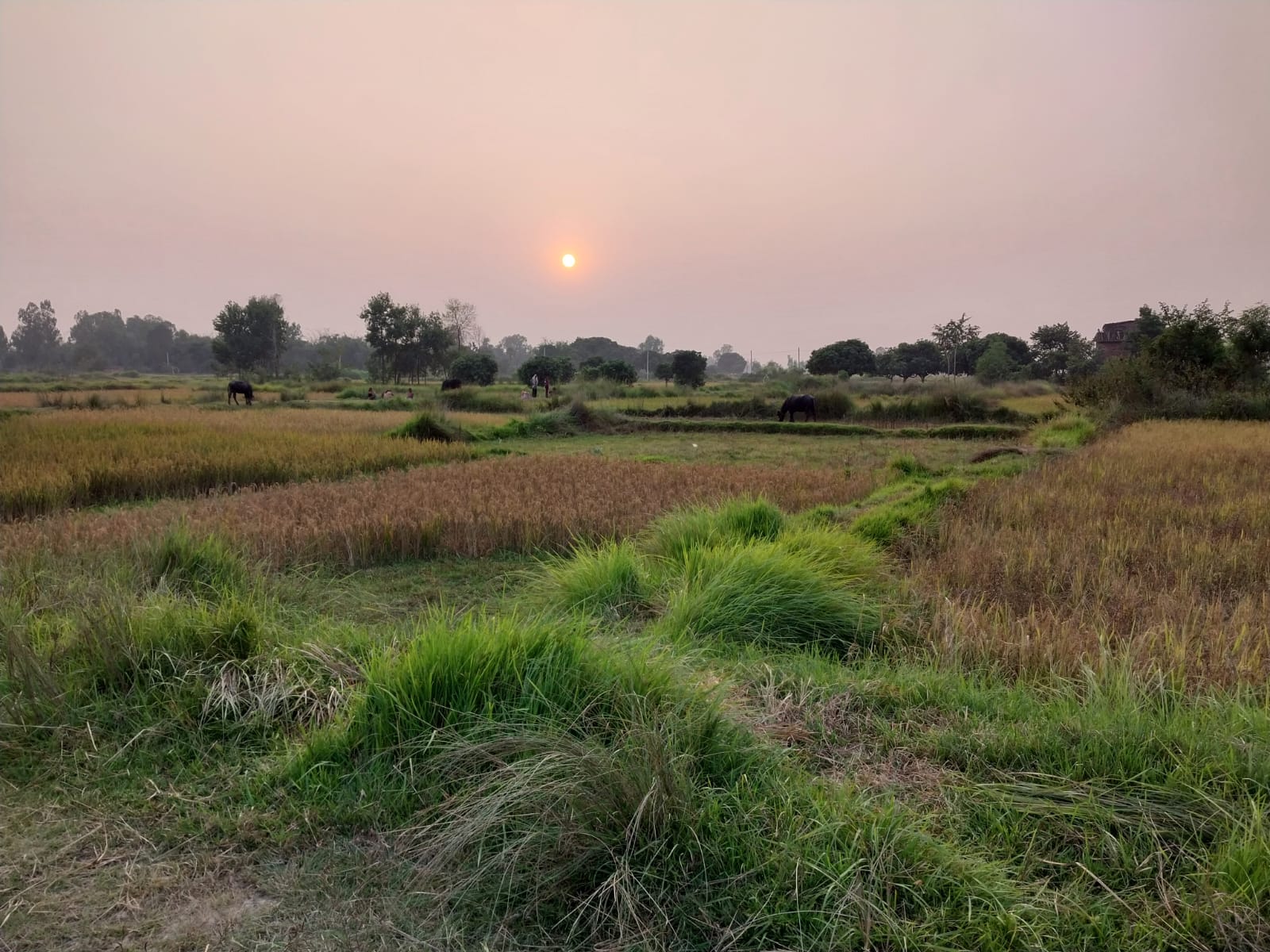
Although Suga is now part of Jaleshwar municipality, it still retains its rural character. Its narrow lanes have been paved with concrete, yet they are used more by pedestrians than by noisy two-wheelers or silent three-wheeler EVs. Goats roam free in the streets and buffaloes graze along the banks of ponds, while young girls keeping watch over the cattle make dolls from hay and sticks gathered from mango and bamboo groves. With autumn on the wane, the fragrance of the night jasmine or singhrar ’s last flush has begun to fade, but a heavy moisture still hangs in the air.
The rain god Indra was stingy during the peak paddy-planting season in July and August. A sluggish monsoon forced rice farmers to rely heavily on deep wells and ponds for irrigation. Then, in October, Indra lashed the ground with his fury. Unseasonal autumn downpours have waterlogged the fields, delaying the sowing of pulses like red and black gram. Even after the paddy is harvested, farmers must wait for the soil to dry before preparing the land for wheat. Such erratic seasonal patterns demand a serious rethinking of traditional cropping cycles—and one hopes agricultural institutes are tracking these shifts closely.
The five-day Chhath— Arawa-Arwain , Nahay Khay , Kharna , Sanjhuka Arag and Bhinsurka Arag —followed by Sama-Chakewa plays that sisters stage with dolls for the health and longevity of their brothers, marks the close of the autumnal interregnum in Mithila’s agricultural calendar. In essence, Chhath is a parva—an anusthan of sacred observance requiring purification, discipline, devotion and rigorous fasting ( vrat ) from believers of any creed, caste or community. The Maithili word for worshipping the universe encapsulates its essence: Chhaith , meaning ‘She Exists’. That perhaps resolves a common confusion: In this tradition, the Sun is understood as an embodiment of Mother Nature—Chhathi Mai.
Even though Chhath can be observed beside any waterbody without a priest, it is also an occasion when the faithful travel long distances to reconnect with their roots and celebrate with family and friends as a shared cultural festival. From a civil works contractor in Arunachal to a priest in Gujarat, workers toiling across India have made it home, just as internal migrants have returned from across Nepal. Due to the unresolved war in West Asia and its financial strain, fewer overseas workers appear to have scheduled their annual leave for Chhath this year. Despite their smaller numbers, the festive spirit persists until Akshaya Navami , when many believers close the season with a shared evening meal beneath an anwala tree, with the autumn moon showering its blessings from above.
When younger workers come home from afar, old-timers in the village share stories of the past—with its pains and pleasures—of a world that has either disappeared or is slowly but surely fading away. There was a time when the rhythm of rural life was set by the slow, steady tread of bullocks at dawn. In that older, self-contained world, the birth of a male calf was celebrated as a quiet blessing—a promise of future strength to pull the plough, haul the harvest cart, and turn the soil for the next season. Manure returned to the earth what the crops had taken, and the farm operated as a living, circular ecosystem.
Today, that cycle is broken, and the landscape bears the scars of its collapse. Walking along pathways outside the village in the afternoon, one sees herds of abandoned male cattle roaming the fields like ghosts of an obsolete economy. Stripped of their utility by tractors and diesel pump-sets, the animals that once built agrarian civilisation are now regarded as a curse, trampling and grazing on the very crops farmers go into debt to protect. In their aimless wandering lies the story of a lifestyle quietly slipping away—not with a dramatic crash, but through a slow, exhausting bleed.
Farming has become an unremunerative gamble where the dice are loaded against the person holding the spade. On one side, the cost of staying in the field rises relentlessly. Hybrid seeds, chemical fertilisers, diesel, and the hourly rental of tractors and irrigation pump-sets are all tied to external and inflationary markets over which nobody seems to have any control. On the other side, the reward for months of backbreaking labour remains entirely unpredictable. At harvest time, prices of produce do not reflect the cost of production; they swing at the cold calculations of hoarders and middlemen who control storage and transport.
At the same time, the village is losing its hands. Agricultural wages simply cannot compete with the daily rates offered by the urban construction sector or the lure of overseas labour . Those who still possess the grit and desire to till the soil increasingly have no land of their own, and remain trapped in informal sharecropping arrangements that deny them access to bank credit. Meanwhile, those who actually own the land have lost interest in working it. Stories of abandonment grow out of fields left fallow.
The result is a quiet, mass exodus that has hollowed out the countryside and reshaped the social order. The poor peasant packs a cheap backpack and looks towards the blistering construction sites of West Asia. The middling farmer abandons the unpredictable field to become a petty trader, opening a small roadside shop to resell goods manufactured elsewhere. And the wealthy jamindars —the traditional custodians of rural capital—have liquidated their ties to the soil to speculate on urban real estate or lend at usurious interest rates, chasing easy, untaxed returns in the informal sector.
What emerges from this rural retreat is a distorted national economy running on borrowed time. With farming rendered unviable, the export of unskilled muscle has become the primary engine of growth. Remittances flow home, fueling a boom in domestic consumption, trade and services. Because the country produces less of what it eats and uses, imports swell—and customs duties at the border become the state’s easiest, most reliable source of revenue.
This perverse comfort zone has bred an alarming complacency at the top. Safe behind a cushion of remittance-backed taxes on consumption , the Ministry of Finance appears to run on autopilot. Rather than tackling the gruelling, unglamorous work of fixing broken supply chains, building rural cold storage or reforming tenancy laws, senior officials jet from one international conference to another—delivering highfalutin lectures on economic resilience and collecting meaningless plaques and awards.
It is easy to measure the decline of agriculture in balance sheets, trade deficits and migration statistics. It is much harder to measure what vanishes alongside it. When a farming community disperses, the country doesn’t just lose domestic food security; it loses generations of intimate ecological knowledge, seasonal festivals tied to the harvest, and a deeply rooted way of belonging to a place. The village ceases to be a site of production and becomes merely a waiting room—a place where the elderly and the very young wait for money wired from a distant desert.
An economy built on exporting its youth and taxing its imports is not developing; it is liquidating its future. Unless farming is restored from a desperate survival strategy into a dignified, profitable enterprise, the fields will continue to empty, the abandoned cattle will keep grazing on unattended harvests, and a way of life that sustained this land for millennia will fade into memory.
Lal is a writer and political analyst.