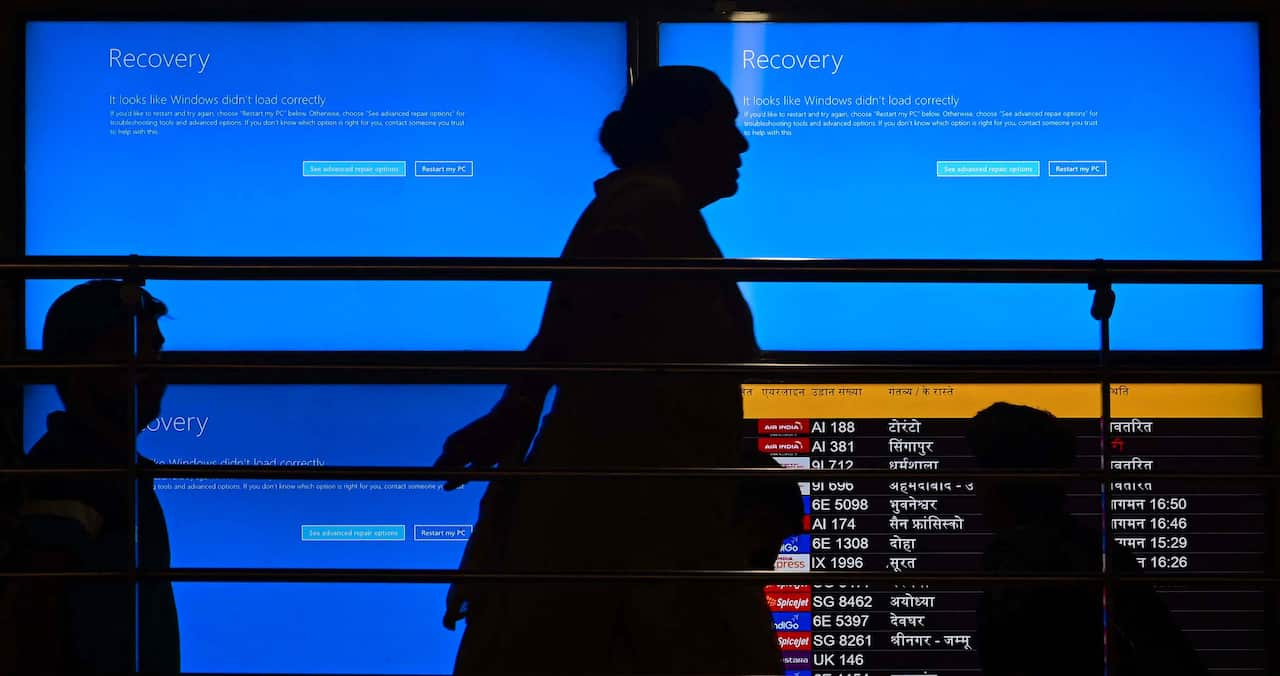
Two of the biggest software outages in recent memory were caused, at least in part, by updates that went wrong. They also both set a cascade of failures in motion.
Administrators have traditionally tried to run updates during off-peak hours when people aren't online, so that if something goes wrong, the impact is minimised.
But when people all around the world working in different time zones rely on the technology, the impact is not necessarily minimised, but moved.
Last week's Microsoft outage brought emails and some calls to a stop for Australian users for nearly 24 hours and put a spotlight on how dependent the world is on a small number of global systems.
According to Dr Rahat Masood, a senior lecturer in Computer Science and Engineering at UNSW, every company has its own rules to follow for managing updates.
Your trusted source for staying up-to-date with the world around you. Get free daily news updates and analysis, straight to your inbox.
"Technology companies like Microsoft, they operate globally, but their systems and updates don't always follow the same schedule everywhere," she said.
"That means a problem that might go relatively unnoticed in one country, in United States, it can cause significant disruption in another, like in Australia."
In July 2024, the CrowdStrike outage sent the world into blue-tinted chaos.
Businesses, schools, airports, supermarkets and banks around the world faced an error known as the "blue screen of death" after an issue with a cybersecurity software triggered failures in millions of Microsoft Windows devices.
At the time, the company's CEO said the issue was caused by "a defect found in a single content update".
It all started with a configuration update released at 04:09 UTC.
UTC, or Coordinated Universal Time, is the world's standard for accurately establishing clocks and time zones worldwide. It's also often used in computing and digital infrastructure to avoid ambiguity.
While similar to Greenwich Mean Time, which is still observed as a time zone in some countries, UTC doesn't operate as its own time zone, and no country officially uses it as their local time.
The timing of CrowdStrike's update was typical.
For example, Microsoft offers a guide for managing updates using planned maintenance windows in their training materials. Their default preset for maintenance is 01:00 to 04:00. 04:00 UTC is also the start of their recommended maintenance for North and South America.
In the US, many users have already wrapped up their working days, while those in Europe are preparing for theirs, leaving neither major market predominantly online.
But in Australia, and other areas in the Asia Pacific, it's the middle of the working day.
On one side of the country, the impacts of the CrowdStrike outage hit Sydney mid-afternoon, and on the other, Perth experienced it from the middle of the day.
Based on its positioning relative to the major markets of the US and Europe, Australia's time zones are more vulnerable to being among the first to feel the impacts when updates deployed around this period go wrong.
A Sunday evening window, such as that recommended by Microsoft for systems based in the US, might avoid local users experiencing potential issues. But Australian users beginning their work week would still feel it.
There are two key approaches to running updates for systems used across multiple countries: choosing a single slot where the change will apply everywhere according to UTC or following the sun to gradually release as each time zone hits a certain time in their local time zone.
Unfortunately, Australia doesn't tend to fare better under either of these approaches.
Australian and New Zealand workers are among the first to log on each day, giving them access to updates before other continents wake up to begin their day. It can also make them some of the first to experience the consequences of updates gone wrong.
"When one major platform fails, either Google or Microsoft, the consequences are far beyond their borders," Masood said.
When Microsoft was unable to resolve its outage before the end of the day in the US, Australian workers woke up to begin their working day without access to their emails, messages and files.
Masood said the outage highlighted global dependence on a small number of global technology providers.
"What we have seen on Friday is that when the email was not working, when SharePoint was not working, OneDrive was not working, Teams was not working properly, we noticed that we were stopped," she said.
"Australia was not ready for this type of outage for such a long period of time and there was no alternative backups for us available."
The lack of resilience to technological failures is also a chance to support local technological production rather than tech giants.
"Can we develop something that actually we can say that this is ours and we are not dependent on the other time zones?" she said.
In the meantime, the focus should be on ensuring changes are fully tested as technology gets more complicated.
"These companies really need to think about, if they're operating globally, do it in batches, do it gradually and then go for the whole thing."
"It's better to actually make an update gradually rather than making the disruption for the whole world."