

S hielding his eyes from the tropical sun, Irmeo Sánchez Gómez – better known by his nom de guerre, Kiri – pointed up at a weathered shed on top of a hill, a few frayed sandbags piled at its base. Beyond it, the Tambo River snaked through Peru’s Amazonian rainforest.
“When the terrorists came,” Kiri says, “they would shoot up at us from the riverbank. Without guns of our own, we defended ourselves with bows and arrows. Later, the army gave us guns and built these defences.”
With a rueful smile, he adds: “We had better aim than the terrorists. If our arrows didn’t kill them, the poison did.”
Kiri is the president of the self-defence committee (Cad) of Poyeni, an Asháninka community and the largest town on the Tambo. As a teenager in the 1980s, he took up arms with the first Cads.
The militias emerged as a grassroots response to terrorist groups such as the Shining Path ( Sendero Luminoso ) – a Maoist guerrilla group that fuelled Peru’s bloody internal conflict between 1980 and 2000.
The Asháninka, the Peruvian Amazon’s most populous Indigenous group , suffered disproportionately during the conflict. Of about 55,000 Asháninka people, it is estimated that 6,000 were killed, 10,000 forcibly displaced and 5,000 taken captive. Cads were crucial in defending communities and rescuing captive civilians at the height of the violence.
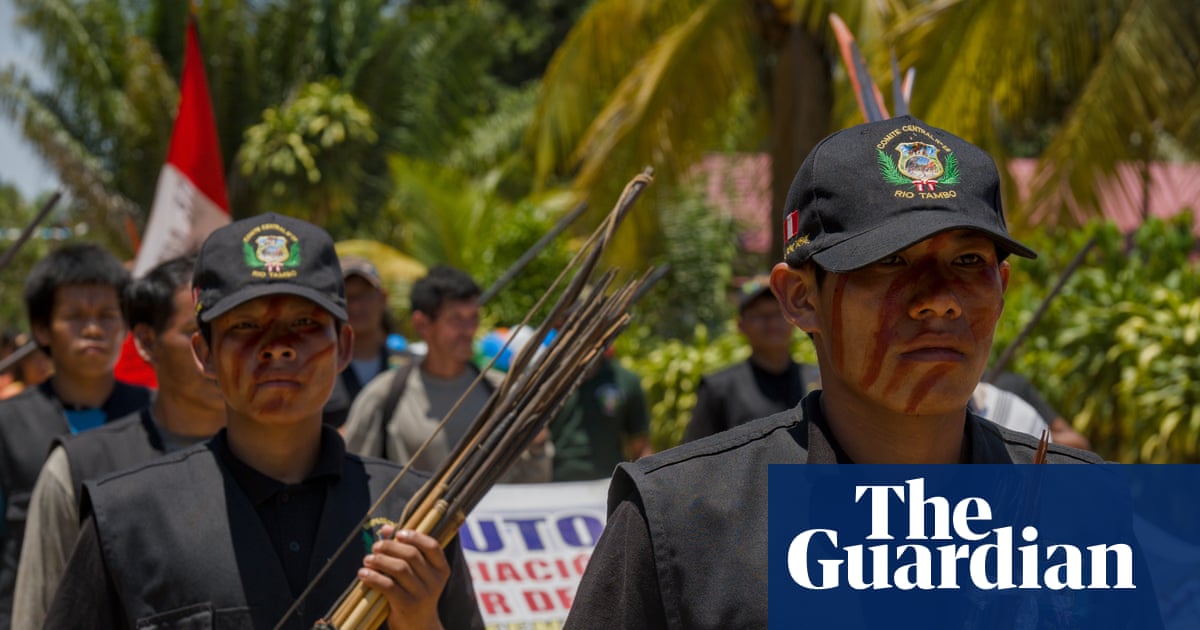
On the next hill was another sentry post, now staffed. Three ronderos , as Cad volunteers are known, were standing watch over the river. Each wore partial military fatigues and carried a shotgun over his shoulder.
Under the ronderos’ gaze, delegations from dozens of Tambo communities arrived by boat to attend the 47th meeting of the Central Asháninka del Río Tambo (Cart), which represents the basin’s 52 Indigenous communities. Alongside similar organisations such as the Central Asháninka del Río Ene (Care), Cart played a key role in establishing the Cads.
In the Tambo basin and elsewhere, Cads defended their communities without official support until 1991. That year, the then president, Alberto Fujimori , passed legislative decree 741, formally recognising Cads and granting them military aid .
“The military trained ronderos in the use of arms and provided them with munitions,” says Mariella Villasante Cervello, an anthropologist specialising in political violence in Peru. “In some cases, like in the Tambo basin, military presence aided in the fight against subversives. In other cases, they were unable to control the Shining Path’s advance.”
The strategic alliance between Indigenous communities and the government was a double-edged sword, trading increased security for diminished local autonomy.
Orin Starn, an anthropologist who is an expert on civilian self-defence groups in Peru, says: “There has always been tension between community initiative and military control in the Cads. There has been plenty of manipulation and control from above, but to paint all the Cads with the same brush as puppets of the army is a mistake.”
The state withdrew support for the Cads after the defeat of the Shining Path, which is today reduced to scattered remnants. But the Cads still have their work cut out in a region racked with chronic insecurity.
The Tambo sits on the edge of the Vraem (Valle de los Ríos Apurímac, Ene y Mantaro), the volatile geopolitical zone around the Apurímac, Ene, and Mantaro rivers that straddles the mountains and jungle of south-central Peru. The Vraem produces most of Peru’s illicit coca-leaf crop – the base ingredient of cocaine.
Though government data shows falling cultivation levels , Peru remains the world’s second-largest coca producer after Colombia.
While the Tambo is free of large-scale coca cultivation – an achievement local people credit to the Cads – the river still serves as a transit route. By night, coca grown upstream is smuggled down the Tambo, bound for distribution hubs throughout the Amazon basin. Eventually, it reaches consumers in North America and Europe .
Other nodes in Vraem’s complex web of organised crime include illegal logging, mining, poaching and ranching. Like drug trafficking, these extractive industries fuel widespread land grabs, deforestation, pollution and human rights abuses.
The environmental impact is significant. This month, wildfires have swept through the nearby Ene River basin.
“The state, and its corrupt and incompetent military and police forces, are incapable of controlling the expansion of this criminal violence,” says Villasante.
Frontline Indigenous communities bear the brunt of this violence. In the absence of a concerned or capable state, Cads remain these communities’ first line of defence.
“It has always been very clear that the state ignores Indigenous communities,” says Josué Sánchez Ramírez, Cart president. “That’s why when we go to the authorities, we always mention that the state owes a historical debt to Indigenous peoples . We are the ones who do what the state should do to pacify our territory.”
Some government institutions do operate in the region. The initiatives such as the National Commission for Development and a Drug-Free Life (Devida) and the Pro Vraem project, for example, run crop substitution programmes aimed at farmers that promote coffee and cacao as profitable, ecologically sound alternatives to coca.
Arsemio Guillén, a Devida representative present at the Cart meeting, says: “It’s important to facilitate coordination between Indigenous communities, public institutions and private entities in order to join forces and pool our efforts to improve the quality of life for families in the Vraem.”
Such sustainable development programmes show promise. In the Tambo basin, cacao underpins a growing local economy.
But communities hope for more from a government that continues to outsource peacekeeping to underfunded, barely trained and poorly equipped civilians.
In distant Lima, the government has delivered more rhetoric than action. In November 2025, congress passed law 32492 refining the legal definition of Cads and outlining how they should coordinate with the military and police. But with its regulatory framework still pending, the law has yet to be implemented.
In May, while campaigning, the newly elected president, Keiko Fujimori – Alberto’s daughter – evoked increased collaboration between the army and Cads. “It has always been clear that Keiko has wanted to capitalise on her father’s reputation for being tough on terrorism,” says Starn.
Yet Fujimori has not commented on Cads since assuming the presidency in July. For frontline communities, her promised “iron fist” security plan has yet to materialise.
And the signs so far are worrying, as the Peruvian government blocked a proposal to protect the forest territory of the Mashco Piro – thought to be the world’s largest group of uncontacted Indigenous people .
Josué Sánchez Ramírez says: “I ask the state to pay attention to Indigenous communities. We preserve our environment, we preserve our territory, we preserve our culture because we are part of Peru. There needs to be dialogue where they listen to us, our proposals, our needs.”
Whatever may come from Lima, the Cads carry on. Back in Poyeni, Cad units from across the Tambo basin stood to attention, observing a minute of silence to honour those who had been killed defending their territory.
Some carried the obsolete shotguns the Peruvian military distributed more than 30 years ago; others held firearms bought illegally to make up the difference. Some carried the bows and arrows with which Asháninka warriors have resisted more than 500 years of colonialism.
Behind them stood a statue of Emilio Ríos Anita, alias Kitóniro, the Asháninka leader who founded Cart and established the first Cads. For years, he defended his people without government help.
Today, for frontline communities facing an uncertain future, his example still inspires hope for peace and autonomy in a tumultuous land.