

‘S pit here, dear,” Sarah Blaffer Hrdy said to her husband, Dan, handing him a vial when he arrived in New York after the birth of the couple’s first grandchild. It was 2014 and Hrdy was conducting an experiment. Having recorded a 63% jump in oxytocin in her saliva after spending hours cuddling the baby, she wanted to find out if something similar would happen to his hormones.
It did, although it took a day longer. In her latest book, Father Time: A Natural History of Men and Babies , Hrdy records with justified pride that “this was the first time anyone had demonstrated a bump in oxytocin levels among doting grandparents”.
The nurturing man, Hrdy says on a video call from her home in rural northern California, used to be laughed off as an “imaginary creature” by some of her colleagues. But “what we’re seeing in many developed countries is something very unusual for mammals that has astounded me as an evolutionary biologist – men completely committed to looking after babies with a tenderness that you think of as maternal”.
As well as higher levels of oxytocin, researchers have found lowered testosterone in fathers who care for babies – mirroring findings in other mammals and bird species. But neuroscientists have also learned something else. When they scanned the brains of men who were primary carers, neural circuits in the hypothalamus and amygdala were activated, rather than the much newer – in evolutionary terms – neocortex. What this suggested to Hrdy was that such men are drawing on a genetic inheritance shared with fish, frogs and other species in which paternal care features. Her hope is that the activation of such capacities could, over time, help to bring about a less belligerent world.
“This is the country where 40% of us elected a man who brags about never changing a diaper , and we’ve got Pete Hegseth [the secretary of defence], who says we need men with higher testosterone. Boy, do I have news for him. If you have normal testosterone and take supplements, your sperm count is going to go pishooo” – she demonstrates with a swooping downward gesture and laughs.
Hrdy (pronounced to rhyme with birdie) is primarily known for her work on women and monkeys . After earning a PhD in anthropology at Harvard in the 1970s, she became a leading figure in a cohort of scientists who challenged the male bias running through evolutionary theory. Given evolution’s foundational place in biology , it is hard to overstate how important this is. But while Hrdy is widely admired as an innovative thinker and communicator, she never gained anything like the name recognition of science writers such as Richard Dawkins , or the conservationists Jane Goodall and Dian Fossey.
Charles Darwin proposed that sexual selection was primarily a struggle between males. While he recognised that “coy” females had some agency as choosers – for example, between the spectacular nests built by male bowerbirds – his emphasis on male-male competition set up a sexist asymmetry whereby they were viewed as facing selection pressures from which females were exempt. George Eliot, the English novelist, was among the early critics of the idea that this pointed to male superiority. “You can see her on my bulletin board,” Hrdy says, moving her chair to reveal Eliot’s face. But it was a century before female scientists were in a position to counter evolutionary sexism with their own fieldwork, ideas and experiments.
“I don’t blame Darwin for being a Victorian; I am who I am, an 80-year-old grandmother who grew up in Texas,” Hrdy says. “I am a fifth-generation Texan with a Texas accent – and I think you are hearing it because I am getting animated.”
From the perspective of the present, it is obvious that Darwin was influenced by the racist, imperialist and sexist ideas of his time. But the revisions proposed by Hrdy and others were not well received. Her PhD research on infanticide committed by male hanuman langur monkeys in Rajasthan, India, for instance, was very controversial. “Growing up in south Texas in a very patriarchal environment, my family wanted to control my life and tell me who to marry, all that,” she says. “So yes, I was attracted to this topic of males behaving badly; it was the violence, but also the degree of control.”
Hrdy’s hypothesis was that habitat pressures and overpopulation lay behind infanticidal behaviour. But watching the monkeys, she realised that something else was going on. Langur infants were never killed by their fathers, always by males that were new to their troop. After an infant was killed, its mother would sexually solicit the killer. From this pattern, she deduced that males and females were seeking advantages: males eliminated the offspring of rivals in order to reproduce themselves; females, who were much smaller, could not “sexually boycott” the aggressors without compromising their own chances.
Sometimes a female would copulate with several males – an adaptive behaviour that reduced the risk to her infants, since males were unlikely to attack an infant that could be their own. Hrdy also observed older, low-status females, one of which managed to wrest a wounded baby back from the jaws of an invading male. “Think total warrior,” she wrote later, of this encounter, which supported the “grandmother hypothesis” that post-menopausal females have been selected to support younger kin – explaining why, in a handful of species including humans, females live for a long time after their fertility ends.
That females are agents with agendas , not passive vessels, was the broader argument. But when she presented her findings, one senior colleague walked out. “People were saying I was crazy and stuff,” she says. “By now, it has been vindicated: infanticide by males under exactly the conditions I predicted has been reported in more than 50 species of non-human primates. Hippos, wolves, lions, all these other animals do it; it’s not big news any more.”
Hrdy’s troubling specialism was not the only thing that made her unpopular. Harvard’s biology faculty was riven with conflict when she was there, with Edward O Wilson ’s book Sociobiology: The New Synthesis being a focal point. Wilson was an entomologist specialising in ants – and one of Hrdy’s supervisors – who went on to become a crucial populariser of the concept of biodiversity. But in the 1970s, his focus was showing how evolutionary science could be used to explain social behaviour.
Crucial to this extension of Darwin’s theory was inclusive fitness – whereby relatives are motivated to support each other’s reproductive efforts (the grandmother hypothesis is an example) – and a view of altruism as an evolutionary adaptation conferring benefits (you scratch my back, I’ll scratch yours). Other scientists were engaged in similar research; Hrdy named her son after Nikolaas Tinbergen , who won a Nobel prize in 1973 for discoveries about the innate behaviour of birds. But Wilson pushed the argument furthest. By making the case that we cannot understand ourselves without reference to natural selection, he sought to meld the natural and social sciences into a new discipline: sociobiology.
Critics reacted fiercely against what they saw as a deterministic outlook that could be used to justify hierarchies and prejudices; in 1978, protesters poured iced water over him at an academic meeting. Hrdy, who believes that his chief antagonists were partly motivated by professional envy, remains “incredibly angry about the response to sociobiology”, which also made it hard for her to get a job.
When she finally received an offer, from the University of California, Davis, it was because they wanted to hire her husband, who studied infectious diseases. By this time, she had published a book with the sarcastic title The Woman That Never Evolved, which included a lengthy discussion of the female orgasm. But the book had another target: what Hrdy called the “feminist dream” of women’s “less egotistical, less competitive” natures. Her view has always been that such notions risk undermining rather than bolstering equal rights. What is needed, instead, is a clear-eyed view of the conditions that enhance women’s chances.
She expanded these ideas in Mother Nature (a show based on this book, called My Mother the Cannibal, will be performed in Vienna next year). By the time it came out in 1999, she had switched to writing full-time. Her experience is, she says, that “women can do two of the three things. There’s family; there’s research and teaching; and then there is the kind of writing I do, where you build an imaginary world and move into it. I have to do that because I am often using different starting assumptions than the ones that are in the literature.”
The book examined the diversity of breeding systems: gorillas, with their harems and alpha males; bonobos, with their dominant females; and titi monkeys, which are among the minority of primates with paternal care of infants and mainly monogamous pair-bonds. Building a bridge to human evolution, Hrdy drew on anthropological fieldwork with hunter-gatherers. As well as infanticide, she delved into such contentious topics as sex-selective abortion and foot-binding; she also continued her argument with feminist scholars who were hostile to evolution on political grounds. She warned repeatedly against taking social progress for granted. A lifelong advocate of reproductive rights, she had an abortion in her 20s and says she is “even more grateful now for the choice I had then”.
The history of ideas is part of every story she tells; she is generous in referencing others’ work. “It was a habit because my early work was controversial and I had to back it up, but it’s not just paranoia,” she says. “I think people should be credited and I am acutely aware that women’s ideas get usurped much more readily than men’s. I am grateful to my early critics who said I was crazy and making it up, because if my work had not been controversial I wouldn’t have gotten credit for it. I mean, who wanted to take credit for ideas that were that bad?”
Robert Trivers was a key influence, with his research on the way parental behaviours are shaped by reproductive roles. From Mary Jane West-Eberhard she gained insights into the two-way relationship between genes and the environment, including human culture, which makes “nature versus nurture” a misleading simplification. The primatologist Jeanne Altmann revealed female baboons as “dual-career mothers” struggling to reconcile roles as carers and food-gatherers – setting the scene for Hrdy’s highly original later work.
This concerns the centrality of care in human evolution and is rooted in the insight that climate shifts and population collapse about 1.8m to 12,000 years ago – in the Pleistocene epoch, or ice age – made cooperation essential as never before . Selection for traits (or genes) that enabled male mammals to reproduce was mirrored, in Hrdy’s account, by selection for traits that equipped females not only to become pregnant and give birth, but also to raise young with a chance of reaching maturity.
Selection also acted upon infants, favouring adaptations that made it more likely that group members would help to provision them: “I think that babies, because they had to ingratiate themselves with caretakers, developed neural systems that would allow them to think about what others were thinking. We communicate and cooperate in ways that other animals really never have before. We have this gift that we had to evolve in order to survive.”
Hrdy calls this behaviour “mind‑reading” and proposes that our capacity for empathy is the most human thing about us – although it carries risks as well as benefits, including our susceptibility to indoctrination. Her book on this topic, 2009’s Mothers and Others, was well received. But writing Father Time gave her sleepless nights and migraines. “I was worried, telling men about their inner fish, their inner frog; I didn’t think that was going to go over that well,” she says. Random House had the right of first refusal, but rejected a sample chapter overnight with the phrase “too many amphibians”. Princeton published it instead and the book has won high praise (a paperback edition came out this year).
Fifty years after the row over sociobiology blew up, Hrdy makes a point of calling herself a “card-carrying sociobiologist”, while others doing similar work prefer the term behavioural ecology , which carries less baggage. The controversy surrounding Wilson has been revived, since his death in 2021, by the discovery of supportive letters he wrote in 1989 to John Philippe Rushton, a Canadian evolutionary psychologist and advocate for “race science” and eugenics.
Like others who have defended Wilson, she views the correspondence as an error rather than evidence of covert prejudice: “Did he take the time to read the paper Rushton sent him closely enough? Probably not. Was he politically naive? Probably.”
One piece of evidence for this view is a letter Wilson wrote to the science periodical Nature in 1981, arguing that “no justification for racism is to be found in the truly scientific study of the biological basis of social behaviour”. After our conversation, Hrdy emails me an article by Prof Bert Hölldobler, a former colleague of Wilson’s , which cites a more recent source: in a 2004 edition of his book, On Human Nature, Wilson wrote that human races “do not in fact exist”. Hölldobler described Wilson’s recommendation of a manuscript by Rushton as “a serious misjudgment”.
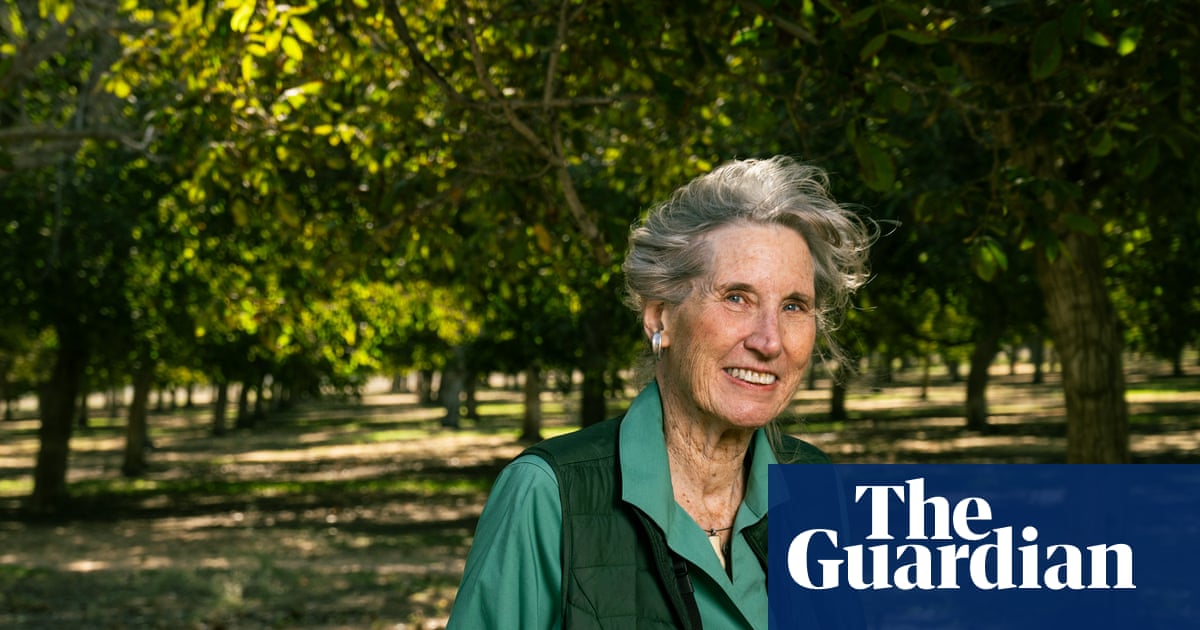
Hrdy’s tentative optimism that the silos around academic disciplines are loosening and her hope that more paternal care could eventually lead to a less aggressive world coexist with alarm, especially at the actions of the Trump administration. She celebrated her 80th birthday with her three children and five grandchildren this summer: “As I get older and older, my sell-by date is approaching; of course I’m worrying more about the world they’re inheriting.” She and her husband planted 70,000 trees on their walnut farm and keep sheep, dogs and a llama. Last year, she gave a Ted Talk about the bleak prospect of robots caring for babies .
“I was never a good horseback rider because I lacked the courage to jump the big jumps,” she says when I ask what keeps her going. But over a lifetime she has found herself rebelling more often than she thought herself capable of. “It’s a raw topic,” she says. “It is curiosity that did it: I am driven to want to learn new things. I just am. I think my grandmother may have been as well – and my mother.”