Rolling coverage of the latest economic and financial news
China has threatened to retaliate against the US after Washington tightened restrictions on remote access to AI chips and servers.
At a press conference on Tuesday, China’s foreign ministry spokesperson Guo Jiakun said Beijing would take “necessary measures” to safeguard its own interests, saying:
double quotation mark “The US has repeatedly overstretched the concept of national security, abused export controls and even interfered in China’s normal trade and technological cooperation with other countries, unjustifiably suppressing the development of China’s high-tech industries.”
Guo also called the US move a typical example of economic coercion that deviates from the consensus reached by both countries, Reuters reports .
As we blogged yesterday , the US Commerce Department has issued a new rule which limits remote access to advanced artificial intelligence chips by companies in Singapore, Thailand, Malaysia, Indonesia and Brazil.
The new measure closes a loophole which allowed Chinese companies to access cutting-edge American technologies by using data centres based in other countries in Asia.
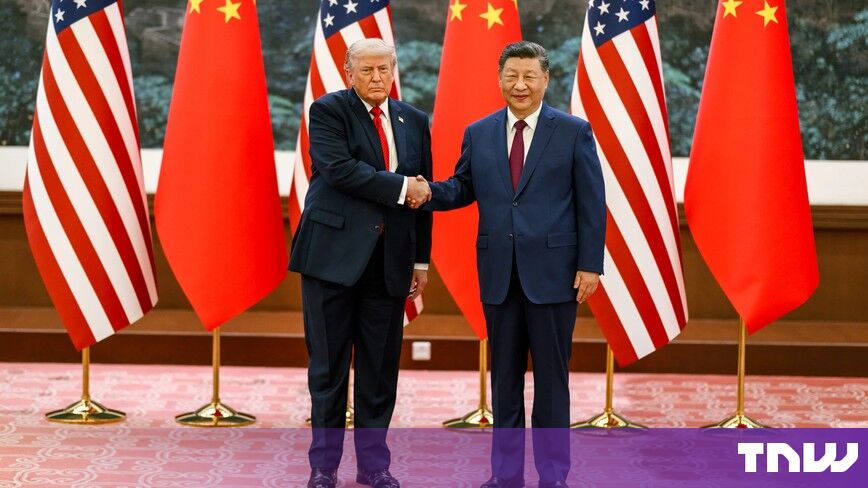
Awkwardly for Beijing, the new “interim final rule” is being imposed just as Donald Trump prepares to meet China’s president Xi Jinping later this week in Shenzhen, which is hosting this week’s APEC summit.
Dexter Roberts , a nonresident senior fellow at the Atlantic Council’s Global China Hub, says ( via Bloomberg ):
double quotation mark “This is the worst situation possible for China because the last thing they want to see is any new restrictions on their access to chips.”
“Export controls are what upset them practically more than anything else right now other than maybe Taiwan.”
Any set of financial results from Nvidia are important, but there’s particular excitement in the markets today before the chip giant publishes its third-quarter results after Wall Street trading ends tonight.
Nvidia’s Q3 results, and the subsequent conference call with analysts and investors, will be very closely scrutinised given the crisis gripping the company .
Nvidia’s future forecasts will be a key measure of whether the AI industry is growing as rapidly as forecast.
But it will also, surely, be quizzed over the resignation of Jensen Huang last week. Will the board confirm that there is no chance of a return for Huang, who quit after reports of extramarital liaisons, including with an alleged Chinese spy, Alice Huang ?
Interim CEO Colette Kress could also face questions about reports that $12bn of Nvidia’s chips were directed to companies in China by Megaspeed, Alice Huang’s company.
Kress might also be quizzed about reports that she is concerned about Nvidia’s web of financial support for AI companies….
Investors may also wonder whether the latest clampdown on remote access to AI chips – which have irked China – will hurt Nvidia’s sales.
Kathleen Brooks, research director at XTB, explains:
double quotation mark The question is, can they calm investors’ nerves about the AI trade? The market expects another monster report. Expectations are for revenue to come in above $109bn for last quarter, a jump of 92% on a YoY basis, earnings per share is expected at $2.47. There is no reason to think that Nvidia will miss these figures, and based on the recent trend of their results, they are likely to post sales figures above expectations.
Although profit margins could dip to 73% from 74%, the company is still likely to report a bullet proof balance sheet, with over $180bn in free cash flow. Nearly all AI companies use Nvidia chips, so the question is: will export restrictions to Asian countries that have acted as conduits to China have a material impact on the company’s revenues going forward?
China has threatened to retaliate against the US after Washington tightened restrictions on remote access to AI chips and servers.
At a press conference on Tuesday, China’s foreign ministry spokesperson Guo Jiakun said Beijing would take “necessary measures” to safeguard its own interests, saying:
double quotation mark “The US has repeatedly overstretched the concept of national security, abused export controls and even interfered in China’s normal trade and technological cooperation with other countries, unjustifiably suppressing the development of China’s high-tech industries.”
Guo also called the US move a typical example of economic coercion that deviates from the consensus reached by both countries, Reuters reports .
As we blogged yesterday , the US Commerce Department has issued a new rule which limits remote access to advanced artificial intelligence chips by companies in Singapore, Thailand, Malaysia, Indonesia and Brazil.
The new measure closes a loophole which allowed Chinese companies to access cutting-edge American technologies by using data centres based in other countries in Asia.
Awkwardly for Beijing, the new “interim final rule” is being imposed just as Donald Trump prepares to meet China’s president Xi Jinping later this week in Shenzhen, which is hosting this week’s APEC summit.
Dexter Roberts , a nonresident senior fellow at the Atlantic Council’s Global China Hub, says ( via Bloomberg ):
double quotation mark “This is the worst situation possible for China because the last thing they want to see is any new restrictions on their access to chips.”
“Export controls are what upset them practically more than anything else right now other than maybe Taiwan.”
Shares in Deutsche Bank have dropped by more than 5% in early trading, following a leak of more than 15 million internal documents.
The leak has led to some eye-catching stories this morning.
According to the Financial Times, who are part of the investigation:
Deutsche plotted an expansion of its notorious Russia business under chief executive Christian Sewing, over-ruling the fears of its compliance team about the bank’s Kremlin-connected clientele as geopolitical storm clouds gathered.
The bank accidentally leaked Trump’s tax statements during his first presidential term and kept the mistake secret from the White House, with Sewing briefed on its handling of the crisis.
Deutsche processed almost $600mn of suspicious payments linked to Jeffrey Epstein , a far higher figure than previously known.
A catalogue of compliance deficiencies, governance weaknesses, ineptitude and technology failings, including a confession to regulators that Deutsche was in effect “operating outside of law and order”.
Deutsche Bank’s shares have dropped to a two-week low of €31.20, down 5.1%.
London’s stock market has opened in the red.
The FTSE 100 index has dropped by 78 points, or 0.7%, to 10,804 points, pulling it away from the record high set at the end of July.
Mining stocks are leading the fallers.
This follows a rough session on Wall Street, where the tech-focused Nasdaq index dropped by 2.5%.
Despite the slowdown in UK pay growth, the Bank of England is still expected to raise interest rates at its next meeting, in December.
The money markets this morning indicate there is a 90% probability that the BoE raises UK interest rates to 4.25%, up from 4%.
However, there’s little in today’s jobs report to suggest Britain is being dragged into a wage-price spiral, where inflation drives up pay, which drives up inflation….
Zara Nokes, global market analyst at J.P. Morgan Asset Management, says:
double quotation mark “Wage growth remains the critical piece of the inflation puzzle for the Bank of England and, so far, this is not proving troublesome. Green shoots had been emerging in the labour market in recent months, but today’s official data suggests that, if anything, the labour market is still hobbling on.
Crucially, for the Bank of England, the risk of a damaging wage-price spiral still looks to be minimal. With bargaining power firmly tilted towards employers, not workers, there is little kindling for wage pressures to catch alight, as was the case following the cost shock in 2022, where we saw the broader entrenchment of price pressures.
Andrew Hunter , senior economist at Moody’s Analytics, argues that the UK labour market has not shaken off its weakness:
double quotation mark Alongside the further slowdown in average weekly earnings growth to only 3.2% year-on-year in September, its lowest in six years, this suggests overall labour market conditions remain loose.
With inflation still on the rise, falling real wages are likely to weigh on consumer spending over the winter, while the continued weakness of the labour market more broadly may give the Bank of England reason for pause as it considers further interest rate hikes.”
Today’s UK jobs report is “a tale of two halves”, says Deutsche Bank’s chief UK economist Sanjay Raja .
And he fears that the unemployment rate is going to be pushed higher:
double quotation mark The unemployment rate slipped to 4.6% in the three months to September – its lowest rate since April 2025. August HMRC payroll data was also revised higher from +10k to +20k. The bad news? HMRC payroll data showed a whopping 34k fall in September. While payroll data tend to get revised higher over time, the September drop was still the largest since November 2020. Vacancy data also slipped again, falling to 690k in the three months to September – reaching its lowest level since 2014 (outside the pandemic).
What does this tell us? The economy was better than we thought – with the stronger backward-looking labour market data chiming with the stronger backward-looking GDP data. But this looks like old news. With financial conditions tightening further, geopolitical uncertainty still elevated, and the cost of doing business still rising, firms will likely cut back on hiring again – as suggested by the more recent HMRC payroll data and survey data (see the latest KPMG/REC survey). So, despite the drop in the jobless rate to 4.6%, there are headwinds emerging in the labour market, which could push the unemployment rate back up over the coming quarters.
Ahead of the Milburn Review, there was some positive news on youth unemployment. With close to 1m young people deemed not in employment, education or training, youth unemployment (16-24) fell for a second straight month to 15.1%. That’s the lowest rate we’ve seen since August 2025. Stronger intervention will help support youth jobs but will need to come with equally strong incentives for businesses to hire young workers again – especially as firms move to an increasingly automated, digitalised and AI world.
Tobacco firm Imperial Brands is planning to cut up to 2,500 more jobs by the end of the decade.
Imperial told shareholders this morning that it has already rolled out plans to cut 2,100 jobs around the world over the last year.
It now expects “a further reduction of between 2,100 and 2,500 roles by the end of 2030,” as it tries to achieve £320m of annual savings by the end of the decade.
This was contained within the company’s latest financial results this morning, which show Imperial’s revenues fell by 1.5% in the 12 months to the end of September, with operating profits down 10.2%.
Lukas Paravicini, chief executive officer of Imperial , says:
double quotation mark “We continue to perform and transform. This is our sixth consecutive year of growth in tobacco & NGP net revenue and adjusted operating profit. In NGP, once again we grew net revenues at double digit and market share in all categories. At the same time, we have made tangible progress on our transformation to become more consumer-centric, agile, data led and efficient.
[* – NGP = next generation products, such as vapes]
The UK’s youth unemployment rate dropped over the summer, today’s jobs report shows, but remains high.
The unemployment rate among 16-24 year olds dipped to 15.1% in July-September, down from 16.2% in April-June, ONS data shows .
Jack Kennedy, senior economist at jobs site Indeed, says:
double quotation mark Youth unemployment fell again but remains elevated by the standards of recent years at 15.1%, setting the backdrop for today’s Milburn Report to lay out the path to reforming employment support for young people and incentivising employers to hire young workers.
The number of vacancies at UK companies has fallen again, to their lowest level in 12 years (if you exclude the Covid-19 lockdown).
The Office for National Statistics estimates that vacancy numbers fell by 22,000 in August-October to 690,000, the largest quarterly fall since May to July 2025.
Outside of the coronavirus (COVID-19) pandemic period, the last time there were 690,000 or fewer vacancies was in July to September 2014, when there were 686,000 vacancies, the ONS says.
Deciphering the UK jobs data can sometimes be a challenge, and today is no exception.
ONS director of economic statistics, Liz McKeown, sums up the key points:
double quotation mark “The latest figures provide a mixed picture overall. The employment rate increased and the unemployment rate fell in the latest quarter, though these movements partly reflect particularly large differences in employment status between the groups entering and leaving the survey. “Over the same period, the number of workers on payroll fell. Vacancies also fell further, with the decline again concentrated in smaller businesses, which report that increased labour and operating costs are affecting their hiring decisions. “Meanwhile, regular wage growth slowed, driven by a fall in public sector wage growth, as the recent impact from the timing of pay awards has started to drop out of the numbers.”
Good morning, and welcome to our rolling coverage of business, the financial markets and the world economy.
Wage growth across the UK continues to slow, as more people fall off company payrolls.
The latest unemployment data, just released, shows that regular wage growth (excluding bonuses), slowed to 3.5% per year in the July-September quarter, down from 3.7% a month ago.
That pulled real earnings growth (accounting for inflation) down to just 0.4%, meaning that most pay rises are being eaten up by rising prices.
Annual average regular earnings growth was 5.4% for the public sector and 3.1% for the private sector, the Office for National Statistics reported.
Worryingly, today’s labour force report shows that the early estimate of payrolled employees fell by 34,000 in October, and was 95,000 lower than a year ago.
In better news, the ONS also found that the employment rate has risen to 75.4% – up from 75.1% three months ago.
And the unemployment rate has dipped back to 4.6%, from 4.7% a month ago.
The report comes just hours before a landmark report into ending Britain’s youth unemployment crisis is published.
Former government minister Alan Milburn will call for a 10-year plan to eradicate long-term youth unemployment, through a “new deal” for the next generation that would fund guaranteed jobs support for young people.
11.30am GMT: Alan Milburn to present report on UK youth unemployment risis