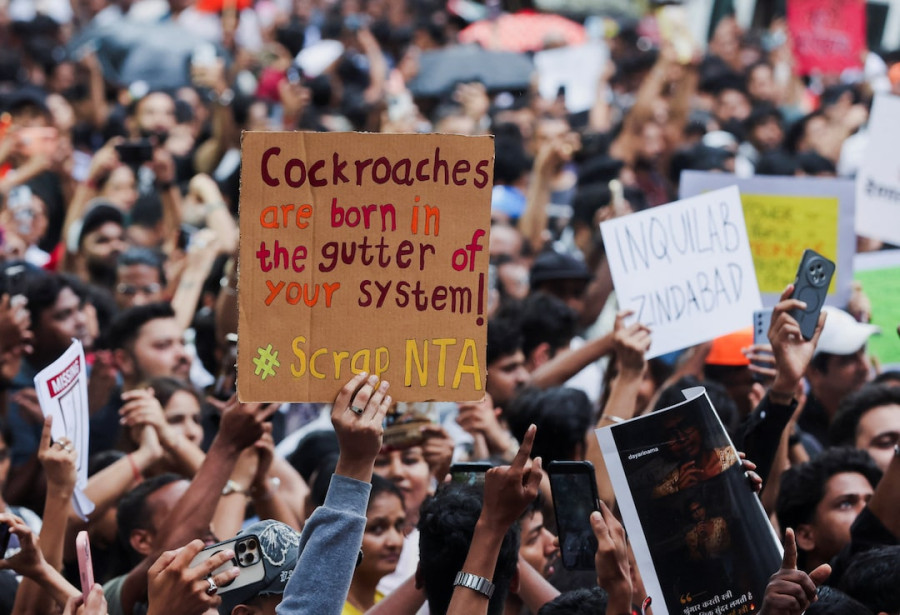
Politics across the world has now been wracked by the upsurge of awareness among youth and anger triggered by popular despondency. Countries, both developed and developing, are increasingly being engulfed by the waves of protests leading to the overthrow of governments. In some countries like Nepal, Sri Lanka and Bangladesh, the movements were spontaneous, turning into uprisings; in others, they were both sporadic and organised. In India, the Gen Z movement led by the Cockroach Janata Party (CJP) seems to be peaceful and organised for achieving minimum demands such as the resignation of the minister of education and the chief election commissioner. The CJP achieved its first objective of getting the resignation of the minister but is now doubling down on its efforts to settle the second. Other parties in opposition have also joined CJP, hoping to set the agenda for the end of the Modi government.
Most Gen Z movements or uprisings are basically extramural in character, as they are not subsidiary organisations that we used to find in the past. The student movements launched in Nepal during the royal regime, for example, were connected with political parties. Tribhuvan University and colleges were the sites of opposition politics because of the ban imposed on parties. Students were able to foil the efforts of the regime to organise its own organisation, which the supporters of free student unions opposed and eventually succeeded in realising their goal of free unions. It was also responsible for triggering a protest movement in 1979, forcing King Birendra to declare a national referendum either to choose the panchayat with reforms or to opt for a multiparty system. It was a major departure from the tenets of the partyless panchayat regime, considered then to be a sine qua non for a system without any alternative. Thus, a regime based on the traditional legitimacy of the King was vulnerable to any kind of protest launched by students at the time when political parties were outlawed or were in exile in India.
Unlike the extra-mural character of student protests that were found in many countries of South Asia, most of the recent spontaneous Gen Z movements were/are independent of parties. On the contrary, weakened as they are for mounting a decisive opposition movement, the Gen Z leaders are no less anxious to form a broad coalition against the Narendra Modi government.
Protests all over the world have more or less focused on corruption, failure in delivery and skyrocketing commodity prices, adding to the difficulties ordinary people face in maintaining their livelihoods. Problems vary from country to country with regard to the crisis of governance, but there are common issues such as rampant corruption, irresponsibility of leaders who are perceived as corrupt and power-hungry, bent on promoting nepotism and kleptocracy.
Some characteristics of the Gen Z movement can be listed under these rubrics. First, many Gen Z movements are leaderless except the Indian movement. Abhijeet Dipke actually started the movement following a cryptic comment by the Chief Justice of India, who compared the youth to cockroaches, provoking Dipke to use it as the symbol of protest. In other cases, the Gen Z movements that often turned out to be uprisings engulfing power elites are leaderless. In Nepal, it was a spontaneous assembly of youth that became the pivot for uprisings that took the lives of more than 76 people and caused massive destruction of both private and public property. In the absence of any acknowledged leaders, Gen Z-ers responsible for the overthrow of the Oli government didn't find any space either in the interim or in the elected government. Amid the uprisings, a bystander, Balendra (Balen) Shah, the mayor of Kathmandu, had suggested that some activists approach the Nepal Army to play the mediatory role between the Gen Z-ers , the army and the president. Later, the RSP found him a suitable popular candidate for the post of prime minister if the party could win the election.
Second, most protests are not preplanned or organised. Events led them to come out on the street, which over time brought them closer to one another. In the beginning, it was 'narrowly a political event' but subsequently 'snowballed into larger protests'. In Tunisia and Egypt, the uprisings known as the Arab Spring were, as Bassiouni, in his chronicle of the Egyptian revolution and its aftermath, describes, more of an ‘outburst’ than a programme for developing an alternative power structure.
The CJP in India took shape much later, while in Nepal, no such organisations have yet been created. The RSP swept the polls due to the tarnished image of established political parties as well as to the popular quest for an alternative force to replace the monopoly of major parties. The election mandate gained by the RSP catapulted a four-year-old party into power with Balen as prime minister. The Balen government can thus be called more of a byproduct of the Gen Z uprising than the direct product of the event.
Third, protest movements taking place in Europe are generally political in nature despite some causes of the protest being similar across the world. In Serbia, students could topple the regime through the electoral process, and now they are working to organise a new government through their own efforts. In France, a small excuse of bad school conditions and rising commodity prices actually found the fountain of protests.
Finally, protests all over the world are by and large not deviating from mainstream democratic processes. They are committed to the basics of democratic order, thereby sending signals that no authoritarian regime would become an alternative to it. In Bangladesh, Sri Lanka and Nepal, the protesters were careful not to allow democracy to derail despite some extra-constitutional routes discovered for averting the imminent threats to democracy. Eventually, most transitional leaders could successfully manage new elections for handing over power to the elected representatives.
One of the developments in some countries of Europe, and in particular, South Asia, is the resurgence of younger generations as stakeholders in power and politics. It has put enough pressure on political parties’ leaders to be cognizant of such realities. Such resurgent interests evident in youths have transformed the modus operandi of political parties. In the Nepali parliament and government today, most ministers and parliamentarians are below the age of 50, thus giving a new impetus to the process of transformation.
Baral is a professor of political science and former ambassador of Nepal to India.