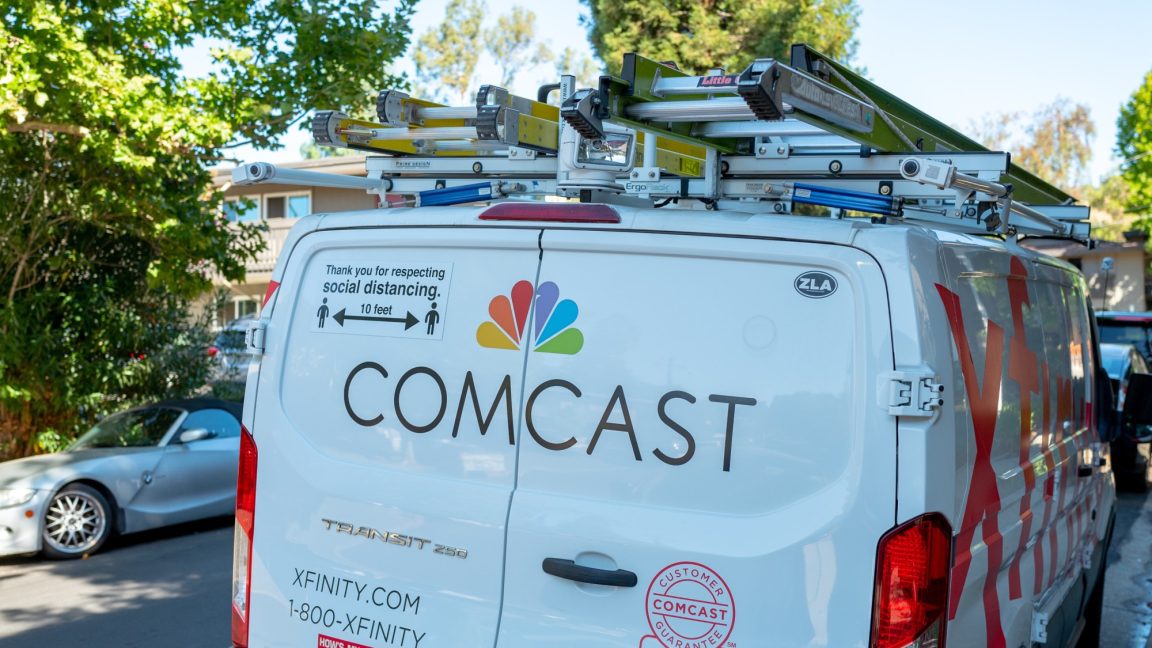
AT&T on Friday accused Comcast of false advertising in a lawsuit challenging the marketing claim that Comcast’s cable broadband service and Wi-Fi is “fiber-powered.”
“This case challenges Comcast’s false advertising campaign for its residential Internet service, marketed under the Xfinity brand to consumers nationwide,” AT&T’s lawsuit said. “At the center of that campaign is Comcast’s claim that Xfinity Internet and its associated Wi-Fi service are ‘Fiber-Powered.’”
While Comcast has deployed plenty of fiber throughout the US, its cable Internet service makes the final connection to homes with coaxial cable. This results in upload speeds being far slower than download speeds.
In contrast, fiber-to-the-home service can provide symmetrical upload and download speeds. Comcast has deployed fiber-to-the-home in only small portions of its cable territory while advertising its service as fiber-powered in the majority of areas where cable makes the final connection.
AT&T’s lawsuit said that in describing its cable broadband as fiber-powered, Comcast “conveys to reasonable consumers the misleading impression that Xfinity Internet is a fiber-to-the-home service comparable to AT&T Fiber. In fact, the vast majority of Xfinity Internet runs over a hybrid fiber-coaxial (‘HFC’) network, where the critical ‘last mile’ connection to the customer’s home uses copper coaxial cable, not fiber.”
AT&T has its own history of ads that mislead customers about the nature of its network. It used to advertise 4G LTE service as “5GE” or “5G Evolution,” and displayed a 5GE network icon on 4G phones. AT&T claimed that its 5G Evolution ads “served to educate customers about the billions of dollars AT&T has invested to give customers an outstanding experience,” but the NAD found the term was likely to mislead consumers into thinking they had 5G connections.
AT&T’s lawsuit said that Comcast’s fiber-powered claim “is literally false” because the cable firm’s HFC “architecture is fundamentally different from true fiber-to-the-home services like AT&T Fiber, which deliver fiber optic cables directly to the customer’s premises.”


