
N aming emotions is a core skill that most people develop as children, and it might seem like second nature. But research indicates that it’s harder than you think – about 10% of the general population have significant difficulty identifying their own emotions.
That’s why a simple tool called the feelings wheel has gained popularity in therapists’ offices and classrooms over recent years.
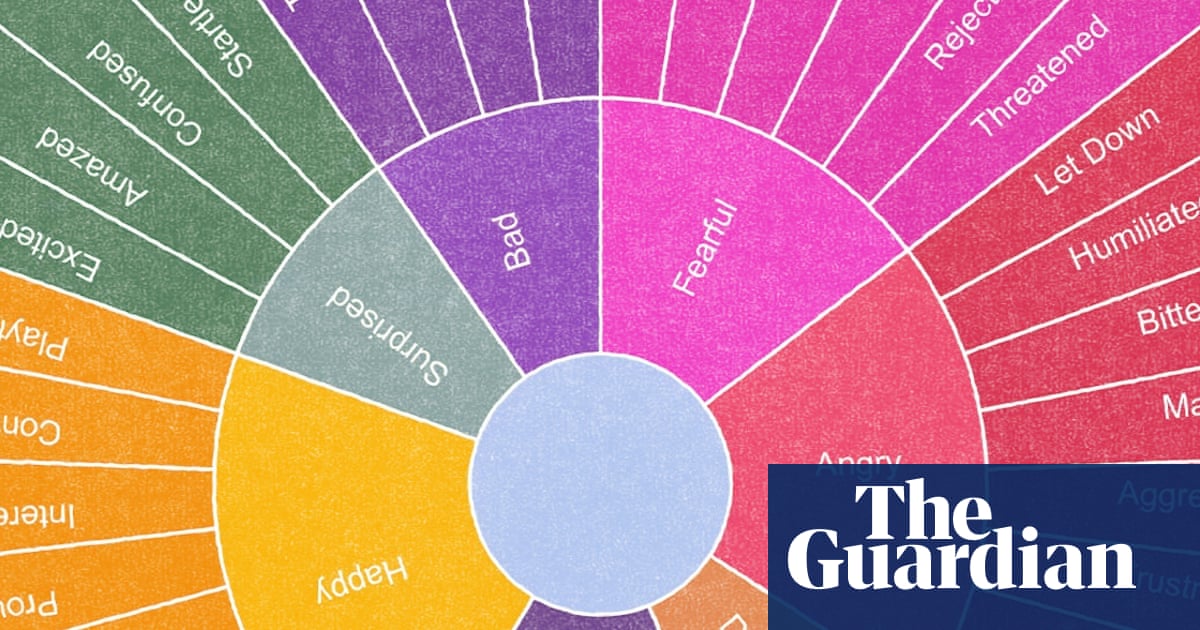
At first glance, it looks a little like a pie chart: three concentric circles sliced into colored sections, with each region representing a different category of emotion. The innermost circle lists broad core feelings (sad/happy/angry), which split off into gradually more specific sub-emotions in the outer rings (remorseful/proud/humiliated).
Created by US psychologist Dr Gloria Willcox during the early 1980s, the feelings wheel is a tool designed to help people identify and clearly name their emotions, by moving gradually from broad blanket terms to more nuanced ones. The wheel has surged in popularity in recent years, thanks in part to its visual appeal – you can get it as a laminated office poster, as a wooden desk chart on a spin-stand or even stitched onto a cushion .
But do people really need this much help with the seemingly simple task of naming everyday feelings? Experts say that in many cases, the answer is yes – and behind this difficulty is an evidence-based scientific concept known as emotional granularity.
First identified by neuroscientist Lisa Feldman Barrett in 2004, emotional granularity is the ability to recognise and name your emotions in a precise way, rather than lumping them into broad, general categories like “bad” or “sad”. You might think of it as the difference between seeing only primary colors, and seeing a full color gradient.
“I think of it as being able to experience and articulate your emotions in very nuanced, context-specific ways,” says Dr Katie Hoemann, an assistant professor of psychology at the University of Kansas. While on one level it’s about precision, what actually makes emotional granularity useful is the level of insight it can provide. “It’s accompanied by a meta awareness of not only what you’re experiencing, but why. Do you have a sense of where this feeling is coming from, and do you have a sense of what you should therefore do about it?”
The extreme opposite of emotional granularity is alexithymia, a trait whose Greek translation literally means “no words for emotions”. Affecting roughly one in 10 people, it describes either an extreme difficulty or complete inability to identify and label one’s own emotions. It’s not a diagnosis in itself, but is commonly associated with autism and can also be a feature of mental health conditions like depression and post-traumatic stress disorder.
Research indicates that higher emotional granularity is associated with a range of positive outcomes, including lower levels of mental illness, more efficient emotional regulation and reduced chances of relapse for substance users in recovery.
“The findings are robust,” says Dr David Kimhy, associate professor of psychiatry at the Icahn School of Medicine at Mount Sinai, and director of the Experimental Psychopathology Laboratory. Kimhy and his colleagues recently published a sweeping review of the existing research, which showed that “across the board, higher emotional granularity has been linked with better mental health outcomes and social functioning”.
The exact reasons for this link aren’t known, but experts have some theories. Emotions act as an internal feedback system, helping us to evaluate what we like and dislike, avoid danger and react appropriately to whatever is around us. “More specific emotions are more informative,” Hoemann explains, “and you can take that information and use it to select and regulate your behaviour.”
For instance, you might start out only knowing that you feel sad, but when you get more granular you realize that what you’re actually feeling is loneliness. That could in turn prompt you to reach out to a friend , or finally join that running group you’ve had your eye on. But a person with low emotional granularity might never move past that non-specific feeling of sadness to reach solutions.
“If you feel anger, that calls for one strategy. If you feel guilt or anxiety, that’s a different strategy,” says Kimhy. “But if all you know is that you feel bad, it’s hard to know what strategy to use.” In that scenario, people tend to default to whatever coping strategy is familiar or accessible, which could look like avoidance (scrolling through social media, or putting off a difficult conversation), aggression (cutting someone off in traffic, or picking a fight) or self-medicating behaviours (substance use or over-eating).
Granularity also has interpersonal benefits, Hoemann adds. “Your words aren’t just for yourself, so if you can tell someone: ‘Hey, I feel frustrated,’ or: ‘I feel disappointed,’ that’s more informative. You’re communicating in a way that tells the other person how they can help you, and maybe how you can move forward together.”
The good news is that emotional granularity is not a fixed trait, but a skill that can be learned and cultivated. Tools like the feelings wheel can help by providing the vocabulary and basic skills to get started, but just like learning any new language, it only really sinks in with practice.
The goal isn’t just to learn a bunch of new words, but to use the wheel in the context of some kind of practice like journalling to reflect on experiences that you’ve had. “I think it’s a useful tool to the extent that people can use it to identify and make meaning out of moments in their life,” Hoemann says.
Experts have hypothesized that tools like mindfulness , mood-tracking and structured therapy can also build emotional granularity. In particular, cognitive behavioural therapy (CBT) highlights the interplay among thoughts, emotions, physical sensations and behaviors, and can help to develop more awareness of all four. When Kimhy works with patients using CBT, he often sees a blurring of the lines among those four areas. “Usually at the beginning of treatment, you’ll get: ‘Well, I felt like running out of the room,’ but that’s a behavior. Then they might say: ‘I thought I was going to have a panic attack,’ but that’s a thought. So you have to work with them to develop that understanding of what a feeling is first, and then to start labelling emotions.”
If somebody is really struggling to articulate how they’re feeling, or they’re experiencing alexithymia, it’s particularly important to consult a mental health professional who can provide guidance, rather than using a self-help tool like the wheel in isolation. Hoemann warns against spending too much time trying to find the perfect word for every experience – for a person who’s prone to overthinking or rumination, the feelings wheel could just lead them to more of the same. “There can be too much of a good thing. Ideally, you want to think about using it to label and sort through your experiences, and say to yourself: ‘OK, what I actually felt was disappointed. I’ve made my meaning of that moment, and now I can put it away.’”
Emma Dibdin is a writer and mental health professional based in London