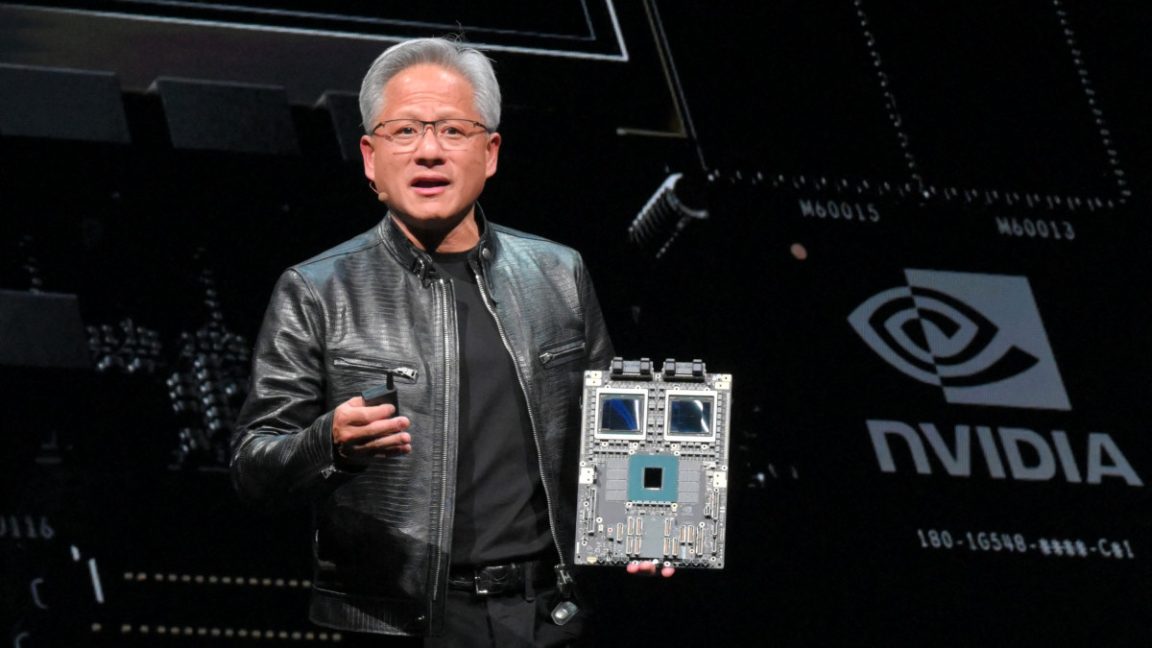
I don’t go into any given week at WIRED assuming I’ll be thinking much about extramarital affairs. But last week, they were the only thing on my mind.
These thoughts, of course, were prompted by Jensen Huang. In the span of a few completely insane days, the billionaire CEO and cofounder of Nvidia went from being a globally influential Silicon Valley executive to a lesson in exactly what not to do if you want to keep your job, and the extraordinary power that comes with it. It’s a damn mess—for Huang and his family, sure, but also for Nvidia, the AI industry the company is instrumental in powering, and the entirety of the global economy.
WIRED’s senior correspondent Lauren Goode has spent years reporting on Nvidia and Huang, including interviewing the man himself on multiple occasions. She also spent last week breaking news about his downfall, despite being in Europe on vacation. (Sorry, Lauren. You can have those PTO days back.) So at the end of a very long week for WIRED’s newsroom, I called Lauren to talk about what she makes of Huang’s ouster, what it means for AI, and where this all goes next. We also made a bet about Huang’s future—one involving a meal he recently made semi-famous.
This interview has been edited for length and clarity.
KATIE DRUMMOND: Lauren, first of all, thank you for your tirelessness these past few days. The last time I saw you, we were both in Miami for WIRED’s big event , and you were getting on a red-eye that night to go to Europe for vacation, which didn’t exactly go as planned. When you saw that first story about Jensen’s affair on Sunday, what did you think? What went through your mind?
LAUREN GOODE: Oof. The story first started bubbling up a while ago because The New York Times, and a lot of credit is due to The New York Times here, first reported on Nvidia’s relationship, if you want to call it that, with this company Megaspeed, back in the fall of 2025.
It was a very unusual story. And for some reason it just didn’t capture the attention of people the way that more recent reporting that we and others have been doing has.
Anyone who’s sort of been paying attention to that story, or had some sources in the industry, were starting to hear things. But the fact that the affair with this person, who goes by Alice Huang, was confirmed, that’s the kind of story that always captures people’s attention in a different way.
There are few things people love to read about more than extramarital affairs, especially when they involve powerful people. The reason it wasn’t surprising to you, was it because of that previous reporting and what you had been hearing here and there? Or was there another reason that you saw that story and thought, “OK, actually some of this is not shocking to me”?
It was both. I don’t know if you remember, Katie, but in the fall of 2024 we were doing a WIRED outing, a few of us hanging out, and we started chatting about whether or not we thought a lot of the most powerful people in Silicon Valley had girlfriends or extramarital affairs or situations. Because there are some people in Silicon Valley who are actually quite open about that. I remember us talking about it at the time, and there’s part of me that always kind of assumes that there are elements of their personal lives that we’re never going to have a full window into.
Not that we were talking about Jensen that evening, but it’s always been in my mind. Then, yes, I think being on the ground in Silicon Valley, you often hear things. But a lot of times there’s a certain threshold that things have to cross in order for us as journalists to consider something reportable or something worth chasing down as reportable.
I think an important distinction is that people cheat, people have affairs all the time, Silicon Valley or otherwise.
What tips this over into newsworthiness is, A) the Chinese espionage of it all, and B) the affair with a subordinate.
You reported that Jensen’s resignation—which really, to be clear, is the board of Nvidia ousting him—probably had more to do with the alleged affair with a subordinate than this other extramarital relationship, which is tied up in espionage allegations. A source told you this. Can you explain why that affair would tip the balance for the board?
I just think it’s important to note that this doesn’t seem like it was simply a moral decision. Someone had posted on X that “I can't believe the board caved to moral pressure.” To me, this doesn’t seem like it’s a moral issue.
I think if you’re looking at the three things that could have led to serious scrutiny of Jensen Huang’s behavior, there’s: One, extramarital affairs. Two, alleged extramarital affairs with subordinates within his own company. And three, an extramarital affair with an alleged Chinese operative, which puts Jensen Huang in this position where the board and the investigators who are looking into this are trying to determine what he knew and when he knew it, and basically whether he was aware of the fact that chips were making their way into China.
This isn’t just about the fact that someone had a girlfriend outside of their marriage. I think what is still to be revealed here could in fact be very, very serious in nature.
Now, you also reported on Monday, in a fantastic scoop for WIRED , that Jensen hired a crisis comms firm a year ago. In October 2025 he hired a fixer, Risa Heller, who is very well known for working with high-profile men who are facing allegations of sexual misconduct, among other things. I’m talking about Anthony Weiner, Mario Batali, writer Jeffrey Toobin. Tell us a little bit about that story and what you found out.
I really feel like with everything else going on this week, I could have gone without ever hearing about all of those stories again.
Oh, you don't want to hear about Anthony Weiner all the time?
No, it turns out. I had kind of forgotten that. I was like, “I think I blocked that from my memory.” And Jeff Toobin—what a throwback.
But this firm, it’s a really interesting firm run by this woman named Risa Heller. They have offices in New York and LA, and yes, they have this reputation for dealing with a lot of sexual misconduct cases, as well as other types of corporate and personal PR needs for high-profile people.
A source had told me a while ago, and I'm not gonna timestamp it, but a while ago that it had been rumored that Jensen Huang had hired this firm. So immediately my antenna went up, and I was like, “Wait, what?”
I thought it was curious, but I didn’t know exactly what the nature of the contract was or when they had been hired, and then eventually through more reporting, I was able to get confirmation of some of the details.
What we know is that this firm, Heller, started working with Jensen Huang sometime in 2025, and ostensibly, Huang and his family had hired Heller for their own personal PR outside of Nvidia's walls. This is because when you’re someone like Jensen Huang, you have a lot going on. You have a family office. You do a lot of work with philanthropy. You’re hosting personal events. He’s also been grooming his adult children to take over these higher profile roles within Nvidia, so some of the PR might have ostensibly been to work on creating more of a public-facing image for his kids.
We do know, though, based on more reporting, that as of October 2025, and then closer to the end of the year, Nvidia’s internal teams had been instructed to start looping this outside crisis firm, Heller, into all press inquiries, all communications related to Jensen.
That was definitely a change from the prior terms of his working relationship with Heller, and also timing-wise coincided with that first New York Times story I mentioned. I think that it was published on October 9th, 2025, and first highlighted Megaspeed and what appeared to be a very close relationship between Jensen Huang and Alice Huang.
I can’t decide if he should get his money back for hiring this crisis comms firm, because this crisis has certainly not been contained, or if the fact that this is now coming up a year later suggests that maybe they did their job quite well for a while.
Well, first of all, I don’t think he needs the money back.
… on how his assets get divided, yes. Or if maybe they won’t divorce. You know, it’s also a very Silicon Valley thing not to necessarily do that.
I also think it’s possible that Jensen himself was not totally upfront with this firm when he hired them. Or, if they knew something was up, they may not have known all of the details. So if that is the case, hypothetically, then you can’t necessarily do everything you would typically do in terms of reputation management. TL;DR, it didn’t work out so well for him in the end.
No, things are not going well for Jensen. Now, Nvidia has named an interim CEO to replace him. Surprise, surprise, to both of us and women everywhere, she’s a woman.
What do we know about Colette Kress , who is the interim CEO of Nvidia?
Well, we know that when we emailed Jensen this summer to say, “Hey, Jensen, who do you think the most powerful women in Silicon Valley are?” He didn't mention Colette. Jensen mentioned Dina Powell from Meta and Ruth Porat from Google, both really high-ranking women, presidents of those companies.
And then [SpaceX president and COO] Gwynne Shotwell, because I prompted him. But no Colette, and that struck me as interesting at the time, too, though I didn’t press him on that. And then we did end up giving Colette a nod in our big feature that we did about high-ranking women in Silicon Valley.
Colette has been with Nvidia since 2013. Prior to that, she worked at Cisco, Microsoft. She’s CFO. She’s a financial whiz. She’s the person who appears on earnings calls with him every quarter.
She actually does a lot of the speaking, because she’s a person who has really, really deep knowledge of Nvidia’s complex financials. She’s the person who gives guidance for the next quarter. She’s CFO of arguably the world’s most important company. I think it makes sense that she would be slotted into this role.
Nvidia doesn’t really have a traditional hierarchy. They don’t have a traditional chief operating officer, for example. You know, when Steve Jobs was at the end of his tenure and he was very sick, Tim Cook, who was the operations whiz at Apple for many years prior, was basically groomed to be the CEO.
Nvidia doesn’t have someone like that. So it makes sense for now that Colette is the person who would slot in, because part of Nvidia’s goal has to be, at this point, easing the stock market. I don’t know if you've been following, but, I mean, it’s pretty bad out there.
I would say that, against my will, I am seeing a lot about Nvidia stock not doing well. I have not looked at my 401(k). I try really hard not to because I’m a control freak, and I simply cannot control how many affairs this man is having and what impact that has on my finances.
These things, though, help paint a picture of Jensen’s character and the way he ran the company. The fact that Nvidia did not do succession planning. There was no hierarchy; he had dozens of direct reports. There was no successor waiting in the wings. What do those things combined tell us about Jensen and Nvidia?
As I understand it, Katie, even you have had to do a succession plan, right?
Yes, without revealing too many details, Condé Nast, like most normal companies, has people in senior leadership roles do succession planning. They take it really seriously. It’s an annual exercise that we do, and my understanding is that that is very par for the course at most companies, at any company, and particularly a company of Nvidia’s stature and importance on a global scale. The idea that there would not be a formal succession plan is shocking to me.
It is shocking, and it’s shocking not just from the perspective that Jensen perhaps didn’t do that or didn’t have a super well-formulated one, but that the board wouldn’t demand that. I’ve heard a few different theories floated as to why this is. One theory is that Jensen may have had a lot of the insecurities that come with being a cofounder, CEO, someone who’s been living and breathing this company, his baby, since 1993, and not necessarily wanting to stuff the ranks with people who are just as capable, if not more capable in some measures, than himself, right?
Like you don’t create an environment in which someone could theoretically replace you that easily. So that’s one theory. The other theory is that—and Jensen himself has said this, both to me and other people in interviews too—he truly believed that keeping a flat org was better for the flow of information, that once you start to create a structure that’s too hierarchical, then any kind of changes that happen in the company, any kind of new information that comes out, even in some kind of white paper, fundamentally changes the direction of the way the industry is going.
I mean, think about the way people inside the AI industry probably reacted when they first saw the famous Transformer paper in 2017 and said, “Oh my gosh, this is going to change everything.” If you’re a big, fat, bloated, slow organization, you’re probably five years behind on your AI strategy. If you’re lean at the top, you can basically say, “Let’s go. We’re going in this direction now,” and you won’t encounter a lot of barriers to doing that. So that helps explain the flat org. It doesn’t necessarily explain the lack of a succession plan.
The third theory that’s been floated to me is that maybe in some, I don’t know, alternate universe, he really did think that his children, one of his two children, who are both working within Nvidia, would one day be the inevitable successors.
You have met Jensen several times. You’ve corresponded with him, you’ve interviewed him, you published a cover story for WIRED that featured an excellent interview with him. You published an edition of our newsletter, Backchannel, at the end of last week with a little bit about this. In it you talk about one experience you had interviewing Jensen at a conference. You wrote, “Huang was domineering, evaded some of my questions, and immediately after our session concluded, did an impromptu Q&A session with a much more adoring crowd than me.” You describe him as obsessed with controlling the narrative.
Again, we’re coming back to this theme of control. I’m curious to hear a little bit more about that observation, this idea of Jensen as fixated on storytelling and the stories that were told about Nvidia and about AI.
That particular interview was July of 2024, and Nvidia had invited me to interview Jensen again at the SIGGRAPH Conference in Denver, which is this whole confab of computer graphics nerds. It’s a really fun conference.
During the preparation for it, when I got on the call with some Nvidia comms executives, Madison Huang, Jensen’s daughter, appeared on the call and she basically took the lead and said, “Here’s this cluster of slides that when you’re on stage, Jensen’s going to be referencing, and he’s gonna have a lot to say about each slide, and it would be great if you could tee him up at this point.”
And I said, “Well, wait a second. This is not a standard journalistic interview. Like, what’s going on here?” The whole thing felt very strange, but I made it clear I planned to ask him the questions I really felt I needed to ask him as a journalist. It was just very clear he did not want to answer a lot of my questions, and that he was going to just own the stage and reference his slides. I remember that he talked about how he made a little Jensen AI of himself, and the crowd was all, “Ha! Jensen AI,” and I was like, “What is happening?”
It was so strange. Afterwards, he did this impromptu Q&A with the crowd. A bunch of people rushed the stage. I could see someone from his PR team being like, “What just happened? What is he doing?” Not standard operating procedure. I thought, wow. It felt to me like Jensen Huang was just riding high on this wave, this AI wave and this incredible success that Nvidia was experiencing and the way the AI industry was growing.
But it occurred to me that he was really, really obsessive with controlling the narrative, and it reminded me of something that he’d said the first time we’d ever spoken, which was that he really admired the CEO of Adobe because he felt that the CEO of Adobe was a very good storyteller, and that he never had a pitch deck when he first pitched Nvidia as a company because he just thought it was better to tell a story.
Storytelling is so important in terms of establishing the culture of a company. He was very good at creating his own story, his own image of himself as this founder CEO who was utterly obsessed with his own company and really passionate about everything.
I guess we know where some of that passion led him.
We do indeed. It’s interesting that you talk about Jensen as a crowd favorite, because he did very much become that. He’s incredibly charismatic. He’s a great public speaker. He can really own a room. He can spin a great yarn. You describe in the cover story about Jensen, that you were “Jensen-pilled” after spending time with him, because he is so compelling.
That was interesting to me this week, in seeing how many leaders in Silicon Valley came out in support of him, despite these very, very troubling allegations, which to be clear, again, go beyond having an affair. This is beyond moral decision-making. Regardless of that, everyone from Elon Musk to Jason Calacanis came out guns blazing for Jensen.
Do you think that speaks to how revered he is in the industry, or do you think that that speaks to the fact that he is mission-critical for the industry’s ongoing growth? Are these defenses of Jensen essentially self-interested on the part of industry leaders?
I don't think they’re all self-interested. There are at least three layers to this, and one is that there are executives and lower-level tech workers who have worked for Jensen directly, and who came away from the experience with not a great taste in their mouths. They left feeling uninspired, and they actually saw a more egotistical side of him that they didn’t like, an obsessive side. There have been stories reported by other outlets about how he has sometimes berated some of his top lieutenants in front of other people. There’s almost a Dr. Jensen and Mr. Huang narrative here. He's got two sides to him. But he’s very smart and almost can come across as sort of mensch-y. I think people really admire him.
Then I think, yes, there are people who probably own Nvidia stock, they’re industry watchers, they’re tech enthusiasts, and they see him perhaps still as a kind of our generation’s rock star who also happens to be keeping the economy afloat with his company.
So there are varying levels of interest there in terms of people who just either wish this didn’t happen, or really wish in some alternate universe he would be reinstated, which would be shocking to me at this point.
I will say WIRED had a great scoop last week , much credit to our amazing journalists, of Nvidia employees who would like to see Jensen back. There is a great deal of reverence for him, in a way that I have to admit gave me acute flashbacks to 2023, when Sam Altman was ousted at OpenAI. Very different circumstances, but yet again, a woman was installed to clean up that mess, and employees revolted and called for Sam to come back . I mean, these allegations are much more significant and serious and consequential. That said, the jury’s still out on whether Jensen makes a comeback in two weeks.
Really? You think there’s a possibility?
Wow. OK. I would be very surprised. We should make a bet.
Oh, Lauren. I was going to say dinner the next time I’m in San Francisco.
Dinner sounds good. Let’s do it. You know what? Whoever loses the bet has to buy dinner at Proposition Chicken, which according to, was it the Daily …?
The Daily Mail reported that Proposition Chicken, which is a slightly elevated fast food chicken place in San Francisco, was being delivered to Jensen Huang’s house in Pacific Heights the other day.
OK. I’m in. Two weeks from today, we will see.
I want to ask you lastly about ripple effects. Nvidia has invested in or bought outright plenty of AI startups. It finances a lot of the build-out happening in this industry. I have been stomping around the New York office all week screaming things like, “The global economy, the global economy!” I mean, this is much bigger than just this company, right? So what are the industry effects that we should all be watching out for from here?
What I’ve heard so far from people is that in the short term—even though we’re seeing this dip right now—there’s still just such incredible demand for Nvidia chips, and they plan everything basically 18 to 24 months out in terms of producing those chips, that I don't think we’ll see any really serious softness in Nvidia in the short term.
But I think that the long tail of Nvidia is going to be interesting, because another CEO could come in with a totally different approach to how Nvidia spends its capital and how it also makes investments in outside companies.
Would a new CEO come in right now and make the kind of investment in CoreWeave or Perplexity, for example, that Jensen decided to? Quite possibly no. Would the new CEO come in and decide to spend so much on, let’s say, Nvidia’s healthcare division? We don’t really know. Would the new CEO come in and be as much of an open source booster as Jensen Huang had become? We don’t really know.
It’s just hard to say. The guys at Hugging Face are probably quite happy that they got in when they did.
Another thing that Jensen had set Nvidia on the path of in the past couple years was really investing in what they’re doing with CPUs as well as GPUs, which is an area that Intel and AMD are in, as well as Arm.
Was that the right path to set the company on, to over-index a little bit on CPUs for now because of the ways that the AI industry is shifting from training on high-powered GPUs to inference computing on slightly lower-powered CPUs? I think it was a smart move, but let’s see how that shakes out.
I don’t know if you remember, Katie, but back in 2008, shortly after the collapse of Lehman Brothers, a venture capitalist at Sequoia sent around a pitch deck to all of that firm’s portfolio companies that became very famous in the industry, and it’s called “ RIP Good Times .”
In that pitch deck, this very prescient VC basically laid out all of the things that they wanted their portfolio companies to do, which meant saving a lot of cash. Like, this is a gird-your-loins moment. I think if we see something like that kind of mentality start to develop in Silicon Valley in the coming weeks and months, then I think that’s a very big indication that people are genuinely worried about what this Nvidia tumble means.
I am going to ask you to make one final prediction.
OK. I’m very bad at predictions, by the way, but please.
Two years ago, you said, “Huang is the man of the hour. The year. Maybe even the decade.” I would argue that that decade has been cut short, but I also think that someone like Jensen doesn’t just go quietly into the night. If he’s not reinstalled at Nvidia, and I’m wrong, and I’m buying your chicken in two weeks, where does someone like that go? Where do you expect we will see Jensen pop up in a year, in two years?
There’s a glib answer and it’s either Jensen goes to jail, or Jensen starts a podcast. I’m sure he’s hoping right now it’s the podcast outcome.
Realistically, let’s say that he’s not implicated in the end result of any kind of federal investigation. And let’s say he’s not reinstated. In either case, I don’t think this is the last we’re going to hear from Jensen Huang.
You can always listen to this week's podcast through the audio player on this page, but if you want to subscribe for free to get every episode, here's how:
If you're on an iPhone or iPad, open the app called Podcasts, or just tap this link . You can also download an app like Overcast or Pocket Casts and search for “uncanny valley.” We’re on Spotify too.
In your inbox: Inside WIRED’s newsroom with Katie Drummond
They war-gamed dimming the sun —it went worse than you think
The Big Interview: Nathan Fielder tells us everything
Live tracker: Elon Musk’s America PAC is spending big on the midterms
Introducing the app: More ways to make the most of WIRED