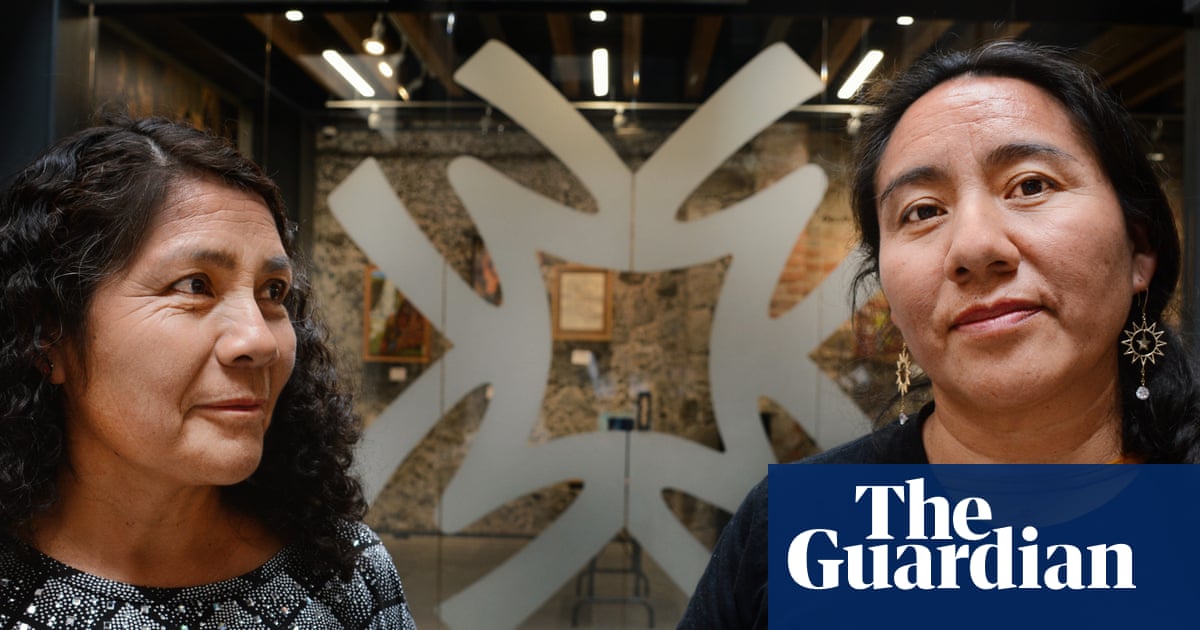


P az Rodríguez woke up about 5am at her home in Milpa Alta, a suburb of Mexico City, on 20 March 2021. She thought about her plans for the day: pick up yellow lilies and cacti from her mother’s house and sell them in the market. Later that evening, they would cook mole , a traditional Mexican dish, together.
She reached for her phone, which was flooded with texts from her sister, Oliviera Rodríguez. “Mum’s dog is barking a lot,” she had written. “I keep calling and she won’t respond.”
Rodríguez, worried, rushed to her mother’s house. “Mum,” she called through the slightly open door. “Mum,” she called again, but no one answered. She walked through the kitchen and saw gas cylinders, usually lined up against the wall, scattered across the floor. She felt something was wrong.
In the bedroom, Rodríguez found her mother lying face down on the floor, unresponsive. “There was so much blood around her body,” Rodríguez says.
Her mother, Melesia García, 72, had been attacked the night before. The police said that assailants broke in, raped and killed her.
“They did terrible things to her,” Rodríguez says. “I don’t understand why. My mother never hurt anyone.”
The siblings buried their mother in Oaxaca, where she had grown up in the mountains, among flowers and cacti.
García was one of the 1,022 victims of femicide in 2021, when intentional murders of women and girls hit a historic high in Mexico.
When a prosecutor told Rodríguez they were treating her mother’s murder as a femicide, she had never heard the term before. The prosecutor’s team were part of a femicide unit formed a year earlier by Claudia Sheinbaum, now president of Mexico but then the mayor of Mexico City.
Six years on from the unit’s creation, official data shows that Mexico’s femicide rate has started to fall, from 1,022 victims in 2021 to 736 last year.
Eduardo Guerrero Gutiérrez, director of Lantia Intelligence, a consultancy specialising in public safety and crime, said the decline can be partially explained by appointing professionals to key positions, such as the femicide prosecutor, to tackle violence. Before Sheinbaum took office, these positions were held by politicians “who didn’t take these issues seriously”, he says.
While independent research suggests the true number of femicides is higher than in official statistics, the unit still represents cautious progress on one of Latin America’s most intractable problems.
T he femicide unit, which operates from the first floor of Mexico City’s police headquarters, is at the forefront of the battle against the killings. Femicide detectives come and go at all hours. LGBTQ+ flags, pink anti-violence posters and a photo of a missing girl with a short black fringe hang on the walls. A lilac room is dedicated to investigating trans femicides.
On a recent afternoon, a female officer, who wanted to remain anonymous due to the sensitive investigations, showed us a video of a man in a helmet, shooting a woman as she walked out of a building. The woman fell to the ground, and the man jumped on his bike and left. The officer pulled up another video and pointed out the same man taking off his helmet. She had found that image after watching hours of CCTV footage and mapping the man’s bike route. Now they are trying to locate him.
Not every case is as straightforward. She is also investigating the murder of a girl at home. Though she has been through every piece of footage available from nearby cameras and flagged suspects, she has not yet found the killer.
The officer is part of the intelligence team that uses digital evidence and technology to track down suspects. In a recent undercover operation, she located a possible perpetrator hiding in Tijuana through his TikTok posts, chatted to him, and set up a date. The detectives arrested him at the location where the suspect believed he was meeting a woman.
The idea for a specialised femicide prosecutor came from feminist activists in 2017, after the body of Lesby Berlin Osorio, 22, was found in a phone booth, strangled by the telephone cable. Her case became a symbol of violence against women in Mexico.
The Mexico City prosecutor investigating Osorio’s murder described her in a social media post as a college dropout who was “drinking and [taking] drugs”. Outraged by his statements, activists demanded a prosecutor who would take femicides seriously.
In March 2020, Sayuri Herrera Román, a prominent human rights lawyer and a longtime activist, became the country’s first femicide prosecutor.
“We believed that we, as a movement, had earned that prosecutor’s office and that space, and that we had to take it,” Román says.
When Román founded the unit, there were only eight officers and the office did not even have cabinets – files were just dumped in boxes on the floor, she says. Over the years, the team has expanded to 86 people, including a photographer, forensics experts, litigators and psychologists.
García’s murder was one of Román’s first cases. The unit usually takes six months from investigation to prosecution, but in García’s case, it took four years. Local people misled the team to protect each other, she says, and witnesses were too scared to come forward.
In 2022, Román became a special prosecutor to investigate crimes related to violence against women across Mexico. Brenda Celina Bazán Varela, a detective on her team who was already investigating García’s death, became the new femicide prosecutor.
Varela ordered a review of the biological evidence in García’s case using the latest scientific methods and ran it through the database, which linked the DNA samples with her neighbour and his friend.
“This case was very difficult for us, but in the end we managed to bring these two individuals to justice,” Varela says. Both men were arrested in 2025.
T he femicide detectives usually arrive at a crime scene shortly after the local police and follow their own protocol: they photograph the body, collect fingerprints and anything that could be considered evidence. Forensic officers swab fingernails and the pubic area, even if there is no sign of sexual assault.
Last year in March, Mexico City’s chief prosecutor, Bertha Alcalde Luján, introduced a new protocol ensuring all violent deaths of women were investigated as femicides. “We understand that the violence is often part of a broader context,” Luján says.
Still, many women feel like the authorities are failing to protect them. Independent reports show that victims and their families are worn down by incompetent police, authorities’ unwillingness to take action, delayed investigations and pervasive impunity.
As the sentencing hearing approached for García’s alleged killers, Rodríguez started to hope that justice would be served in her mother’s case. But on 28 July, the judge acquitted both defendants. The verdict, reviewed by the Guardian, found DNA evidence from the vaginal swab linked to at least two men and matched one defendant’s family, but the judge decided not to rely on it as the samples were “not collected and stored properly” and needed further examination.
“Sometimes there is a very thorough investigation and there is evidence, yet the judge’s interpretation fails to recognise that violence,” Varela says.
Having a specialised unit can help cases reach the courts. This year, Mexico City’s prosecutor has recorded 33 femicides, 32 of which have reached the courts. In total, 63 femicide cases were tried in 2026, including cases carried over from the previous year, and nearly half ended in a conviction.
However, the unit is unique to Mexico City, while other states are neglected, says Chantal Flores, a Mexican journalist who has been covering femicides for years. So far in 2026, 518 women have been killed in femicides across the country.
Feminists are trying to convince the senate to adopt a bill , signed by Sheinbaum in July, that would standardise femicide investigations and appoint a femicide prosecutor or unit in every state, as well as increasing the punishment from 40-60 years to 50-70 years .
Rodríguez, now 45, plaits her hair and hangs it over her shoulder, as her mother did. She attends feminist marches, wearing a T-shirt with her mother’s picture that reads “Justice for Melesia”.
Since the judge released the two defendants accused of her murder, Rodríguez and her family say they have been harassed by the men’s relatives.
“These men feel protected by the system that should have punished them,” Rodríguez says. She now rarely leaves the house, and is trying to save enough money to move to Oaxaca, to be close to her mother’s grave and to feel secure again.
“I am still mourning,” she says. “The judge killed my mother one more time by letting the perpetrators go free.”