While Anthony Albanese's promotion of a Filipino fast food chain has raised some eyebrows online, experts say the prime minister's fried chicken meal could strengthen ties with a regional ally.
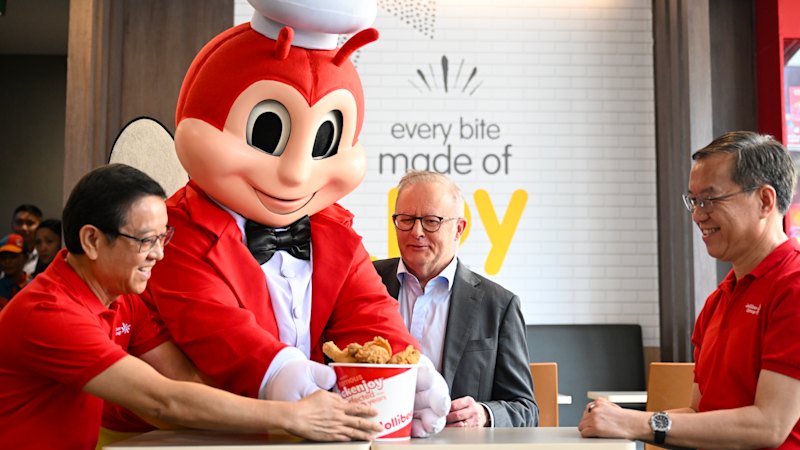
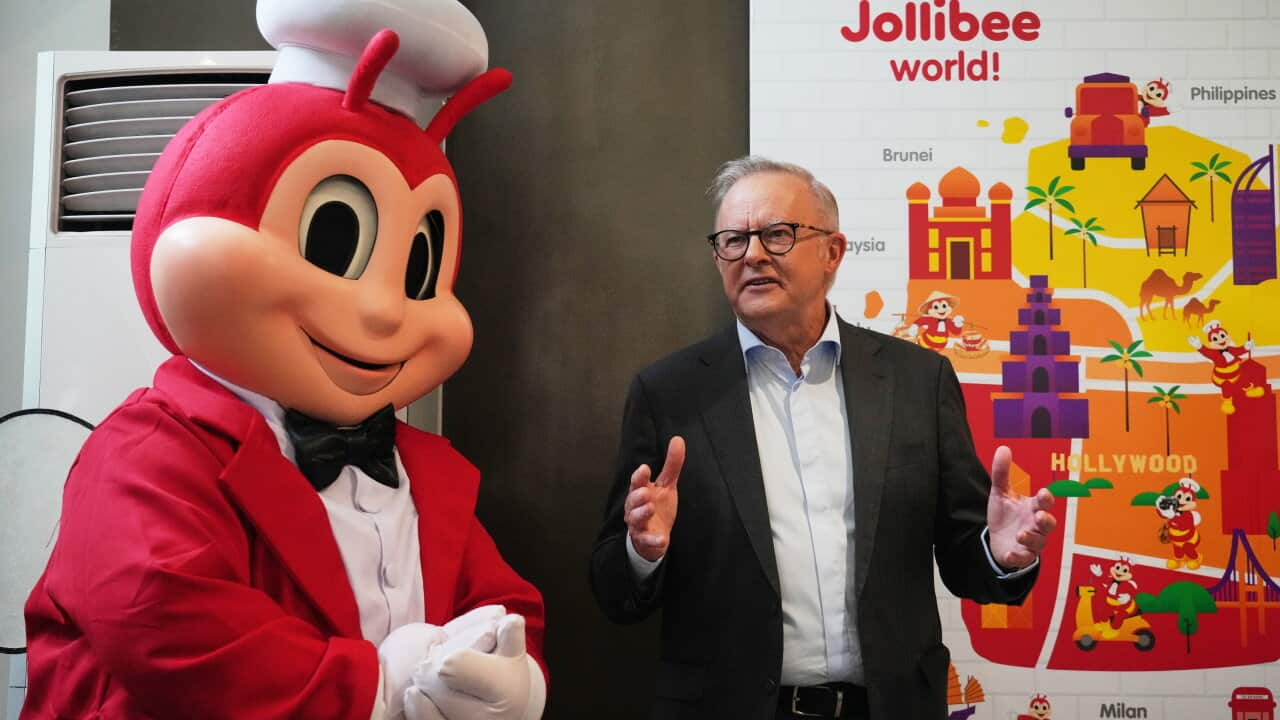
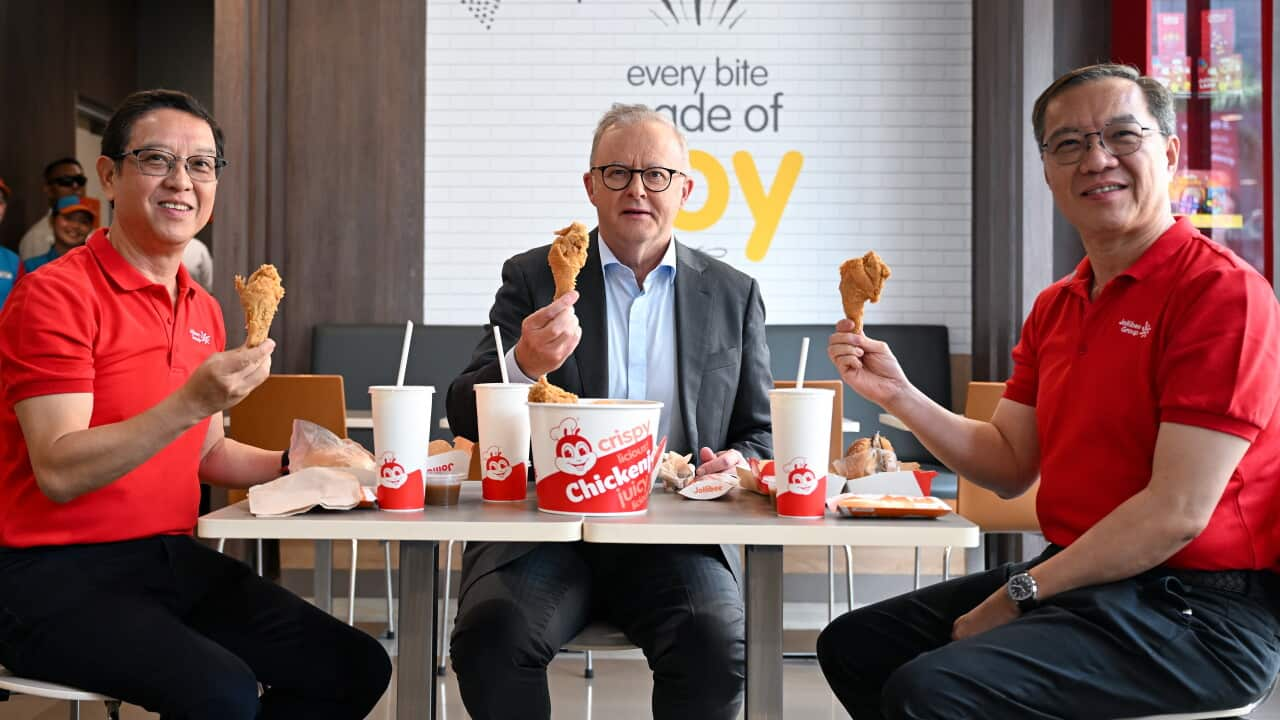
Filipino fast food giant Jollibee is set to open in Australia — and the prime minister has celebrated the move in Manila with the company's president and CEO Ernesto Tanmantiong.
The chain, well-known in the Philippines for its fried chicken, operates more than 1,600 stores worldwide and aims to open 35 in NSW and Victoria over five years.
The Australian outlets are expected to create 900 direct jobs.
Albanese, who is in Manila for the summit of the Association of Southeast Asian Nations (ASEAN), said he wants to see "more businesses choose Australia as a place to grow and succeed".
Your trusted source for staying up-to-date with the world around you. Get free daily news updates and analysis, straight to your inbox.
He welcomed Jollibee as a "great example of the cultural connections that strengthen our relationship with the Philippines".
More than 400,000 people living in Australia were born in the Philippines, making it the country's fifth-largest diaspora community.
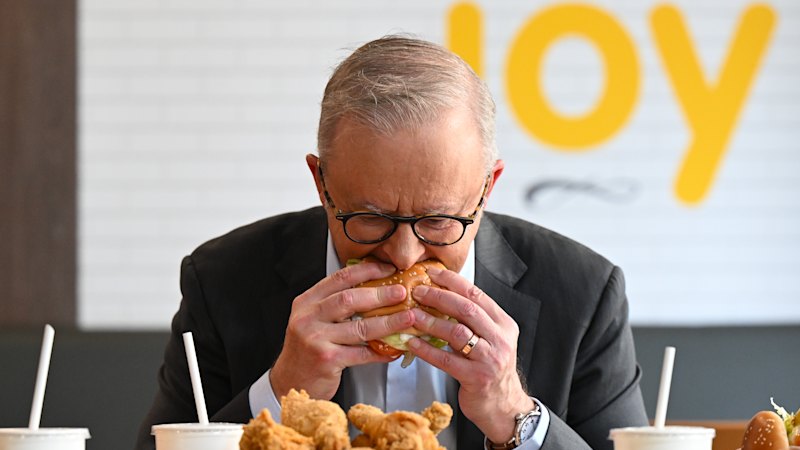
In a video posted to Albanese's Instagram, the prime minister celebrated with Jollibee staff and ate a meal at the fast food chain.
However, some social media users expressed confusion about the post and Albanese's endorsement of the chain, with one user commenting, "So, are you getting paid for this? Thought it was AI when I first saw it and can't believe it's for real."
Comedian and media personality Ben Sorensen commented on Albanese's video asking: "Was this a sponsored post?"
Politicians highlighting small businesses and large employers around Australia during election periods is extremely common, according to Emily Foley, a research fellow at the University of Canberra.
However, Foley told SBS News she hasn't seen this in a foreign affairs context before.
"I wouldn't say it's particularly common," she said.
Anne Nalder, founder and CEO of the Small Business Association of Australia, told SBS News the prime minister's promotion of Jollibee was "disappointing" at a time when small businesses in the food industry are "barely surviving" due to high costs.
Nalder also noted that around a third of small businesses in Australia are run by migrants.
"There's nothing wrong with an overseas company coming into Australia ... the thing about it is, I would like to see [the prime minister] concentrating on supporting Australian businesses because they need all the support they can get," she said.
Foley said there aren't any rules for politicians that would restrict a post like Albanese's, and his decision to post it likely comes down to a political calculation about appealing to Australia's Filipino diaspora.
"There is a bit of a grappling about what is acceptable for politicians to put on social media and the public sphere, but I don't think there's anything in particular that's necessarily frowned upon [in this case]," Foley said.
Whilst attracting critical comments, Albanese's video also received many supportive responses and attracted over 71,000 likes.
This is also not the first time the prime minister has encouraged a foreign business to enter Australia. During a meeting in the United Arab Emirates in 2025, Albanese visited a Lulu Hypermarket store — one of the largest retail chains in the Middle East, with over 250 stores across the region.
Albanese said at the time he had a discussion with Lulu Hypermarket chair Yusuff Ali as they walked around the store and invited the company to bring more competition to Australia's supermarket sector.
"They are the largest throughout the Middle East. Egypt, here ... the second-largest in Saudi Arabia," Albanese said.
"We know that Aldi, of course, has come to Australia, but this is a significant player that has an engagement with Australia, and I want to see that competition."
However, no plans have been announced for Lulu Hypermarket to enter the Australian market.
On Sunday, the Philippines and Australia signed a defence pact, strengthening ties between the two nations, which have grown over the past decade.
The agreement will step up maritime training and activities amid shared security concerns about China's growing militarisation of the South China Sea, particularly in an area deemed part of Filipino territorial waters by a UN arbitration in 2016.
Australia has taken part in 12 joint patrols with the Philippines in the South China Sea, with four in the last year.
However, Albanese insisted the defence agreement was not aimed specifically at any one country.
"This is about supporting the sovereignty of every country," he said.
While supporting the fried chicken chain is a demonstration of softer diplomacy than a defence pact, emeritus professor Paul Hutchcroft told SBS News the prime minister was likely trying to forge a connection between Australia and the Philippines.
"Jollibee is a source of pride for many Filipinos, competing successfully at home with American fast-food chains while also expanding overseas," he said.
"I can imagine that the PM was tapping into that sense of pride as a way of connecting with citizens of an important Australian ally."
Foley said Albanese's support of Jollibee has "interesting" foreign affairs implications as it highlights a "non-US, non-Western style business that's coming into Australia".
"It obviously speaks to the Labor government's real focus on trying to engage more with the Indo-Pacific, in particular highlighting things like ASEAN centrality — the kind of push to focus more on the political, economic and social ties and connections with neighbouring regional partners, rather than necessarily with the US."
— With additional reporting by the Australian Associated Press.