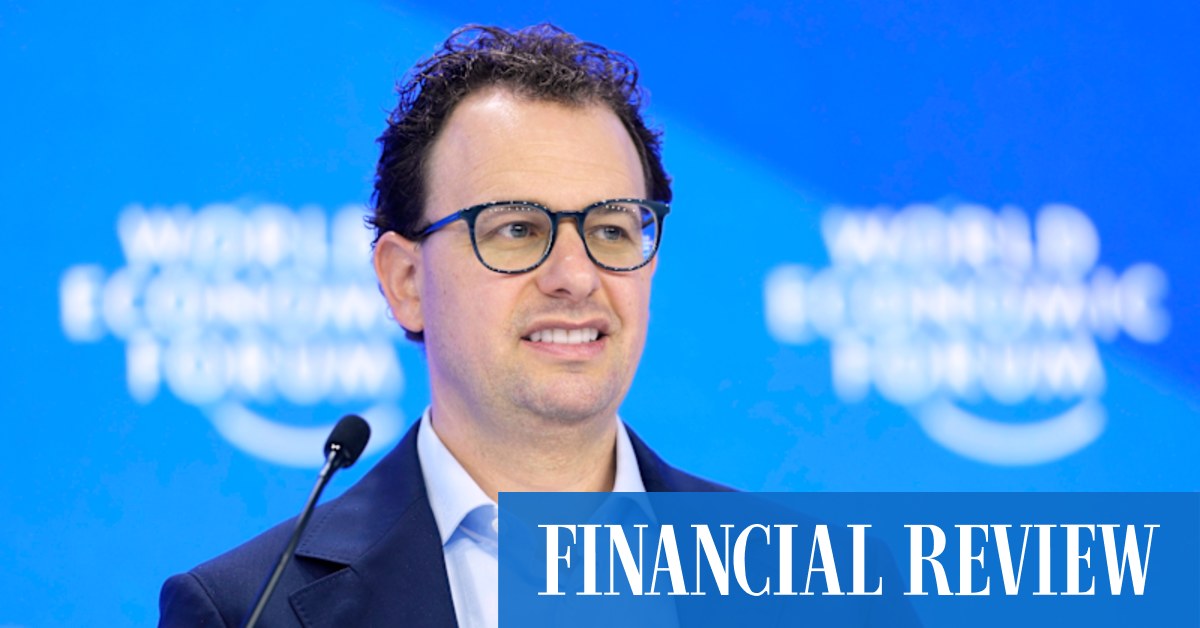
Boris Cherny loves to code. So much, in fact, that he once said coding is the reason most people choose to become engineers in the first place.
He’s also the reason why many tech workers may never have to write a line of code again.
Cherny, 35, is the creator of Claude Code, the wildly popular Anthropic coding agent that’s made the company a driving AI force. The agent can write code, run commands, and access files to accomplish work on a user’s behalf. Claude Code was a hit with programmers and non-programmers alike in Silicon Valley, giving Anthropic an early foothold in the workplace. The tool also paved the way for Anthropic’s AI tools to play a larger role in industries like finance, legal work, marketing and more.
Anthropic’s success has thrust the company into the middle of both the anxieties and optimism about AI’s impact on future jobs , and Cherny has embraced his place in that discussion.
“I think for the job market, in particular for engineers, it will be disruptive,” Cherny said in an interview with CNN earlier this year. “I hope that over the long term, it’s amazing for humanity and what it unlocks.”
Anthropic’s expected more than trillion-dollar initial public offering hinges on whether it can succeed in making Claude indispensable to office work.
And it all started with Cherny’s Claude Code.
“When people think about the IPO, they’re thinking, ‘Okay, how much room left does Claude Code have to grow?’” Willy Lee, principal at venture capital firm Neostellar, whose portfolio includes OpenAI and CoreWeave, told CNN.
Here’s how Cherny, whose official title is head of applications, became a critical part of Anthropic and the broader discourse over AI’s impact on jobs.
Cherny joined Anthropic in 2024 after a nearly seven-year run at Meta, where he worked in various divisions, including Instagram, Facebook Groups and the code quality team, according to his LinkedIn.
In 2022, during his Meta tenure, he and his wife temporarily moved to Japan for her work. Across the world from his colleagues in California, Cherny loved being able to code all day without the interruptions of meetings and project management tasks, he said on an episode of the tech industry podcast “The Peterman Pod” in 2025.
He was one of the few engineers in Meta’s Instagram division who was coding so much.
“For me, when I write code, I have an emotional relationship with it, and it’s something I think about when I’m really deep in a problem,” he said on the podcast. “I dream about it.”
He spent a month experimenting with Anthropic’s models after joining the company, he told “ Lenny’s Podcast, ” a show about product development. In his early days at Anthropic, he mostly built prototypes to test the boundaries of what the Claude maker’s AI could do.
But he reached a turning point a couple of months later when he created a command-line interface tool for Claude, which enabled the AI helper to interact directly with his computer’s operating system. Cherny made a simple request: figure out what music he was listening to.
He was shocked when the tool wrote code to answer that question without being specifically told to do so.
“The model was given this tool, and it figured out how to use it to answer this question that I had that I wasn’t even sure it could answer,” he said on “Lenny’s Podcast.”
That side project laid the foundation for Claude Code, which surpassed $2.5 billion in run-rate revenue in February. Anthropic doesn’t disclose usage numbers for Claude Code, but a chart in the company’s S-1 filing ahead of its IPO shows revenue ramping up following Claude Code’s release.
For Cherny, expanding Claude Code’s reach involves talking to real people about how they use the product. On X, Cherny replies to questions from Claude users on a weekly — sometimes almost daily — basis.
It’s a habit he formed long before joining Anthropic. When he worked at Meta in California, he often showed the cafeteria workers new features to see if they were able to figure them out quickly, he told “The Peterman Pod.”
“The thing that actually excites me is talking to people and understanding how we can make the product better,” he told CNN in March. “I’m just completely focused on that.”
Enterprise AI spending accelerated in late 2025 following Claude Code’s release to the general public in May, said Ara Kharazian, senior economist at financial services company Ramp, which tracks business spending on AI.
“That was the first commercially advanced version of AI that was directly productivity enhancing for a specific segment of jobs,” he said of Claude Code and other coding agents.
Anthropic’s coding tool served as a jumping-off point for Claude Cowork, the company’s AI agent for general office work that can manage files and automate tasks. The idea for Cowork came after Cherny observed people and companies using Claude Code for non-technical duties. Cherny himself uses it for paying parking tickets and project management work for his team at Anthropic, he said on “Lenny’s Podcast.”
Non-technical employees at the Mid-Ohio Food Collective frequently use Claude Code, according to Mark Mollenkopf, the organization’s director of software engineering. Its director of nutrition used Claude Code to build a game that’s like Tinder for food, aiming to help families choose healthier options based on their preferences.
They had the idea for nearly a decade; Mollenkopf says he still has photos of a whiteboard with the initial concept from 2017. But the team has been too busy with higher priority tasks until it’s been able to have Claude Code handle it.
“We’re not going to put it in production today yet, but it’s that unlock for us to be able to democratize great ideas that we’ve always had,” Mollenkopf said.
Anthropic built Claude Cowork in 10 days using Claude Code. It shows how important Cherny’s brainchild has been for Anthropic’s own growth, not just drawing in more customers.
Still, the company faces myriad challenges, including increased competition from OpenAI, reliance on a limited number of customers and pressure to live up to its sky-high valuation.
Meanwhile, Anthropic has played a fundamental yet complicated role in the AI boom.
The company has warned about the risks of AI, saying it’s capable of catastrophic consequences , yet it continues to charge ahead with new models. It worries that the economy isn’t ready for AI’s impact on jobs, yet it creates and iterates on tools like Claude Code and Claude Cowork for automating work.
Cherny is at the center of that paradox. Some software engineers have grown increasingly wary of AI’s role in their jobs, with six in 10 tech workers saying they actively try to avoid using AI , according to a recent survey of 30,000 programmers conducted by tech site Stack Overflow. Some believe the tech isn’t as capable as it’s been made out to be, while others feel AI’s role in tech has led to more burnout over the pressure to perform and stay up to date on the newest technologies.
Cherny has a lot of thoughts about what the future looks like. The job of a software engineer already involves doing a lot more than just coding; it entails working with designers and other teams, and figuring out what to build next. As AI takes over most coding tasks, engineers will be freed up to focus on these other parts of the job, he said.
That’s why he said in March that he thinks software engineering jobs are going to start disappearing by the end of this year.
“The (job) title will be maybe ‘builder,’” he told CNN. “Maybe we’ll still call them software engineers, but they’re going to do much more than engineers do today.”
Cherny has emerged as somewhat of an icon among developers and engineers like Mollenkopf, who said he watches podcasts featuring the Claude Code creator and others in similar roles to learn more about AI. That’s how Mollenkopf learned about Claude Tag, a feature that lets users connect work data to Claude and then tag the AI helper in Slack.
Mollenkopf said he would be “a total fanboy” if he could ever meet Cherny.
What Cherny can’t predict is how long that shift could take. It’s almost the end of 2026, and software engineering jobs still exist – although they likely look different than they did several years ago.
But if there’s one thing he learned during his time in Japan, it’s how to think long-term.
He remembers learning to make miso, a traditional Japanese seasoning made by fermenting grains like soybeans and barley, to bond with his neighbors. It’s a hobby that starkly contrasted the fast-paced tech world Cherny was used to: a single batch could take months to make.
“Miso is this interesting thing where it teaches you to think on these long-time skills,” he said. “…You just have to be very patient.”