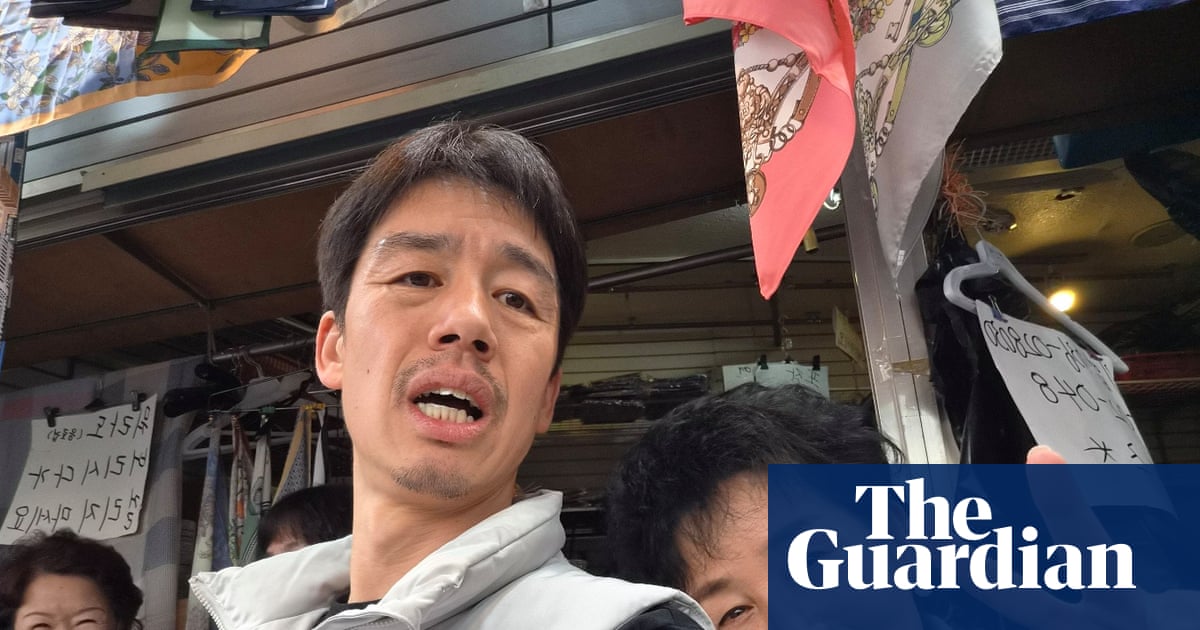
Most shopkeepers will do just about anything to make a sale.
But one merchant in Seoul has built an unexpected internet following by doing the exact opposite.
“Didn’t you come here knowing that we sell nothing but crappy stuff?” he asks customers in a video shared on social media. “Didn’t you all come here to buy scarves for your doghouses?”
His unorthodox sales strategy is the opposite of the hard sell. Instead of talking about how great his products are, he tries to convince shoppers they don’t need a scarf at all. He complains about their requests, pokes fun at their shopping habits and occasionally suggests he might be better off quitting the business altogether.
Maybe it’s reverse psychology. But it’s working.
Hundreds of people have been flocking to his small shop inside Seoul’s sprawling Namdaemun Market for a chance to meet the man behind the viral videos. The international travelers joining the queue may not even be able to understand his Korean-language zingers, but that doesn’t stop them from showing up anyway.
The scarves themselves are hardly a luxury purchase. Six sell for 10,000 won, or about $7. But it seems the merchandise isn’t the point.
Namdaemun is one of Seoul’s most recognizable traditional markets, a maze of hundreds of shops and stalls. Vendors of clothing, handbags, shoes, household goods and snacks all push up against each other, competing for space. For generations, it has been a place where merchants and customers haggle, bargain and build relationships face-to-face.
Videos of Scarf Man’s colorful exchanges with customers have spread across social media, earning him more than 100,000 Instagram followers and a growing audience on YouTube.
His online popularity has even translated into a new online store, where customers can purchase his scarves without making the trip to Seoul. The first batch of products sold out within 24 hours. Fittingly, Scarf Man has since asked customers to cancel their orders because he received too many.
Still, plenty of fans would rather see the man in person.
Some visitors have traveled considerable distances, only to find his shop closed or the day’s customers already turned away.
Ahn Hyo-sun traveled across Seoul to visit the shop after repeatedly watching clips of Scarf Man online. She arrived hoping to meet him, but missed her chance.
“I heard his voice earlier, so I got really excited thinking he must be here,” she said.
The vendor’s humor provides a welcome pick-me-up. Followers compare his entertaining, occasionally foul-mouthed remarks to those of a hilarious grandmother.
“Listening to this man’s funny banter gives them a kind of happiness boost,” she said.
Another customer, Cho Yoon-sook, traveled roughly an hour and a half from Incheon, west of Seoul, hoping to catch a glimpse of him. She had already been turned away once after arriving too late.
“Maybe I’ll come back tomorrow,” she said. “I’ve made up my mind to come all this way, so I have to see him at least once.”
Cho said she wasn’t particularly interested in the scarves — just in the Scarf Man.
“There’s something endearing about the way he talks,” she said.
For all the attention surrounding him, there’s still plenty about Scarf Man that remains unknown — like his name. In a livestream on social media he shared that he’s married with children and has been selling various products at Namdaemun for years, but that’s about all we know.
Even figuring out when his shop will be open has become something of a guessing game. CNN tried visiting three days in a row this week, and only on the last day did we briefly catch Scarf Man as he closed up his store. As he did so, people watched in awe, with their cameras out, cheering when he turned and gave a quick smile.
These days, it seems like everyone is chasing viral fame, or eager to embrace it if it comes along.
In Italy, Venetian Monica Poli became a social media sensation after she took it upon herself to warn tourists when they were about to be pickpocketed . Poli’s Attenzione, pickpocket! warning became an oft-shared earworm online, and she told CNN that she appreciated being thanked for the work she calls her “mission.”
Meanwhile, a good-looking Istanbul native named Alper Temel became a viral celebrity while selling corn and chestnuts at a roadside stall with his brothers. Online fans dubbed him the “ corn star ” and began flocking to the stall to get selfies. Temel has taken the attention in stride, and the family business is booming.
But Scarf Man doesn’t seem to be chasing the influencer dream.
He has turned down myriad interview requests, including from CNN.
In an age where social media can turn just about anyone into a celebrity, this merchant has found an odd but effective way to stand out: telling people his products aren’t worth buying.
Judging by the lines outside his shop, customers aren’t listening.