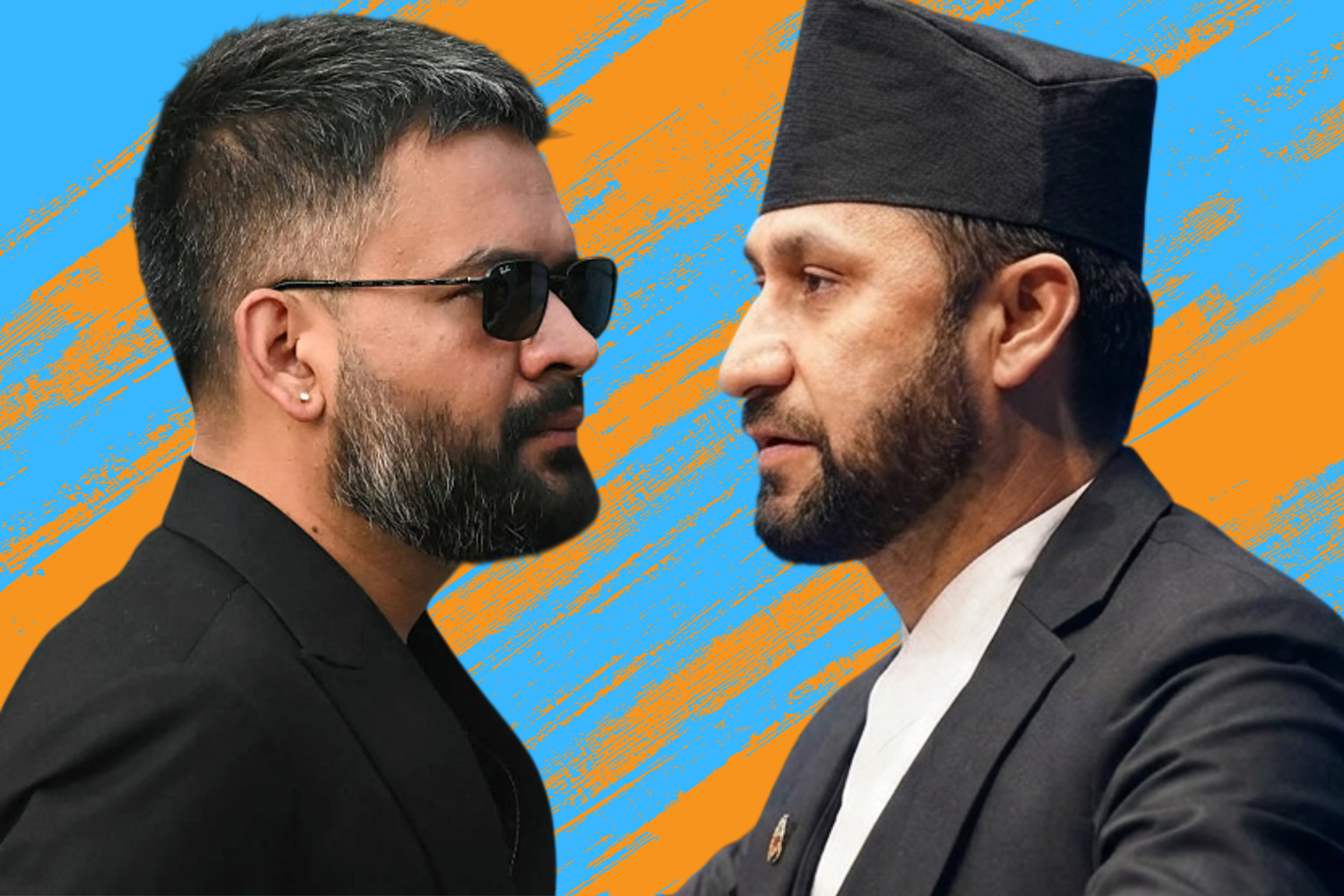
On November 6, speaking in Chitwan, Rabi Lamichhane questioned two decisions of the government : the transfer of Nepal Police chief Dan Bahadur Karki and the detention of journalists. Balendra Shah is the prime minister who answers for those decisions. Lamichhane is the party chair who suggested, in the same speech, that the party could step in. Media coverage read the moment as a possible clash between the two men, while Lamichhane used the occasion to defend their relationship.
Behind that speech sits a question the Rastriya Swatantra Party (RSP) has avoided since the day Shah joined it: who is the real prime minister of Nepal? The Constitution points to one man, and a party statute approved in June hands extraordinary power to the other. The controversy over Chitwan has subsided, yet the question has outlived it. How the RSP answers will decide whether its 182-seat majority becomes a government or a standoff.
Shah joined the RSP on December 28, 2025, under a seven-point agreement with Lamichhane that split the work. Lamichhane would run the party organisation. Shah would lead the parliamentary wing and carry the party’s banner as its prime ministerial candidate. Each brought what the other lacked. The RSP offered an election platform, and Shah offered popularity and a name for integrity built in urban governance, first as an independent who won Kathmandu’s 2022 mayoral race after a start in music. On March 5, voters handed the party 182 of 275 seats .
Public hopes rested on that arrangement. A party that wins on trust owes its voters a programme, and a government that rides that trust owes them delivery. Party guidance on political goals is fair game, while interference in government decisions is where the line falls. Read generously, Lamichhane’s Chitwan remarks amount to oversight of decisions that raised legal and accountability concerns. His suggestion that the party could intervene is another matter, since oversight with no stated limit turns into a veto.
The two men reached the party through different doors. Lamichhane came from journalism and television campaigns on public grievances and institutional failures, then founded the RSP, and his influence draws on party leadership and mobilisation. Shah’s standing comes from a record in running a city. Those bases may complement each other, though they also invite competing expectations about who decides what.
The statute approved at the June 2026 general convention gives those expectations a legal shape. It allows the chair to issue policy directives to the parliamentary party leader and to remove the leader for non-compliance. Shah leads the parliamentary wing, which places the prime minister within reach of both provisions. The chair also nominates 51 of the 158 Central Committee members , a share that leaves the independence of other party bodies open to doubt.
Beneath the Centre, the organisation is thin. In Madhesh, the RSP won 57.33 percent of proportional representation votes , yet seven of the province’s eight districts had held no district convention before the June gathering, and delegates attended under temporary arrangements. With authority gathered at the top and local structures weak, coordination slows, decisions drag, and accountability slackens. Attention drifts toward managing the party just as households wait on decisions about jobs, migration, infrastructure, education and healthcare.
Nepal has watched this play out before. In 1999 , a conflict between Nepali Congress president Girija Prasad Koirala and Prime Minister Krishna Prasad Bhattarai ended with Bhattarai’s removal before his government finished its term. After the 2018 unification, the Nepal Communist Party commanded a near two-thirds majority and still frayed under the quarrel between KP Sharma Oli and Pushpa Kamal Dahal. In both cases, a commanding majority proved no substitute for agreement at the top.
Talk of a rift between Shah and Lamichhane circulates in the media and the public mind, with names such as Dol Prasad Aryal and Swarnim Wagle drawn into it. Evidence of two organised factions remains insufficient. Posts, appointments, access to powerful networks and influence over policy give leaders ample reason to compete without any formal camps.
The RSP can still settle the matter on its own terms. It needs to define, in writing, the roles of the chair, the parliamentary leader, the government and the secretariat, with the party supplying oversight and the government holding the executive decisions the Constitution assigns to it. Regular consultation, clear accountability and fully functioning party structures would give those roles substance. Until then, each transfer order and each arrest will revive the question Chitwan raised, and the answer will keep depending on who is speaking.
Gurung is a political sociologist with a PhD in Nepal’s land rights movement.
.png)