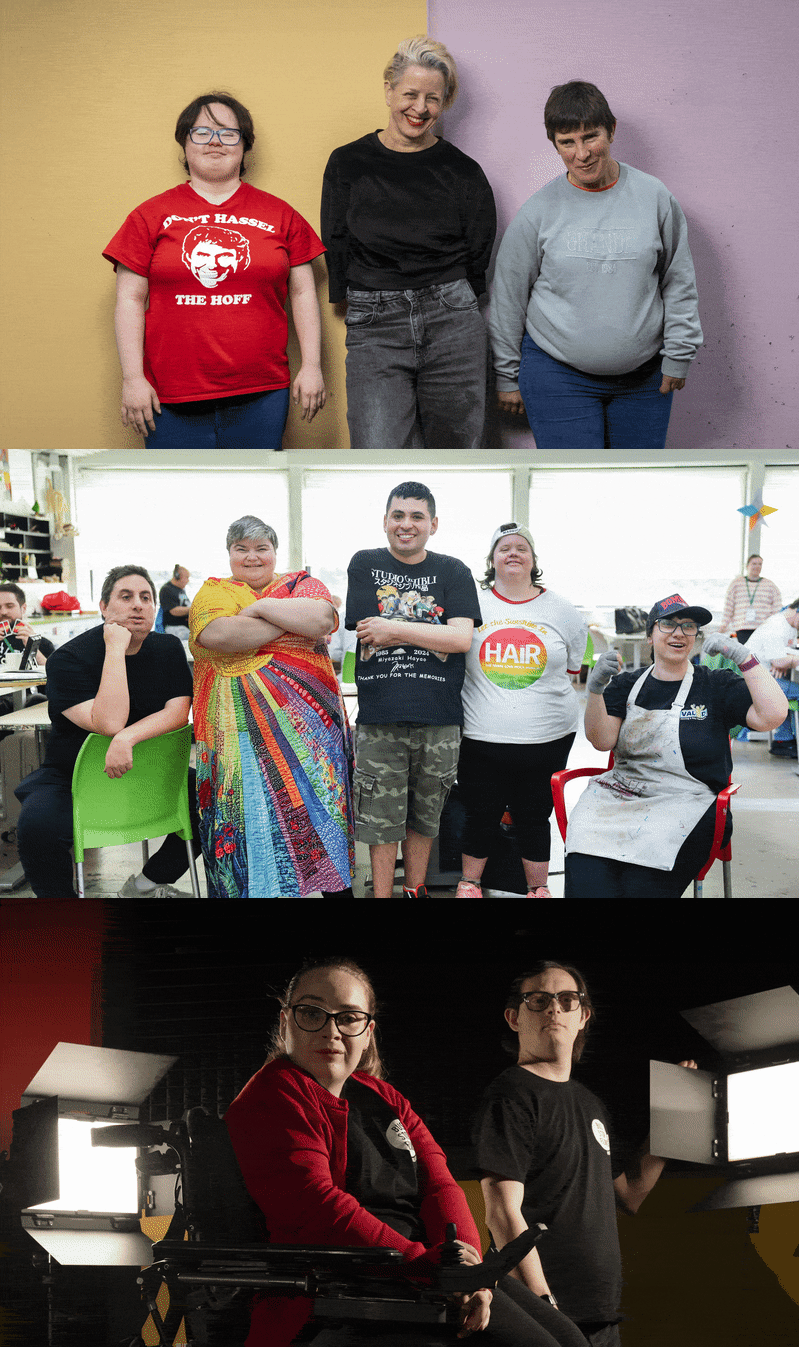
Michael Smith and Lij Bolden found the community they had been looking for through CROOKED. (Image: Emma Jones, ABC North Queensland) ( ABC News: Emma Jones )
Townsville is known for humidity, rugby league, and its unofficial status as North Queensland's capital.
Its queer culture is less visible, but that is changing as more people create the communities they once had to leave regional Queensland to find.
Michael Smith knows that experience well.
The professional dancer grew up in Gladstone before moving to Brisbane.
"Growing up as a queer person in a regional place, I didn't have any elders or community members to paint a picture of what a queer life could be," they said.
Mx Smith grew up in Gladstone before moving to Brisbane, but later returned to regional Queensland. ( ABC News: Isabella Garrido )
Years later, Mx Smith returned to regional Queensland.
"There's actually a really large queer and trans community in Townsville," they said.
"There just aren't many things that are overtly visible that bring everyone together."
Finding a queer community did not necessarily mean Mx Smith found where they felt most at home.
Rather than leave, they began wondering how else a queer community could look.
With writer P. Eldridge, they created CROOKED, an independent queer publication — due to launch on November 14 — rooted in Gurambilbarra, the traditional Wulgurukaba name for Townsville.
The project quickly revealed there were others also looking for a different way to connect.
Lij Bolden participated in writing workshops to prepare their written piece for CROOKED. ( ABC News: Emma Jones )
Writing for CROOKED gave Mx Bolden the chance to tramp down memory lane.
"It's peppered [with] vignettes of my life and realising I'm queer and discovering other people like me," they said.
They reflected on the parts of themself they had once kept hidden.
"I got to sit in that space and relive my queerness in a place where I did feel lonely and unseen, but realising that maybe I've had that queerness in me this entire time," Mx Bolden said.
Greater visibility, however, can come with risk.
"With the amount of political divisiveness and extremity in the world, it takes effort to be neutral," Mx Smith said.
That risk became reality at a Townsville Pride event in June 2025, where Mx Smith was preparing to perform when a small group disrupted the event.
An attendee who asked the group to leave was allegedly assaulted.
"It had been a long time since I had felt that kind of hostility targeted towards a specific group of people," Mx Smith said.
The experience reinforced for them why visible signs of safety mattered.
"As a young queer person in a regional place, you can be hypervigilant in public, constantly assessing every room you step into, looking for danger and looking for safety," they said.
"If someone has gone to the effort of putting up a [pride] flag, it takes a little of that social anxiety and pressure off your shoulders."
Queensland Council for LGBTI Health chief executive Rebecca Reynolds agreed visible signs of welcome mattered but said what followed was just as important.
Rebecca Reynolds says belonging also means having room to be the whole of who you are. ( Supplied: Queensland Council for LGBTI Health )
"Visible inclusion needs to lead to something people can use: a welcoming person, clear information, an activity they can join or help reaching the right support," she said.
Research suggests knowing a community exists is not necessarily the same as feeling part of it.
A 2025 University of Southern Queensland study of 87 LGBTQ+ people in the Toowoomba region found participants wanted safety, support, acceptance, friendship and connection.
Ms Reynolds said everyday recreational groups could foster connection across the year, beyond larger moments of visibility such as pride events.
"These spaces can take many forms, shaped by the people who use them. What matters is that people can find somewhere that feels right for them."
For Ms Eldridge, those spaces should grow from the places they serve.
Writer P. Eldridge helped create CROOKED, an independent queer publication. ( Supplied: P. Eldridge )
"I'm deeply suspicious of the idea that interesting queer culture only happens in capital cities because it doesn't," they said.
"Gurambilbarra has its own queer histories, its own ways of surviving and making community that I think we, as a culture and a movement, can benefit from listening to.
"CROOKED came from wanting to listen to that rather than parachuting in with an idea of what regional queer life should look like."
Ms Eldridge said trans and queer writing had its own lineage, one that was still being defined, shaped and expanded.
"I believe that means there's no reason to confine ourselves. We can pretty much make anything new whenever we want," they said.
"I don't want to mitigate how dangerous regional life can be because of the backward turn toward fascism, but I will say that in the midst of so many crises, there is even more strength, solidarity and hope."
CROOKED, an independent queer publication, is due to launch on November 14. ( Supplied )
Mx Smith said they felt a responsibility to make visible what they could not see growing up.
"CROOKED is the messier version of queerness," Mx Smith said.