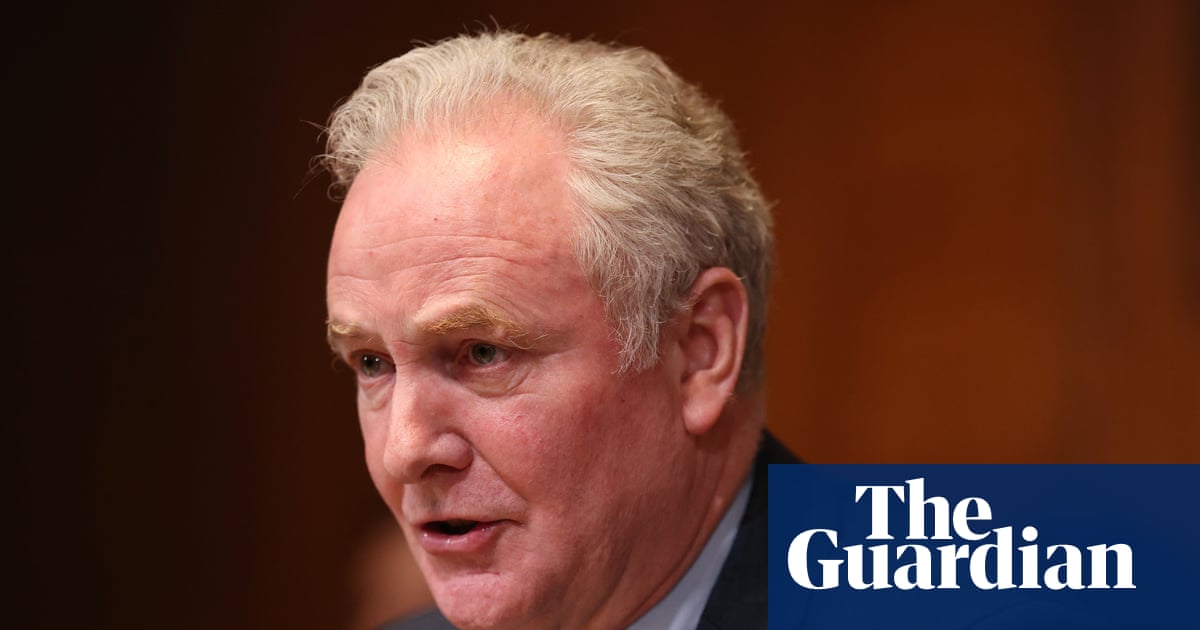
A Democratic leadership tilt between a 70-something Chuck and a 60-something Chris hardly screams of the torch-passing moment many activists crave.
But in the US Senate, “generational change” is a relative term.
Still, Maryland Sen. Chris Van Hollen’s challenge to Sen. Chuck Schumer’s leadership of next year’s Senate Democratic majority is more significant than it might seem. To start with, it suggests that the magnitude of the Democratic triumph is already changing the party.
“We saw a huge outburst of democracy on Election Day. Red states, blue states, purple states,” Van Hollen said on MS Now, arguing that the result went deeper than an anti-Trump backlash. “The call was really to reject the status quo and to reject business as usual. And to do that, I think we need new leadership.”
The role of leading 55 and possibly 56 Democratic senators next year will be crucial in what is already shaping up as a vicious tussle with President Donald Trump during his final two years in office.
This is also more than a Beltway popularity contest. It reveals a party still digesting the meaning of its shockingly broad midterm election victory and working out what to do with it. The contest will showcase disputes over ideology, tactics, policy and the frustrated aspirations of Democratic rising stars, which intensified after the election produced a governing coalition that is far more philosophically and geographically diverse than anyone expected. And it shows that tensions between the base and the party’s Washington leaders will be a leitmotif of the run-up to the 2028 election.
Schumer, a five-term senator from New York, is a strong favorite, and says he’s confident that he will win the leadership election on December 1. But unlike his Republican counterpart, current Majority Leader John Thune, who was swiftly reelected to head his party despite the GOP defeat, Schumer will now face a leadership race that could raise questions about his authority even if he wins.
Van Hollen has emerged as a surprise vessel for progressives and some newer members of the incoming Democratic minority who want more dynamic leadership — or at least want to push Schumer toward a more aggressive posture. A Van Hollen vs. Schumer showdown will also lay bare the divide over Israel wracking the party. The Maryland senator has harshly criticized Israel’s operation in Gaza, while Schumer has long been one of the Israeli government’s most outspoken supporters in the Democratic Party.
The prospect of a leadership face-off gained momentum earlier this week when Sen. Bernie Sanders, a progressive icon, and Michigan Sen. Elissa Slotkin, a moderate pragmatist, held a joint Capitol Hill news conference .
“I like Chuck. Nobody … works harder than Chuck Schumer. But in my view, the time is now for change and I will not be supporting Chuck to be reelected as the Democratic leader,” said Sanders, a Vermont independent who votes with Democrats. Slotkin added: “We need a new generation of leadership … Senator Sanders and I disagree on some items, but we agree on the need for change.”
Senate power is accrued over decades. But a brash new intake of Democrats elected in an anti-Trump backlash is immune from the chamber’s clubby traditions. Schumer has led Senate Democrats through minority and majority periods for a decade. By definition, he’s hardly an avatar of change. Many activists also believe he was too passive in the first two years of Trump’s second term. He was accused of betrayal when a group of Democrats joined Republicans in voting to end a government shutdown without securing their demands for an extension of enhanced Affordable Care Act subsidies .
Now, the most progressive Democrats in the Senate view the massive midterms triumph as the moment to push for far more expansive reforms.
“I don’t want to take anything away from Senator Schumer. He’s put a lot of effort into helping to architect the majority that we are going to enjoy in the next two years,” Michigan Sen.-elect Abdul El-Sayed told CNN’s Kaitlan Collins on Tuesday. “But I do think that this moment calls for a different kind of leadership. When my state spoke up, they were asking for money out of politics, money in your pocket, Medicare for All. They wanted action.”
El-Sayed, a progressive, may see little reason to shield the party’s establishment. He won a bitter primary against Rep. Haley Stevens, who Washington leaders had viewed as best placed to win in November. Now he’s backing Van Hollen.
Some critics see Schumer, as a quintessential New Yorker, as unrepresentative of the geographical sweep of the new majority, which will welcome new senators from previously red states like Texas, South Carolina, Mississippi, North Carolina and Iowa. Such candidates ran as much against their own party’s leadership and the cultural positions of progressives as against Trump. They’ve got little incentive, then, to make a vote for Schumer their first act in Washington.
New Mississippi Sen.-elect Scott Colom told Jen Psaki on MS NOW after the election that it was hardly ideal that both Schumer and the presumed next Democratic Speaker Hakeem Jeffries “live in the same borough.” He added: “Too many our leaders are from the same areas of the country. … I want someone who understands rural America, understands our values, understands our needs.”
Colom has a point. But Congress is an institution that processes change slowly. That’s especially true in the Senate, where members serve six-year terms. Logically, there’s a case for fast-tracking a member of the new intake straight into a leadership post. But Democrats already in line would complain. Still, if the party hopes to succeed, it will need to find a way to accommodate cultural and ideological priorities of the freshmen who delivered its large majorities.
The most important quality in a Senate leader is a flair for counting votes. And Schumer sought to tamp down the possibility of a Democratic revolt by publicly expressing assurance that he has them.
“I’m confident I will be elected majority leader. And our caucus is really united in focusing on bringing down costs, on ending the corruption, on ending the chaos, on ending the war. We have great unity in our caucus,” Schumer said Tuesday. On Thursday evening, he welcomed a contest of ideas and repeated his assurance that he had the votes.
He may be exactly right. Secret voting for the Democratic leadership will mean that senators can say what they like publicly — but their choice will be between them and the ballot box. This means that senators could make a show of standing up to the establishment while offering private assurances of support.
The leadership contest is another unwelcome twist late in Schumer’s long career. The possibility that he could face a primary challenge in 2028 from progressive Rep. Alexandria Ocasio-Cortez has already fueled speculation about his possible retirement.
Some Democrats — especially those who’ve been around for a while — argue that dumping Schumer as leader would be unfair and unwise. “When the manager takes you to the World Series, you give him another contract,” Arizona Sen. Ruben Gallego said this week.
Schumer’s fellow Empire State senator, Kirsten Gillibrand, said he should be rewarded for recruiting a great class of candidates and raising hundreds of millions of dollars to back them. “That is why you will see, despite all the grumblings, enormous gratitude for the hard work he has done to get us to this position,” she said. Gillibrand also pointedly noted that she and Schumer took part in a fundraiser a year ago for Colom.
The Senate chamber, with its impenetrable codes, is no place for rookie. A bitter internal fight right at the moment when Democrats finally won back power would only confirm the party’s reputation for self-sabotage.
And some demands for change may be simply undeliverable. Even if Democrats were to shatter Senate tradition by eliminating the filibuster that requires 60 votes for most major legislation, they’d still run in to Trump’s veto. Their best bet may be a long game that positions them to win back the White House and maintain their congressional majorities in 2028.
But that won’t placate vocal demands for immediate change.
So it’s quite possible that Schumer will become Senate majority leader again. But after 2028, calls for fresh leadership may become irresistible.