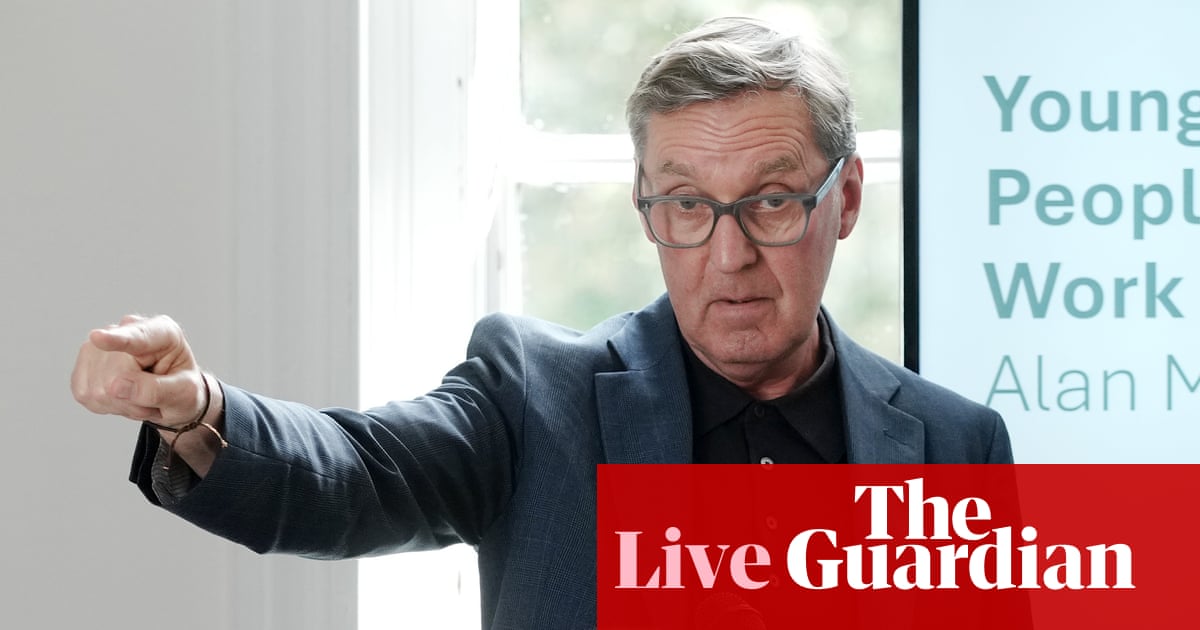
Milburn’s review is considering how to address the growing number of young people classified as not in education, employment or training
The Alan Milburn report on youth unemployment, or Neets (young people not in education, employment or training), is expected to lead to the biggest overhaul of the welfare system for at least a decade (when Iain Duncan Smith merged six different benefits into universal credit). Arguably, it could be even bigger.
It is certainly the most heavily-trailed benefits reform plan in recent history. Milburn, a former Labour cabinet minister, began pitch-rolling with the publication of an interim report in May . Unusually for a Westminster document, it was a compelling read, and was widely praised at the time . Since then, barely a week has gone by without Milburn dropping further hints about what the final report will say. Milburn says he has government backing for what he is recommending and he wants this to be a blueprint for legislation, not a set of recommendations ultimately ignored by ministers.
We still won’t get the final report until next week, but in his interview in the Times today he has given the fullest account yet of what he will propose.
This is how Steven Swinford sums up the plans in his write-up of the interview.
double quotation mark Under [Milburn’s] proposals, young people aged 18 to 24 would be barred from claiming the two main sickness and disability benefits: the health element of universal credit and personal independence payments (Pip).
They would instead be given a new youth allowance , which would be paid at the standard rate of universal credit, while billions would be invested in one-to-one employment support to get them into work.
Many of those who currently receive Pip would be moved on to a new benefit called the “additional cost allowance”. It would be paid to those with “significant, well-established and ongoing” costs relating to their disability.
Covering assistance, mobility, specialist transport or daily living support, the allowance would go to a smaller cohort than the 453,000 young people currently claiming Pip. It would not be means-tested and people would receive the money “regardless” of whether they were in work or not.
The most severely disabled individuals — those with “profound” and “lifelong” conditions who can never be expected to work — would be given a new benefit. It would be paid at a higher rate than current disability benefits and would have no waiting period.
Here are more quotes from what Alan Milburn told the Times about the proposals in his youth unemployment report, which is being published next week.
Milburn said he concluded fundamental change was needed. He said:
double quotation mark The whole system needs to be changed, because the system is geared to keeping people inactive when, for young people in particular, it’s all about how can you make them active, get them earning, learning, so that they can rely on a wage rather than on a benefit. So, this is not about cutting one benefit, it’s about rebuilding the system from scratch.
He said that he decided existing claimants should be covered by the changes, not just new changes.
double quotation mark It’s a big rewriting of the welfare system. And obviously one of the conundrums was, ‘Should this apply to only new claimants?’
I came to the conclusion that wouldn’t be right, not least because you’ve got hundreds of thousands of young people stuck in a benefit system that is trapping them in poverty, giving them no prospect of prosperity or a job.
That conclusion makes it difficult politically because it means people are getting a current entitlement and that entitlement is going to change. But it needs to.
It is relatively normal for welfare changes to cover existing claimants as well as new ones. But governments seeking to cut benefits do often restrict those changes to new claimants because people are much more likely to complain about losing something they already get than about losing something they might notionally get in the future.
Milburn admitted this meant the plans would not be “pain-free”.
double quotation mark I’m not saying that any of this will be easy or that it will be pain-free because it won’t. You know, candidly, it could mean that some people will get less financial support at the beginning of their benefit claim than under the current system.
He said he wanted the system to prioritise improving people’s life chances in the long term over easing their financial hardship in the short term.
double quotation mark Actually for young people there’s a different debate that we’ve got to resolve, which is whether the priority is their longer-term life chances or just their immediate shorter-term finances.
I think what the current system does, it prioritises the latter over the former. I believe that’s the wrong choice and it needs to be the other way around.
The approach I’ve taken on this is to try to define what would give young people the best chance of building a good life, not just over a year or two, but over the course of their lifetimes.
He said, alongside the cuts to benefits he is proposing (see 11.56am ), he wanted to improve employment support for young people.
double quotation mark We need to make sure people have the opportunities to get an apprenticeship, a job, a work placement, a pre-apprenticeship, a college place.
The menu of opportunities has got to increase. They’ll have a personal adviser, they’ll be coached all the way through. The adviser will stick with them until they have found a job or an apprenticeship or college place.
He also confirmed he wants to let young people do some work before they start losing benefits.
double quotation mark They will get immediate access to support if that’s what they need, if that’s the thing that is holding them back from being in education or training.
He admitted that offering better employment support and mental health support would mean his plans would initially cost money. According to the Times, he did not did not deny claims the whole package could cost £6bn. But, in the long run, there would be savings, he said.
double quotation mark Obviously this costs money. And frankly it’s a better use of money, both from the point of view of the young person and the taxpayer, to spend that money getting them into work rather than spending that money keeping them on benefits.
This is the sort of fatuous thing about this debate. You’ve got to invest upfront in order to get savings out of the back end. Cost-free is fatuous. So we’ve got to be candid about that. It will need significant investment.
When it was put to him that it could take a decade for the savings to materialise, he replied:
double quotation mark To get a return on investment will take time … the only way of cutting the benefits bill sustainably is by getting young people into work, paying their taxes and being less reliant on benefits. Unless you are prepared to put the investment upfront it will never be possible.
He said he was “confident” that Andy Burnham was full-square behind the changes that are needed.”
The Alan Milburn report on youth unemployment, or Neets (young people not in education, employment or training), is expected to lead to the biggest overhaul of the welfare system for at least a decade (when Iain Duncan Smith merged six different benefits into universal credit). Arguably, it could be even bigger.
It is certainly the most heavily-trailed benefits reform plan in recent history. Milburn, a former Labour cabinet minister, began pitch-rolling with the publication of an interim report in May . Unusually for a Westminster document, it was a compelling read, and was widely praised at the time . Since then, barely a week has gone by without Milburn dropping further hints about what the final report will say. Milburn says he has government backing for what he is recommending and he wants this to be a blueprint for legislation, not a set of recommendations ultimately ignored by ministers.
We still won’t get the final report until next week, but in his interview in the Times today he has given the fullest account yet of what he will propose.
This is how Steven Swinford sums up the plans in his write-up of the interview.
double quotation mark Under [Milburn’s] proposals, young people aged 18 to 24 would be barred from claiming the two main sickness and disability benefits: the health element of universal credit and personal independence payments (Pip).
They would instead be given a new youth allowance , which would be paid at the standard rate of universal credit, while billions would be invested in one-to-one employment support to get them into work.
Many of those who currently receive Pip would be moved on to a new benefit called the “additional cost allowance”. It would be paid to those with “significant, well-established and ongoing” costs relating to their disability.
Covering assistance, mobility, specialist transport or daily living support, the allowance would go to a smaller cohort than the 453,000 young people currently claiming Pip. It would not be means-tested and people would receive the money “regardless” of whether they were in work or not.
The most severely disabled individuals — those with “profound” and “lifelong” conditions who can never be expected to work — would be given a new benefit. It would be paid at a higher rate than current disability benefits and would have no waiting period.
The Green party has said it is opposed to the proposal from Alan Milburn for many young people to lose sickness or disability benefits. (See 10.35am .)
Commenting on the proposals, revealed by Milburn in an interview in the Times, Siân Berry , the Green MP and the party’s work and pensions spokesperson, said:
double quotation mark So the solution to young people without education or jobs is to continue demonising young and disabled people instead of addressing the structural inequalities stacked against them?
What is the point of a deep review like this if the conclusion is that the government goes on blaming young people for needing help?
The prime minister must remember that social security is a human right whatever your age.
More than 3,500 patients a day received care in hospital corridors or makeshift treatment areas in England last month, as other figures show the NHS is already facing growing pressures before winter has arrived, the Press Association reports. PA says:
double quotation mark The waiting list for hospital treatment has also risen to its highest level in nearly a year.
Officials said this autumn has been the “busiest ever” for the health service, with record numbers of people attending A&E.
The latest performance data from NHS England shows an average of 3,558 patients received corridor care each day in October, with 2,718 in A&E departments and 840 in other hospital areas.
This is up from a revised average of 3,310 patients a day in September and the highest since figures for corridor care started being collected in May.
Prof Nicola Ranger, general secretary and chief executive of the Royal College of Nursin g, called the figures “a mark of shame”.
She said: “Nursing staff will be filled with dread thinking of just how bad things will get as temperatures drop.
“The data shows once again that corridor care is occurring not just in emergency departments but across hospitals. This is an incredibly dangerous situation with much colder temperatures on the horizon.”
Liberal Democrat health spokeswoman Helen Morgan claimed the “true scale of the crisis is likely far worse”.
She added: “We are hearing troubling reports of trusts reclassifying spaces to keep the numbers down.
“Hospitals are under pressure to hit targets rather than put patients first. Patients on chairs in waiting rooms or in converted cupboards deserve to be counted.”
In emergency departments, some 74.0% of patients were seen within four hours in October, down slightly from 74.4% in September.
Elsewhere, an estimated 7.38m treatments were waiting to be carried out at the end of September, relating to 6.24m patients.
This is up slightly from 7.37m treatments at the end of August and is the highest since the list stood at 7.40m treatments in October 2025.
The figure for patients is broadly unchanged month on month, but is also at a level that was previously seen in October 2025.
Good morning. I’m Andrew Sparrow , taking over from Taz Ali.
Andy Burnham won’t arrive in Dublin for his meeting with other leaders from the European Political Community (the EU plus non-EU states in Europe) until this afternoon, but it is the first time he has met many of them, and they are anticipating his arrival.
Kaja Kallas has said she would “very much like to see Britain back in Europe”, but warned there is “a lot of … trauma from Britain leaving” that could affect any reset talks.
double quotation mark So the negotiations will not be that easy, but I think we can take the little steps. And I’m confident that if we are together, we are much stronger when it comes to economy, but when it also comes to security.
Over in Dublin, where the European Political Community summit is taking place, European parliament president Roberta Metsola told journalists she would do “anything in my power” to turn the political intent behind the announced UK-EU reset plan into “very tangible steps”.
“We have a very solid UK-EU parliamentary assembly and partnership, and that is the partnership that we will be using in order to make sure that any agreement and all measures that are taken next week during the [EU-UK] summit will be implemented through majorities in parliament,” she said.
“That is what I hope for, and I am extremely optimistic in that regard,” she added, describing herself as “a big fan of the United Kingdom”.
For more updates from across Europe, follow our live blog here:
“Britain is back and ready to play its full part,” Andy Burnham has said at the opening of today’s Cop31 summit.
The UK prime minister celebrated domestic clean energy projects including windfarms and electrified steel factories, stressed the need to make the transition affordable, and announced the UK’s first special representative for climate security , Madeleine Alessandri.
“The climate crisis is not a distant threat, it is upon us now, devastating lives and livelihoods everywhere,” he said. Pointing to the effects of two global wars on energy prices, he added that the “common thread running through all of this is fossil fuels.”
Burnham repeated the UK’s commitment to meeting its 2050 net zero emissions target and said he would work with all of partners to reach theirs.
“In that spirit, I am proud to support this Cop’s focus on electrification,” he said. “If we depend on energy we do not control, we depend on prices we cannot control. The shift to clean energy is the only route to energy security.
He called on industry to “play their part” in helping people on all incomes make the green transition. He highlighted progress in bringing the price of clean technologies down for consumers.
“If you drive a new electric car today in the UK, it costs less than a petrol equivalent. Get on the right tariff and a heat pump can be cheaper to run than a gas boiler.”
But he also warned that some of the fundamentals had worsened.
“The consensus we once enjoyed on science is gone,” said Burnham. “And the reality is the world will breach the 1.5C target.”
For more updates from the fourth day of the climate summit in Turkey, head over to our Cop31 live blog here:
Good morning and welcome to the UK politics live blog. Young people could lose entitlement to the main sickness and disability benefits under a significant overhaul of the welfare system , according to proposals expected to emerge from the government-commissioned review into young people and work .
Led by former health secretary Alan Milburn, the review is examining the barriers preventing young people from entering the workforce and how to address the growing number classified as not in education, employment or training (Neet), which currently stands at about 981,000 across the UK.
The review, which has been under way for a year, is expected to include proposals that would remove under-25s’ entitlement to the health element of universal credit and personal independence payment (Pip), replacing them with a standard-rate youth allowance. Under the plans, first reported by the Times , those with additional needs arising from a disability would receive a separate, non-means-tested allowance, while those with severe disabilities and who are not capable of working would qualify for a higher rate.
Speaking to the newspaper, Milburn acknowledged that the changes would not be “pain-free”, admitting some young people could initially receive less financial support than under the current system. The final review is due to be published on Tuesday.
Prime minister Andy Burnham addressed world leaders at Cop31 in Turkey , pledging a “new era of British leadership” on climate change and reaffirming the UK’s commitment to its 2050 net-zero target. He said international consensus on science and climate “has gone”, adding: “The reality is the world will breach the 1.5C target.” You can keep up to date with the latest from the Cop31 summit in our live blog here:
The UK has appointed the world’s first special representative for climate security , with Madeline Alessandri taking on the role to advise the government on the national security risks posed by climate change. Read more: