Radicalisation is happening faster, at a younger age, and is less ideologically coherent, experts told a Senate committee this week.
The committee also heard misogyny is one of the strongest factors determining extremism, as are feelings of anger.
Treating children who are on the path to radicalisation as victims of grooming instead of would-be terrorists is one of the suggestions made by associate professor Josh Roose, research and policy director at the Dor Foundation, a non-profit organisation researching antisemitism and hate.
"Teachers aren't trained to spot extreme political perspectives among young people. But it may help by reporting the issue and add to the intelligence picture, enabling authorities to intervene at the right point and avoid a terrorism designation," he said.
Senator Raff Ciccone, the committee's chair, told SBS News that this week's hearing provided insights into how young people can be drawn towards radicalisation online, including on gaming and chat platforms.
Your trusted source for staying up-to-date with the world around you. Get free daily news updates and analysis, straight to your inbox.
"Algorithms shape what young people see online and can steer them towards extremist content," Ciccone said. "We also heard how misogyny online can act as a gateway to more extreme views.
A key question for this inquiry is what online platforms can do to protect children from being drawn into violent extremism.
The eSafety Commissioner found weak age assurance and detection on major services.
The social media minimum age excludes gaming and messaging apps such as Discord, Telegram, Rumble, 4Chan, and 8Chan forums, which are all used by teenagers and contain dangerous material, experts told the inquiry.
In a submission to the committee, the Australian Federal Police reported on research that found viewers of violent fringe and radical content were most likely to have seen the content on Facebook, YouTube or X, followed by Instagram, Reddit and TikTok.
The average child spends up to 30 hours a week on devices where they're exposed to an "extreme array of material", Roose said.
"And that is exploited by actors promoting an extreme form of politics by posting provocative material and then allowing comments to run amok."
Facebook pages presenting as news and their unmoderated comment sections are an under-recognised vector, he said.
The Dor Foundation's analysis of some 2,500 abusive posts directed at royal commission witnesses found threats, concentrated in comments beneath provocative posts, not removed by platforms, and framed in both extreme right and extreme left terms.
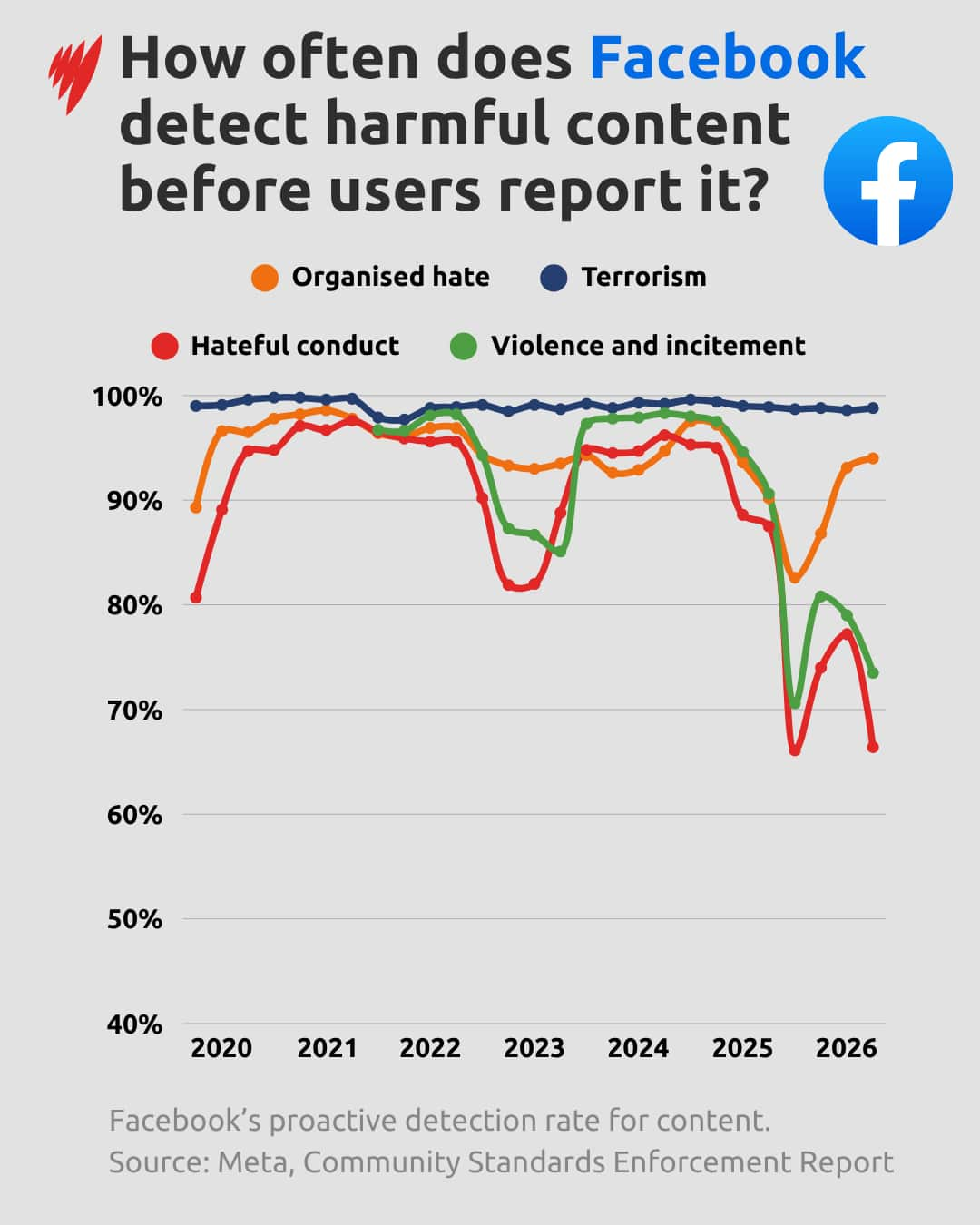
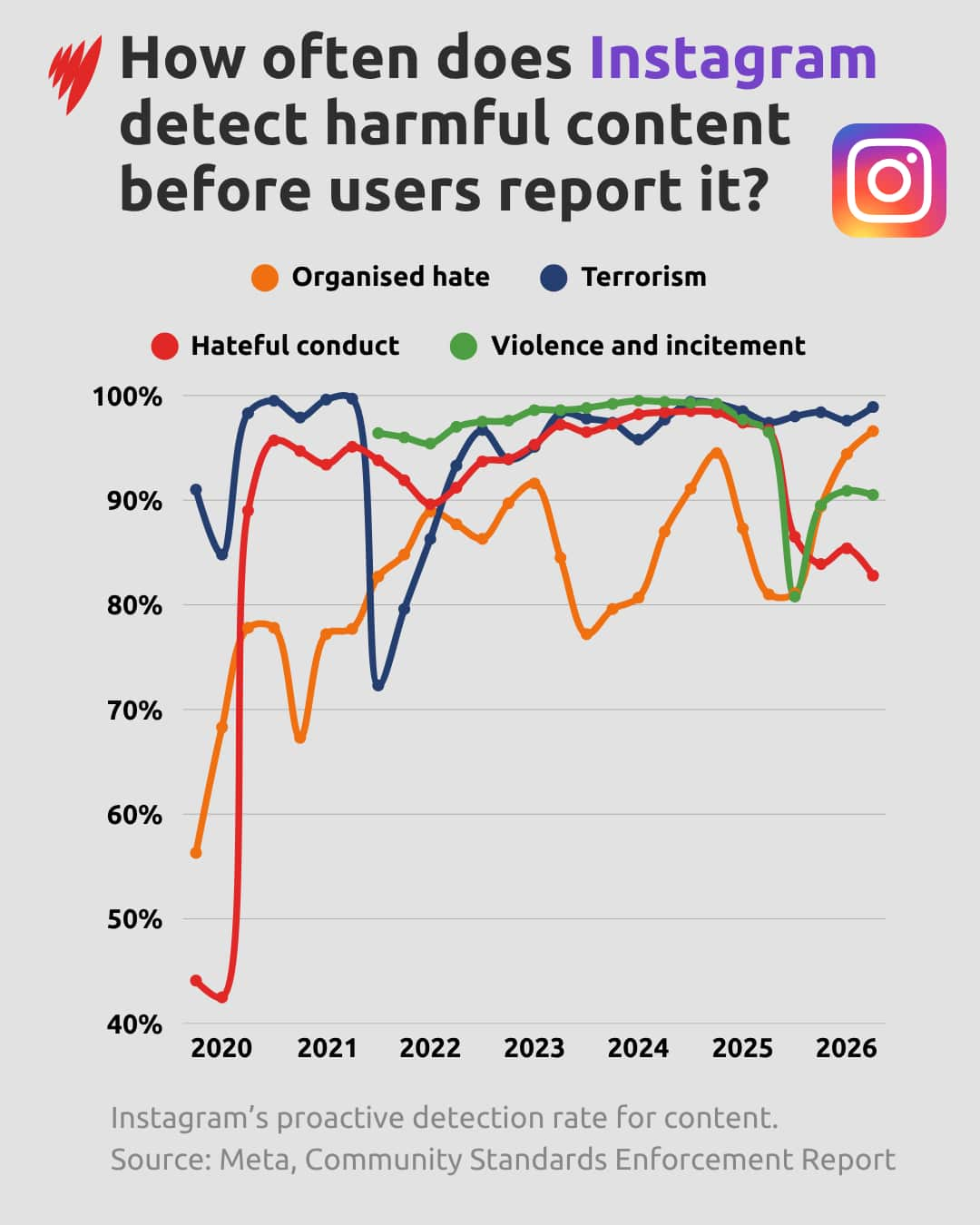
Meta reported that it took action to remove around six million pieces of "hateful conduct content" published on Facebook and Instagram in the six months to June 2026. This content is increasingly being found and reported by users rather than being proactively removed.
Meta defines hateful conduct as direct attacks against people based on characteristics, including race, ethnicity, national origin, disability, religious affiliation, caste, sexual orientation, sex, gender identity, and serious disease.
Meta says it cannot estimate a prevalence for organised hate "right now" but in a submission to the inquiry said they employ algorithms "running continuously across more than 20 million daily uploads", removing 98 per cent of (all) violating content in Australia before any user reports it.
"Since 2019, Meta has run a Search Redirect Initiative in Australia, which automatically redirects users searching for extremist terms on Facebook to specialist support from the Step Together service," Meta said.
Step Together is a support service that offers resources and early intervention for people concerned about behavioural changes or radicalisation in themselves or someone they know.
Teach Us Consent, an Australian organisation whose mission is to eliminate sexual violence, said in a submission to the committee that there were 230 active participants in programs aimed at countering violent extremism in Australia.
It said two-thirds were aged between 10 and 24, and all of them were male.
Research by University of Melbourne senior lecturer Sara Meger found attitudes normalising, excusing, or permitting violence against women are the strongest individual-level predictor of support for violent extremism measured in Australia, outweighing factors such as political ideology, religion, ethnicity, and time spent online.
"It establishes a reasoning pattern where coercion is viewed as a legitimate response to a target 'stepping out of line', which easily transfers to other political, racial, or religious out-groups," Meger's submissions said. "Primary prevention of misogyny should be recognised and resourced as counter-extremism work."
There's been "a significant rise in hard misogynistic views", Roose said.
"My research in 2019 of a representative sample of men in 28 countries found about 4 per cent of 18-34-year-olds thought women didn't deserve the same rights as men. In 2024, that number was about 12 per cent," he said.
"If you engage with misogynistic content, very often you're steered towards other forms of extremism by the algorithm because it intersects or aligns neatly with a racist or violent worldview towards LGBTQI+ people."
Roose said much of the caseload for authorities working to prevent radicalisation was based around 'thin' ideology, which has limited scope and doesn't offer a cohesive, comprehensive view of the world.
"I ask in my research if people think their lives are going forwards or backwards," he said.
Insecure work, family breakdown and the loss of trusted institutions can erode a person's sense of control.
"Extremist leaders can give people a political explanation of who is to blame and how they can recover their standing. A teen boy who feels disregarded at school may find people on a private server who remember his name and take his grievances seriously. Sharing violent material can earn him status."
Roose said one of the "key drivers" is anger fuelled by resentment, shame, humiliation, disappointment and a loss of trust.
"The majority of terrorist manifestos that we’ve done analysis of had anger as the driving emotion."
Submissions from ACT Children and Young People Commissioner Jodie Griffiths-Cook and associate professor Kristy Campion linked radicalisation to adverse childhood experiences — including family dysfunction, physical and psychological punishment, trauma, and toxic stress.
These experiences curtail early-life bonding and emotional regulation, making kids highly susceptible to extremist groups offering artificial attachment, power, and control, they said.