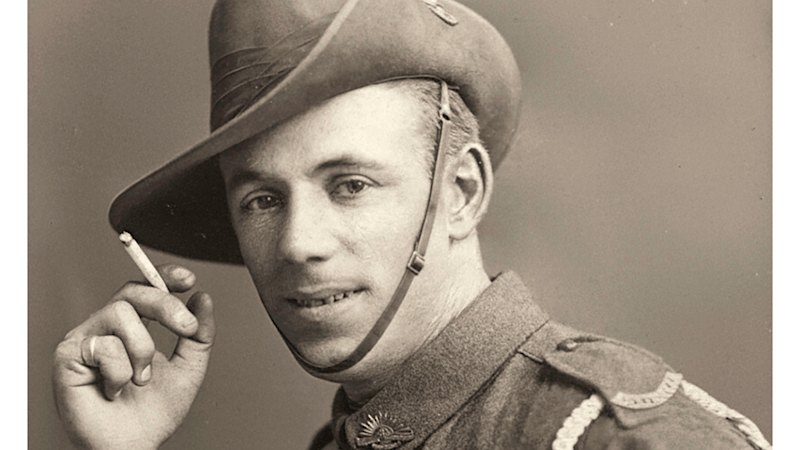
Private Roy Hawkins from Armidale in New South Wales was part of the Australian Imperial Force's 3rd Battalion. ( Supplied: Department of Defence )
Eleven Australian soldiers killed in World War I have been formally identified for the first time to ensure their service and sacrifice are recognised by future generations.
The men, long commemorated as unknown soldiers, were identified through extensive historical research, archaeological investigations, and DNA analysis.
Private Thomas Easton from Adamstown, NSW, was part of the Australian Imperial Force's 30th Battalion. ( Supplied: Department of Defence )
The newly identified Australian soldiers are:
Lieutenant John Lyons MC, MM, MSM, from Randwick, New South Wales, was part of the Australian Imperial Force's 17th Battalion. ( Supplied: Department of Defence )
Descendants of the identified soldiers, French authorities and independent researchers assisted Defence's Unrecovered War Casualties — Army (UWC-A) team, the Office of Australian War Graves and the Commonwealth War Graves Commission.
The federal government announced the identities for Remembrance Day, which this year marks 108 years since the Armistice was signed to end the conflict.
Among the 11 newly identified soldiers is Lieutenant Andrew Anderson, who was killed in action on September 20, 1917, during the Battle of Menin Road near Ypres, Belgium.
Researchers say fellow soldiers buried Lieutenant Anderson on the battlefield near Westhoek, with an eyewitness account describing a roadside burial marked with a wooden cross.
In March 1919, an unknown soldier's remains were recovered from almost the same location and reinterred at Hooge Crater Cemetery.
Lieutenant Andrew Anderson from Bundaberg in Queensland was part of the Australian Imperial Force's 7th Machine Gun Company. ( Supplied: Department of Defence )
The original grave registration record noted "Anderson on shirt", indicating that the soldier's clothing bore the name Anderson, but his identity was not established at the time.
More than a century later, an independent historical researcher identified the possible connection between that unknown soldier and Lieutenant Anderson.
In 2020, she submitted her findings to the Commonwealth War Graves Commission and the UWC-A team, who took up the investigation and established an evidentiary link between Lieutenant Anderson and the unknown Australian soldier.
Now, 109 years after his death, Lieutenant Anderson's headstone at Hooge Crater Cemetery can be replaced to commemorate him by name.
Lieutenant Howard Morey from Lilydale in Victoria was part of the Australian Imperial Force's 58th Battalion. ( Supplied: Department of Defence )
Defence Minister Richard Marles said the identification was "deeply personal" for his family since Lieutenant Anderson was his great-uncle.
"Like so many Australian families, we've carried the story of a relative who served their country and never came home," Mr Marles said.
"For more than a century, Andrew Anderson's final resting place was unknown.
"To know where he now lies and to see him identified by name is profoundly meaningful for my family.
"His story is a reminder of the sacrifice made by a generation of Australians whose service continues to shape our nation. We are proud to remember that sacrifice this Remembrance Day."
Private James Campbell from Queenstown in Tasmania was part of the Australian Imperial Force's 2nd Australian Field Ambulance. ( Supplied: Department of Defence )
Veterans' Affairs Minister Matt Keogh said it was through the dedication of military historians, archaeologists, researchers, forensic specialists, and the family members that the soldiers had now been identified.
"The identification of these soldiers who were killed in action across France and Belgium will provide long-awaited answers for families who have experienced generations of uncertainty," Mr Keogh said.