A nger at the dilapidated state of schools may have been the starting point for the unrest that has rocked France for over a month, but the protest movement has grown into something much bigger. It has widened to take in a far broader segment of society whose grievances, including institutional racism and Islamophobia, are now connecting.
I have no doubt that one of direct causes of this snowball effect is the repressive nature of the response to the initial protests, which were treated entirely as a matter of law and order – criminalised, not listened to.
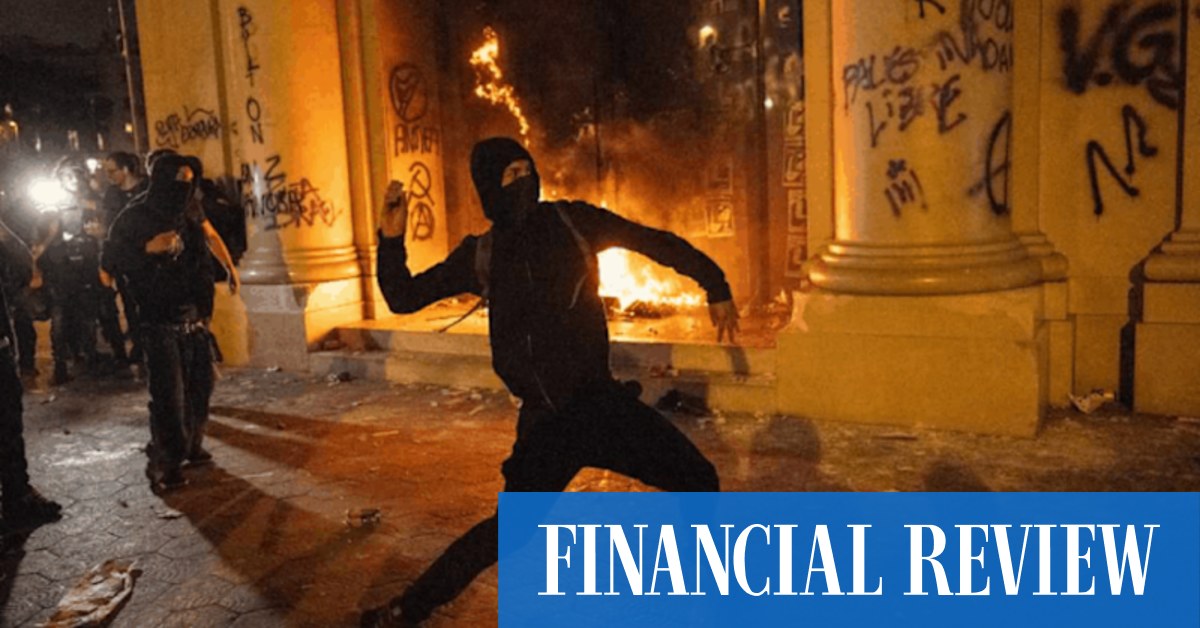
Think back to the night of 17 October – the movement’s first major mobilisation – when the French prime minister, Sébastien Lecornu, focused his response primarily on the looting in several cities . He called on the public to “ choose a side ”: either “the Republic – and therefore the security forces”, or “the rioters”. The following day, President Emmanuel Macron reaffirmed “the nation’s support” for the security forces, declaring that there was “no place for violence”.
What Macron did not say was what kind of violence we should reject. There was no mention of the shocking levels of brutality and force used by French police against protesters. Or the violence that has plunged nearly 10 million people into poverty.
And so, since 17 October, the protests have been met with increasingly harsh levels of repression, and the mobilisation of ever-larger deployments of security forces, including special police units and the military.
This needlessly securitised response to legitimate civic action reflects an “ authoritarian drift ”, as the head of one of the biggest trade unions said. But it also presents a serious, potentially lethal, threat to young people and racialised minorities.
Teenagers are now dealing with life-changing injuries because they took to the streets or blockaded their schools. Since 17 October, an estimated 5,000 people have been arrested in connection with protests, 85% of them minors, and many subjected to disproportionately harsh treatment in detention.
Seventeen children, for instance, spent the night of 20 October at the Bobigny police holding facility without bedding or mattresses. Lawyers who visited the site described conditions as inhumane and degrading. A photograph released by the lawyers brought me to tears. It showed teenagers huddled together, wrapped only in emergency foil blankets, curled up on the floor in fear.
The escalating “security-first” approach – of which young people are the victims – is setting up a dangerous future. We risk the emergence of a generation of young people who are maimed, scarred and traumatised by the forces who are supposed to ensure their safety. Clear democratic boundaries have to be restored urgently.
With further protests on the way, I feel a wave of overlapping emotions – and I know many others feel the same way. Anger, yes, and a determination to keep going because we still hope that our demands will ultimately be met. But there is also a profound sadness, exhaustion and fear. For me, as for many other French Muslims, this fear is visceral because we are so routinely vilified in a toxic public discourse by the far right.
This discourse can have deadly consequences. In the midst of the tension created by a militarised crackdown on protests, a racist and Islamophobic gun rampage in the town of Trappes , near Paris, on 23 October claimed the life of a young black man called Pengo Bossio Wangi . Five others, including a 12-year-old girl , were wounded. The suspect told police he had targeted individuals he perceived as “Muslim, African, or north African”. He also said he chose Trappes because he viewed it as a “hub for Islamists”.
That was a chilling echo of a remark made in 2022 by Jordan Bardella, president of the far-right National Rally (Rassemblement National), who described Trappes as “an Islamist republic in miniature ”. Anti-terror investigators discovered stickers at the gunman’s home, some of which bore slogans such as “Long live France,” “RN” (National Rally), and “Proud to be French”. The suspect was not affiliated with the party and Bardella condemned the killings. Yet the media continues to platform far-right political figures – including those whose rhetoric regarding Muslim, Black and Arab communities is deeply troubling.
To emerge from this crisis, France as a society must get over its collective amnesia around racist violence .
To consider the attack in Trappes as an isolated tragedy would be to erase a long history of violence directed at minority communities. We need only count our dead to understand the truth – which is that, for far too long, the lives of Black, Arab and Muslim French people have been placed in jeopardy by a failure to tackle systemic racism. We cannot simply accept as inevitable the sight of grieving families or tear-filled crowds – like those I saw in Trappes where Pengo was laid to rest on Saturday.
The authorities claim they are tackling the hatred shown to Muslims: Macron denounced the Trappes murder as racially motivated terror . But how credible is this when the French political class still challenges and disputes the term “Islamophobia”, and therefore fails to recognise it as a form of racism? Aurore Bergé, the minister in charge of combating discrimination, openly refuses to use what she calls an “invented” word .
The French media also needs to examine its biases urgently. Far-right political figures are granted repeated exposure, while the communities on the receiving end of hate speech often struggle to have their experiences heard.
The capacity of young people to take action – to claim their rights – in such bloody chaos should be recognised as truly admirable. But how do we hold on to hope for the future – for what lies ahead, and for the generations even younger than our own – when our own prospects seem so bleak?
Kamélia Ouaissa is a French journalist based in Paris
Do you have an opinion on the issues raised in this article? If you would like to submit a response of up to 300 words by email to be considered for publication in our letters section, please click here .