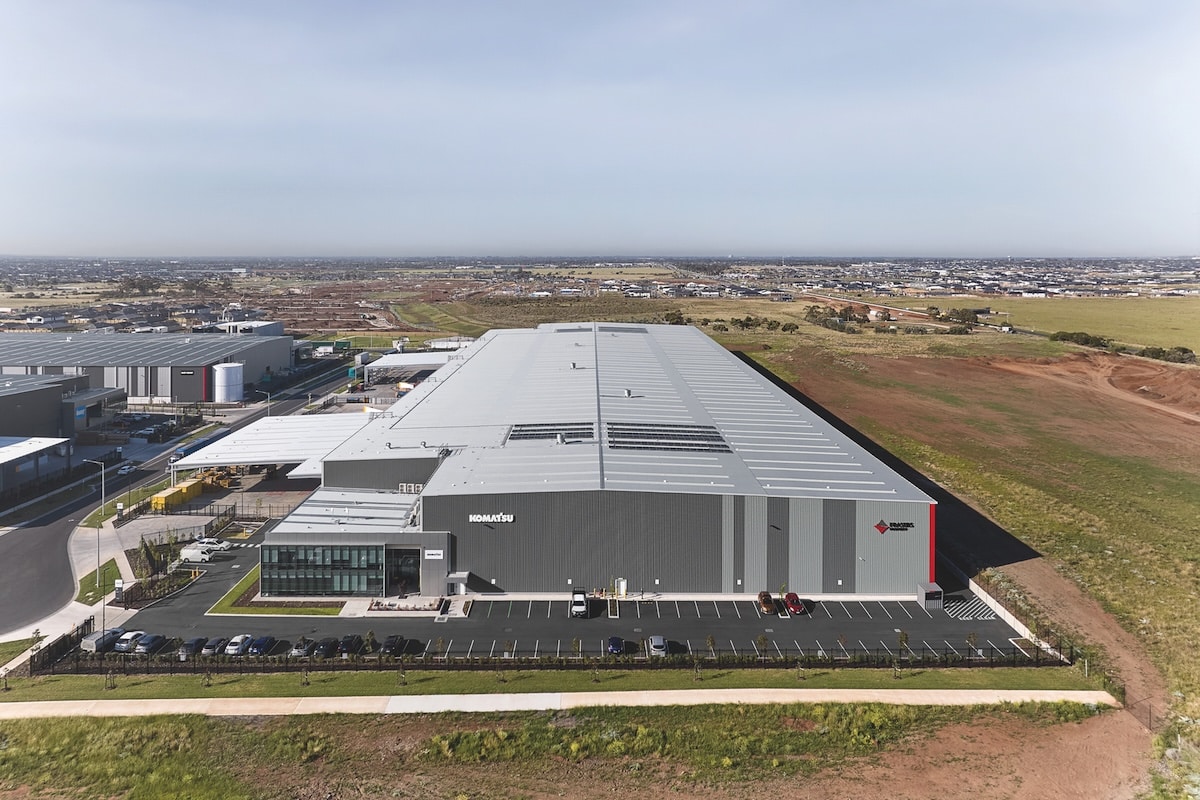
Komatsu designed its Melbourne Fulfilment Centre around a single priority: getting parts to construction customers quickly and efficiently.
Location: Tarneit, Victoria Investment: $9.9 million Facility size: 12,500sqm Inventory capacity: 35,000 unique stock items Key technologies: AutoStore robotic system, high-density storage systems, mobile racking, electric material handling, energy-efficient automation
Parts demand in construction doesn’t always run to a simple maintenance schedule. A contractor with one excavator can suddenly need a component because the machine has stopped, while another might see rain in the next day’s forecast and bring planned maintenance forward, creating an immediate parts requirement. Komatsu designed its Melbourne Fulfilment Centre around that kind of reactive demand.
Inside Construction recently visited the $9.9 million, 12,500sqm facility in Tarneit to see how that response is built into the operation. On site, Aaron Kumar, general manager of supply chain and distribution, set out the thinking behind Komatsu’s investment.
The centre opened in 2024 after Komatsu relocated its primary construction parts fulfilment operation from Fairfield in Sydney. The move followed several years of reviewing how the company supported its construction customers across Australia and Oceania.
“Melbourne was a strategic location for Komatsu. We wanted a purpose-built facility to better support our construction customers, and Victoria has one of the largest concentrations of our construction machine population,” says Kumar.
“One of the challenges we had in Sydney was our ability to deliver to our customers and branches the following day. Relocating the fulfilment centre to Melbourne gave us direct access from the Port of Melbourne, allowing us to reduce lead time and costs, placed us within the centre of our construction machine population, and allowed us to fulfil next-day deliveries to all of our East Coast branches overnight.”
The relocation was intended to improve reach without reducing service elsewhere in the network. Metropolitan Melbourne customers have gained access to same-day delivery, while next-day delivery is now available across regional Victoria, South Australia and southern NSW.
Komatsu also analysed its existing machine population and anticipated demand before the move, including the infrastructure pipeline expected over the next decade. The company increased the amount of inventory held in Australia at the same time, recognising that the speed of the fulfilment process has limited effect when the required part is still sitting at a factory or another location overseas. At the time of our visit, the Melbourne facility held about 23,000 product lines, with the centre capable of holding 35,000 unique stock items as demand grows.
“With the scale of infrastructure work ahead and labour capacity already constrained, machine downtime can have a major impact on a customer’s business,” says Kumar. “Holding the right inventory locally is therefore a critical part of the strategy.”
The breadth of that inventory shaped the facility from the outset. Komatsu needed enough density to support a large existing machine population while continuing to accommodate parts for new models entering the market, but it also wanted the operation to have room to grow over the next decade.
Much of the infrastructure is modular, allowing the operation to expand as demand changes. Larger, slower-moving items such as track links, engines and motors are held in mobile racking that closes together when access isn’t required, while palletised stock is stored in very narrow aisles serviced by turret trucks. Both systems increase storage density without using more floor area than necessary.
Once the stock is in place, the next pressure point is turning a customer order into a completed consignment. Regional fulfilment centre manager Isabelle Mychajlyk led us through that process, beginning with inbound goods. The team aims to process them on the day they arrive and move them into storage so they become available for sale quickly.
Standard orders can be placed through customer service or Komatsu’s online parts portal, where customers select a service level to suit the required timeframe. Machine-down orders carry a much tighter target.
“If a customer has a machine down and places an urgent order, the team has one hour to pick and pack that order and have it ready for collection,” says Mychajlyk. “For a standard order that needs to be delivered the following morning, once the order flows through to us, we pick the parts from the different zones and consolidate them so everything for that order comes together.”
Much of that picking takes place in AutoStore, the centre’s parts-to-person automation system and its fastest picking location. About 70 per cent of the product lines held in Melbourne are stored in 17,900 tubs beneath an aluminium grid, with each tub able to be divided into smaller compartments for multiple products.
Eight autonomous robots travel across the grid. Komatsu’s warehouse management system allocates the inventory and feeds that information to AutoStore, which identifies the tub containing the required part and its position. If the tub is buried beneath others, the robots work together to move those above it, retrieve the correct tub and deliver it to a picking port, where human operators complete quantity and quality checks.
“Because we are essentially a same-day facility, any downtime can affect our ability to fulfil customer orders,” says Mychajlyk. “AutoStore has eight robots, so if one has a breakdown or needs to come off the grid, it can be removed and serviced while the operation continues. The system provides a substantial productivity benefit.”
AutoStore can expand with the facility. Additional grid can be built alongside the existing system without stopping the operation, after which the robots can be programmed to access the new section.
Parts for one customer can come from several storage zones, so they are brought together at consolidation before packing. Larger components from palletised storage and smaller parts from AutoStore are matched to the same order, with a visual indicator turning green once every item has arrived. The complete order then moves to outbound to be packed into one box or onto one pallet for dispatch.
“Automation plays a key role for us because the ultimate objective is speed to the customer,” says Kumar. “There are operational efficiencies that come with automation, but our focus is on how quickly we can retrieve parts from a location, consolidate and pack them, and get them out the door.”
Komatsu is now looking at where technology could cut further time from the supply chain. Automated guided vehicles are being considered for moving goods through fulfilment centres, while AI may have a future role in helping planning and procurement teams make faster decisions. Kumar says any new technology still needs to add value to the operation and complement the people using it.
“We have a very strong workforce across our distribution and fulfilment centres in Australia, and technology isn’t going to replace the need for those people,” he says. “We still need their knowledge and judgement to make decisions.”
Safety measures throughout the warehouse focus on limiting interaction between people and machinery. Dock locks and barriers reduce risks around loading areas and work at height. Four Komatsu electric forklifts operate on site, while a 15kg manual lifting limit applies across the facility.
Other measures reduce the physical demands on operators. AutoStore removes the need to walk aisles retrieving parts, while height-adjustable packing tables allow operators to set their workstation to suit them.
“That manual handling approach has also helped us create a more diverse workforce than you might traditionally see in warehousing,” says Mychajlyk. “About 60 per cent of the team is female, and we have an all-female leadership team.”
Environmental performance was another design consideration, with the centre achieving a 5 Green Star Design rating. The AutoStore system was also selected with energy efficiency in mind, using low-power robotic technology and regenerative energy features to reduce energy use across warehouse operations.
“There was a clear aspiration to achieve that outcome because it aligned with both Komatsu Australia’s objectives and our global environmental and sustainability strategy,” says Kumar. “With a new purpose-built facility such as this, meeting those requirements was non-negotiable. It was intended to be a flagship facility that could set the benchmark for what we wanted to do elsewhere.”
The Melbourne operation already supports customers across a wide geographic area, and its role is expected to grow with demand across the region. Its modular infrastructure, inventory capacity and expandable AutoStore system allow the centre to accommodate additional volume over time.
“The facility also forms part of how we support construction customers more broadly across Oceania, including New Zealand,” says Kumar. “The service model may differ between markets, but we needed to look across the region to understand the capability required from Melbourne.”
Wherever that demand comes from, the requirement is the same: have the right stock available and get it to the customer quickly.