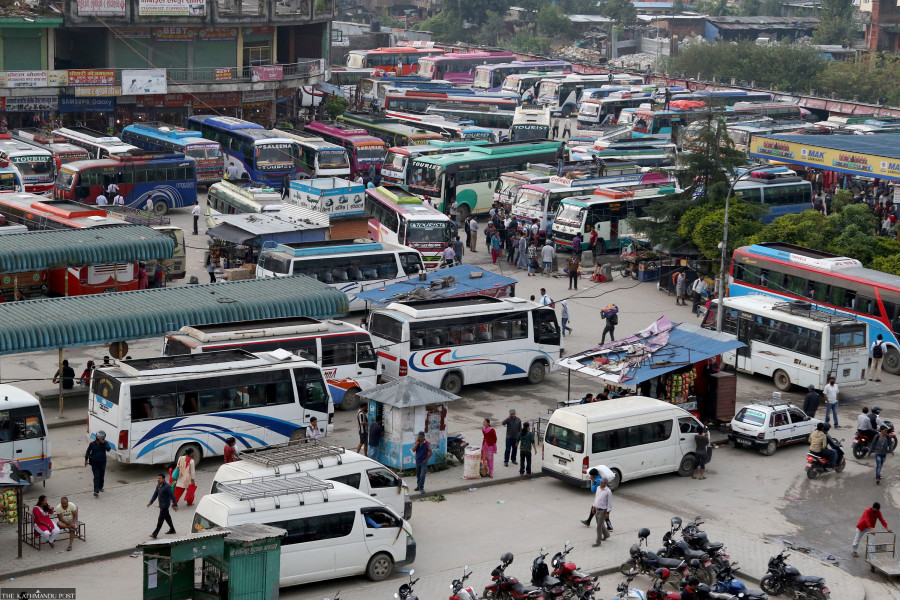
Nearly 73 percent of jobs in Nepal’s transport sector remain informal. Drivers, conductors, helpers, and other transport workers often lack written job contracts and have little or no social safety net, according to a new policy brief by the International Labour Organization (ILO).
The brief, ‘Informality in Nepal’s Transport Sector: Promoting enterprise formalisation and extending social protection to transport workers’, points to a critical gap between business registration and workers’ rights.
Although 89.5 per cent of transport establishments were registered in 2018, informal employment relationships remained widespread, with approximately 62 percent of jobs within formal enterprises still informal in 2022-23, the report said, highlighting how business registration has not necessarily led to employment formalisation.
The numbers are stark. Of 160 transport workers surveyed, none had a written employment contract, only three were enrolled in the Social Security Fund (SSF). Around 41 percent of informal employees earned below the minimum support wage, and informal transport workers were four times as likely to live in poverty as their formally employed counterparts.
Nepal’s transport sector supports economic activity and diverse forms of employment, yet many workers remain in informal jobs with limited access to decent working conditions and social protection. Transport contributes 6.73 percent of Nepal’s gross domestic product (GDP) and connects people, businesses and markets. Yet the drivers, conductors, and helpers who keep it running face unstable incomes, long hours, unsafe working conditions and little or no social protection, the brief says.
Numan Özcan, ILO Country Director for Nepal said, “A registered business is no guarantee of a protected worker. When nearly three in four transport jobs are informal, a licence on the wall changes nothing for the person behind the wheel. Workers need a written contract, a fair wage and social security that actually reaches them. Formalisation has to be measured in workers’ lives, not in registration certificates.”
The gap is following workers onto the apps. The brief notes that ride-hailing and delivery services are creating new income opportunities, but workers often lack written agreements, clear employment protections, and pathways into social security.
The ILO brief identifies eight priority actions to advance formalisation and extend social protection to transport workers. Key recommendations include making social security contributions more affordable and flexible for workers with irregular incomes, simplifying enterprise registration and compliance procedures, strengthening enforcement of minimum wages and labour standards, and establishing a clear legal framework to protect digital platform workers.
It also calls for better worker registration, accessible grievance mechanisms, and stronger measures to address occupational safety and gender-related risks.
The brief is blunt: formalisation cannot stop at registering businesses. It has to show up in workers’ lives, as fair wages, safer working conditions, employment security, and effective social protection.
By identifying practical pathways for reform, the brief offers policymakers, employer organisations, workers' organisations, and other stakeholders guidance on advancing inclusive and decent work conditions in Nepal’s transport sector. The recommendations can help inform Nepal’s ongoing efforts to strengthen its labour laws and policy frameworks and expand social protection coverage.
The ILO brief argues that formalising employment and extending seocial protection would not only improve transport workers’ lives and protect their families but also contribute to a more resilient and productive economy.