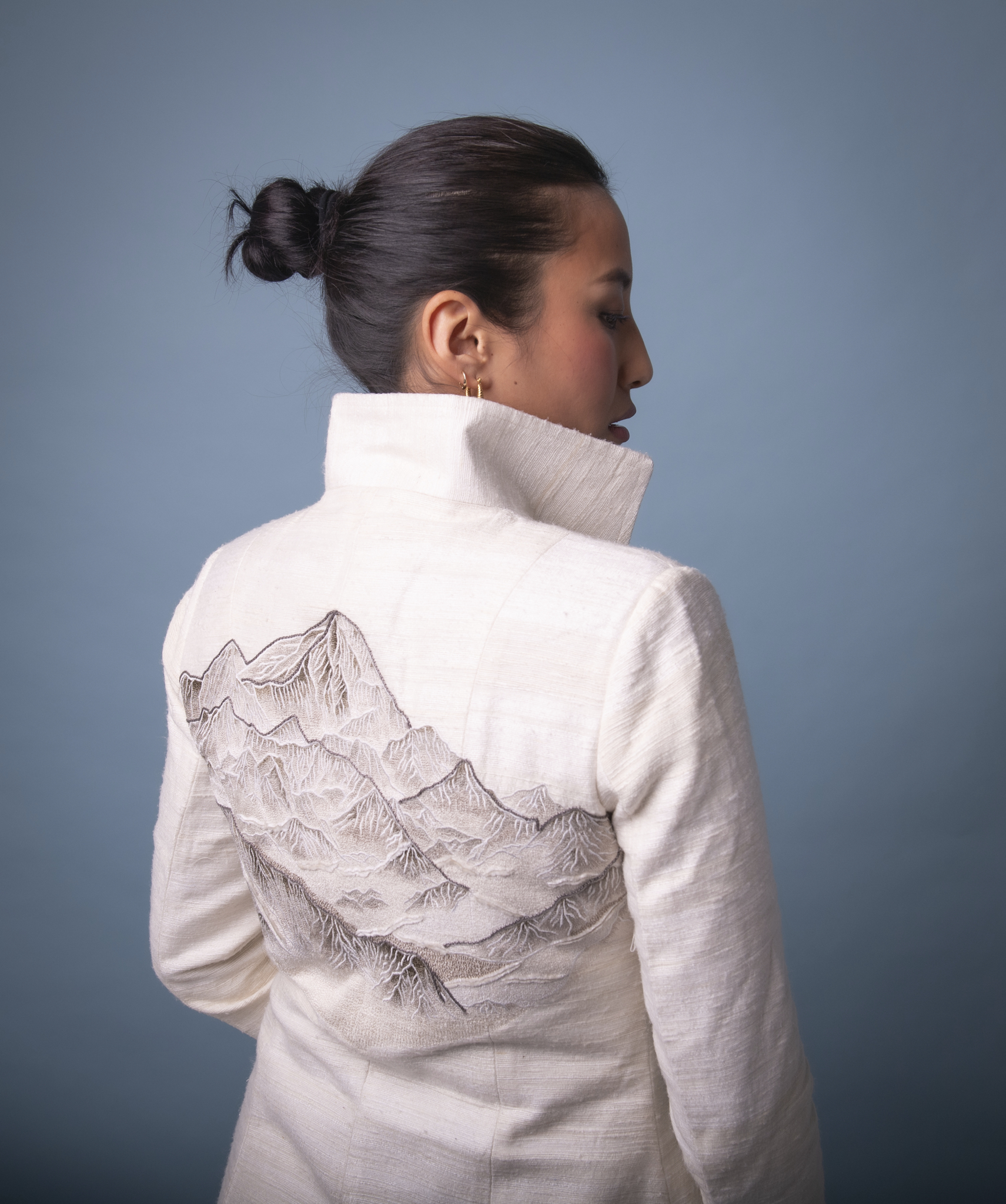
When actor Thinley Lhamo walked the carpet at the Telluride Film Festival for the premiere of “ Tenzing ” in September, she carried Mount Everest on her back, its ridges worked in tonal thread across an ivory raw silk suit.
Created by the Kathmandu label Jijivisha, the look was made entirely in Nepal. It combined hand-spun, handwoven silk with Panchadhatu jewellery set with Himalayan stones, and a single button of uncut blue sapphire.
None of that came from Paris, Milan or New York.
For a country whose clothing is often assumed to mean tourist markets and bargain prices, the look made a quiet argument that Nepali design can appear on international stages on its own terms, with its own materials and its own hands. Its designer, Shavona Shrestha, who never trained in fashion and started Jijivisha four years ago, sees the moment as proof of concept.
“It has shown that Nepali designers can provide couture pieces at an international level,” she told the Post recently, as she sat in her store at The Dwarika’s, a boutique hotel in central Kathmandu.
The suit is austere from the front: a long, narrow jacket over wide-legged trousers, both cut from the same pale silk with uneven texture of handspun cloth. The collar is tall and angular, turned sharply upward, framing the face like architecture. The sapphire fastens the jacket at the waist, below a deep V.
The jewellery fills that opening. A rigid gold collar supports five raw stones arranged vertically down the breastbone, dark and smoky at the top and warming to honey-yellow below.
From behind, the restraint gives way to detail. Across the shoulder blades, a mountain range rises in layered embroidery, its cream, white and taupe threads forming ridges and glaciers. The colours stay close to the silk’s own, so the peaks seem to surface from the fabric rather than sit on it. At the centre is Chomolungma, Everest’s name in Tibetan, meaning “Mother Goddess of the World.”
“I wanted it to look as if she was carrying Everest on her back while representing our country,” Shrestha said about Lhamo’s look at the Telluride. “You need to bring some traditional elements into the outfit, but you cannot make it entirely traditional. It was for a film festival so it needed to reach that level.”
Lhamo, who shot to fame from the Himalayan drama ‘Shambhala’ (2024), had modelled for Jijivisha’s Mustang campaign and approached Shrestha with a request: “Didi, please design my outfit for the premiere.”
During their first brainstorm, she shared a photograph of the film’s director, Jennifer Peedom, wearing a jacket embroidered with a mountain. The idea developed from there. No studio or producer commissioned the look.
Lhamo plays Dawa, Tenzing Norgay’s wife, in ‘Tenzing’, the biographical drama that revolves around its eponymous hero’s legendary 1953 ascent of Everest. For her, choosing the outfit was about more than its appearance. “I’m really happy and proud that I could bring a piece of our culture and the beautiful craftsmanship of our local artists onto an international platform,” Lhamo told the Post.
She later wore it for her official portrait at the Toronto International Film Festival. “It had a personal connection to the film, the mountains, and where I come from,” she said.
Shrestha traces the materials to several parts of Nepal. She said the silk came from cocoons raised in Itahari, Dhankuta, Dhunibesi in Dhading, Chitapol, Khopasi in Panauti and Dang. The button’s blue sapphire came from Kanchenjunga, the quartz from Ganesh Himal and Makalu, and the tourmalines and kyanite from Kushe Himal.
The jewellery is Pancha Dhatu, a five-metal alloy long used in traditional Nepali metalwork. About 20 artisans across Bhaktapur, Patan and elsewhere worked on the piece.
Jijivisha is a slow-fashion label, and a garment like this normally takes one to two months. The raw silk alone takes two to three months to produce, so Shrestha used fabric that had already been made. Its natural irregularities required adjustments throughout the making. The team finished in about a month.
She has no in-house production unit. Instead, she commissions small, family-run workshops. She said producing in-house would be cheaper, but sharing the work matters to her. “I want all of us to grow together,” she said.
The label uses only natural fibres, including cotton, silk and bamboo, dyed with plants and vegetables. Fabrics are pre-shrunk three times before sale. Buttons are hand-carved from discarded buffalo bone, with wood or coconut shell for vegan customers.
One tailor told her that because of Jijivisha, he had bought four new machines. But the survival of craft skills remains a concern. In Mustang, she met a weaver of about 90 who, she said, was the last person familiar with a particular technique. “Nobody wants to take it up,” Shrestha said. “Staying at home and weaving is not considered cool.”
Since the festivals, Shrestha said, international producers and directors have praised the work, and people have written asking for similar pieces. She has declined, telling them the look was a tribute to Lhamo. “I am not making another one,” she said.
She is cautious about claiming a direct effect on the artisans so far, but hopes the attention will encourage others.
“I think the craftsmen who are watching will feel encouraged,” she said. “They will think, if they can do it, maybe I can do it too.”
Jijivisha itself has a new collection and a jewellery line on the way.
Shrestha said that her team now arrives at work with more confidence than ever before. After all, they made a mountain in Nepal and had it travel well beyond it.
Aarya Chand is a reporter at The Kathmandu Post covering social issues. Before moving to the social beat, Chand was an intern covering culture and lifestyle for the Post.