As Australia continues to grapple with the housing crisis, a number of projects delivered under Victoria’s monumental Big Housing Build banner are demonstrating that welcoming, dignified and well-designed housing is more than just a pipe dream.
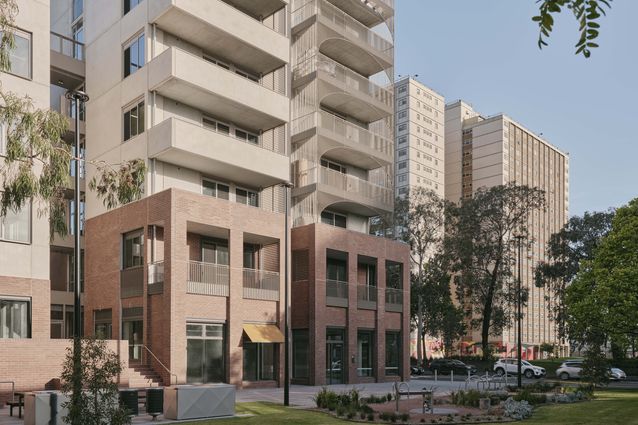
Elizabeth Street, North Richmond reads as a series of street-front buildings rather than a monolithic form.
The Victorian government ’s $5.3 billion Big Housing Build (BHB), beyond its goal of creating new housing for the vulnerable, should also be understood as a chance to reframe social housing as a civic practice. The investment, first announced in 2020, promised to boost supply and meet urgent social need, delivering 12,000 new social, affordable and publicly owned rental homes, with a focus on providing modern dwellings close to transport, services and employment. Six years on, state and Commonwealth investment has grown to over $8 billion, delivering more than 16,000 dwellings with the expansion of programs that include the Regional Housing Fund, the Social Housing Growth Fund, and the Public Housing Renewal Program.
Housing at this scale and with this intent can create meaningful impact, particularly when these homes offer diversity, accessibility, quality and dedicated connections to public open space. This holistic focus has informed recent developments including Elizabeth Street, North Richmond (Kerstin Thompson Architects and Hayball), Housing Choices Australia Belmont (Kennedy Nolan) and Merri Northcote (Six Degrees Architects). With time, expertise and intent, design-led precedents such as these show how social housing can build streets, define blocks and create enduring value for residents and surrounding communities.
A counterpoint to this good news story is the investment’s one-off character. There simply is not yet enough public housing to meet demand. To reach a stable supply of subsidised housing, the state (and nation) needs a long-term, bipartisan commitment that recognises the true social and financial value that such housing provides. Further, risks can be introduced when the civic potential of social housing is diluted by poorly informed feasibility studies, rigid yield targets and limited site-planning decisions: these determine every outcome that follows.
A defining feature of social and affordable housing is an ongoing rental subsidy for the tenant – a structure that is understandably unattractive to private investors. As such, delivering subsidised rental housing for people with the greatest need – many of whom have experienced homelessness and violence – must remain a state and federal responsibility. Experts suggest that expanding the remit of a dedicated vehicle such as the existing Housing Australia Future Fund with increased capital could better sustain holistic social housing investment long-term.
At its best, the BHB makes the case for treating social housing as an ongoing bipartisan investment, not a one-off stimulus. Well-designed projects remind us that social housing creates key infrastructure for the city while enabling residents to retain dignity, build lives, and foster independence from health, welfare and justice systems.
Elizabeth Street, North Richmond by Kerstin Thompson Architects and Hayball
Housing Choices Australia Belmont by Kennedy Nolan
Merri Northcote by Six Degrees Architects
– Rebecca Roke is an author, editor and researcher focused on innovative medium-density housing. She is cofounder and editorial director of Corvo.
Set in a rising neighbourhood of north-west Sydney, a new apartment tower trades generic glass-box urbanism for an expressive form carefully attuned to sun and …
A delightfully different one-bedroom apartment renovation in Roy Grounds’s Quamby flats is testament to the creativity and critical thinking of its Gold Medal-winning architect.