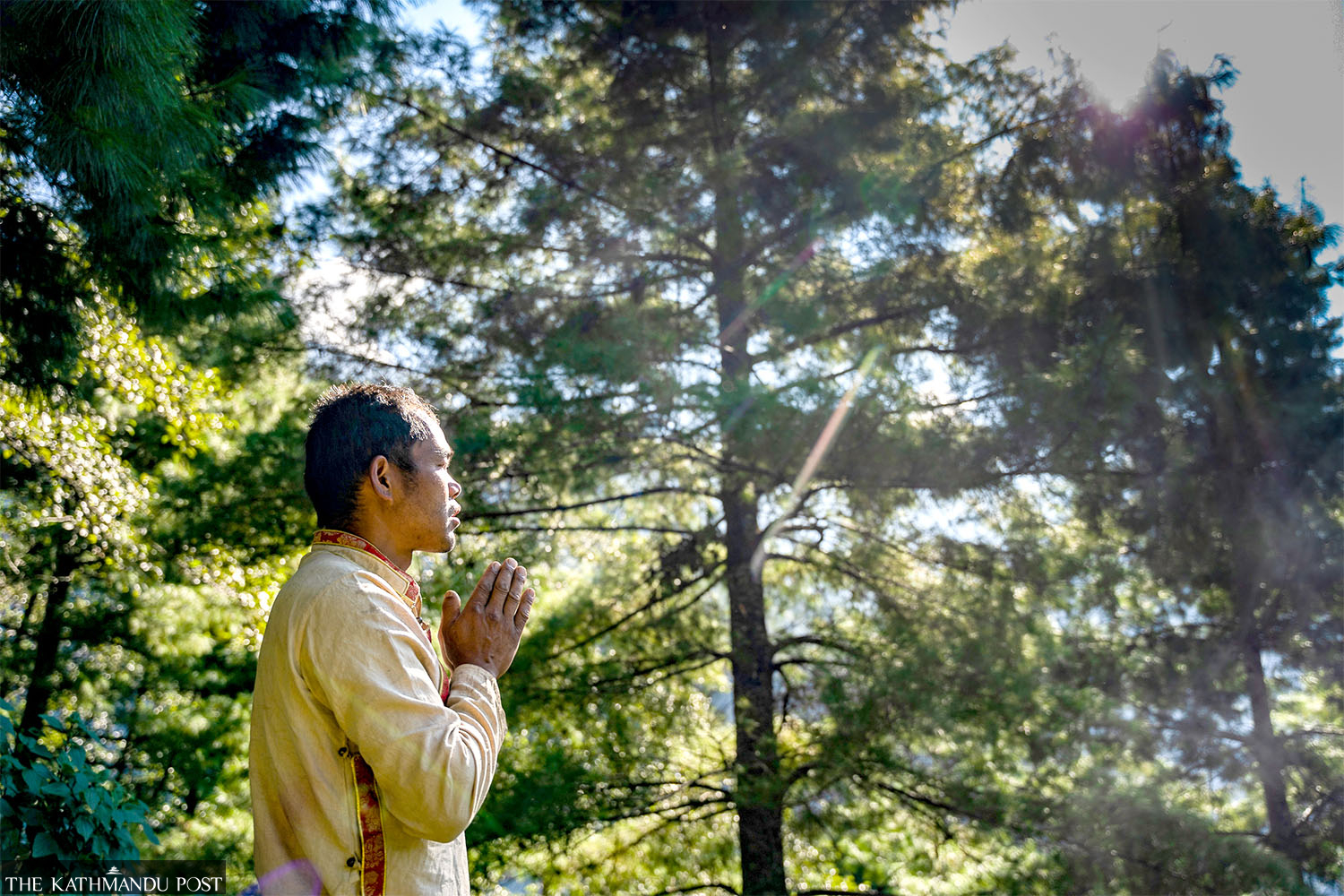
On a winter night in 2023, Jojo Bhote drifted off to the gushing Chhujung river, a sound that had carried him into sleep for over three decades. Around midnight, he felt the rumble of distant thuds. Jojo, whose family has tended these mountain pastures for generations, sprang from his bed, corralled his family, and stepped outside to find bulldozers tearing through stone walls that marked the community’s ancestral land. When he and his neighbours approached the workers, a company supervisor pulled a sheaf of papers bearing official seals and signatures, Jojo recalls — his own name among them.
The man shrugged and continued. At dawn, Jojo and other villagers followed the tracks into the forest, where the slopes he had known since boyhood now lay gouged open. This was where he had once learned to gather Satuwa, a wild herb that his mother boiled to prepare a tonic when fever swept through the village. Nearby stood Lothsalla, the Himalayan yew his elders protected because it yielded compounds used in anti-cancer medicines. “The forest was always our pharmacy,” he says. “As much as our home.”
The bulldozers were clearing ground for the Chhujung Khola Hydropower Project, one of dozens of projects reshaping Sankhuwasabha into a frontier of Nepal’s clean-energy ambitions.
Nepal, water-rich and fossil-poor , is in the middle of one of Asia’s most aggressive hydropower expansions. For generations, hydropower has been presented as the engine that would transform Nepal’s economy. The transformation has been slower and more uneven than promised. Yet the government's ambitions have only grown: an energy roadmap targeting 28,500 MW over the next decade, backed by $46.5 billion in investment, has unleashed a building frenzy. As of July 2026, more than 197 plants are operating, 262 have received construction licenses, and 244 hold survey licenses. Increasingly, Nepal's rivers are being transformed into power corridors , carrying electricity across borders to India and, more recently, Bangladesh. In places like Chyamtang, many Indigenous communities question who the power is ultimately for.
The warning arrived last week when a flash flood tore through the Bhotekoshi river in Rasuwa — a different Himalayan watershed several hundred kilometres west — killing at least 1,342 people and leaving nearly 5,000 unaccounted for as of Saturday. Hundreds are believed still trapped in flooded hydropower tunnels as rescue teams searched the wreckage days later. The disaster is a reminder of how little separates the mountains’ promise from their risk — and how much is still unknown about what Nepal’s hydropower expansion is building on.
Nowhere is that ambition more concentrated than in Sankhuwasabha, cut through by the Arun river basin, where dozens of hydropower projects are operating, under construction, or in various stages of licensing. For the Bhote Singsa community, who have lived along these slopes for generations, the project that feeds into a tributary of the Arun marks the beginning of a long tug-of-war over the land itself, one that would eventually pull Jojo and his neighbours into courtrooms, government offices and, ultimately, in front of a bulldozer that refuses to move.