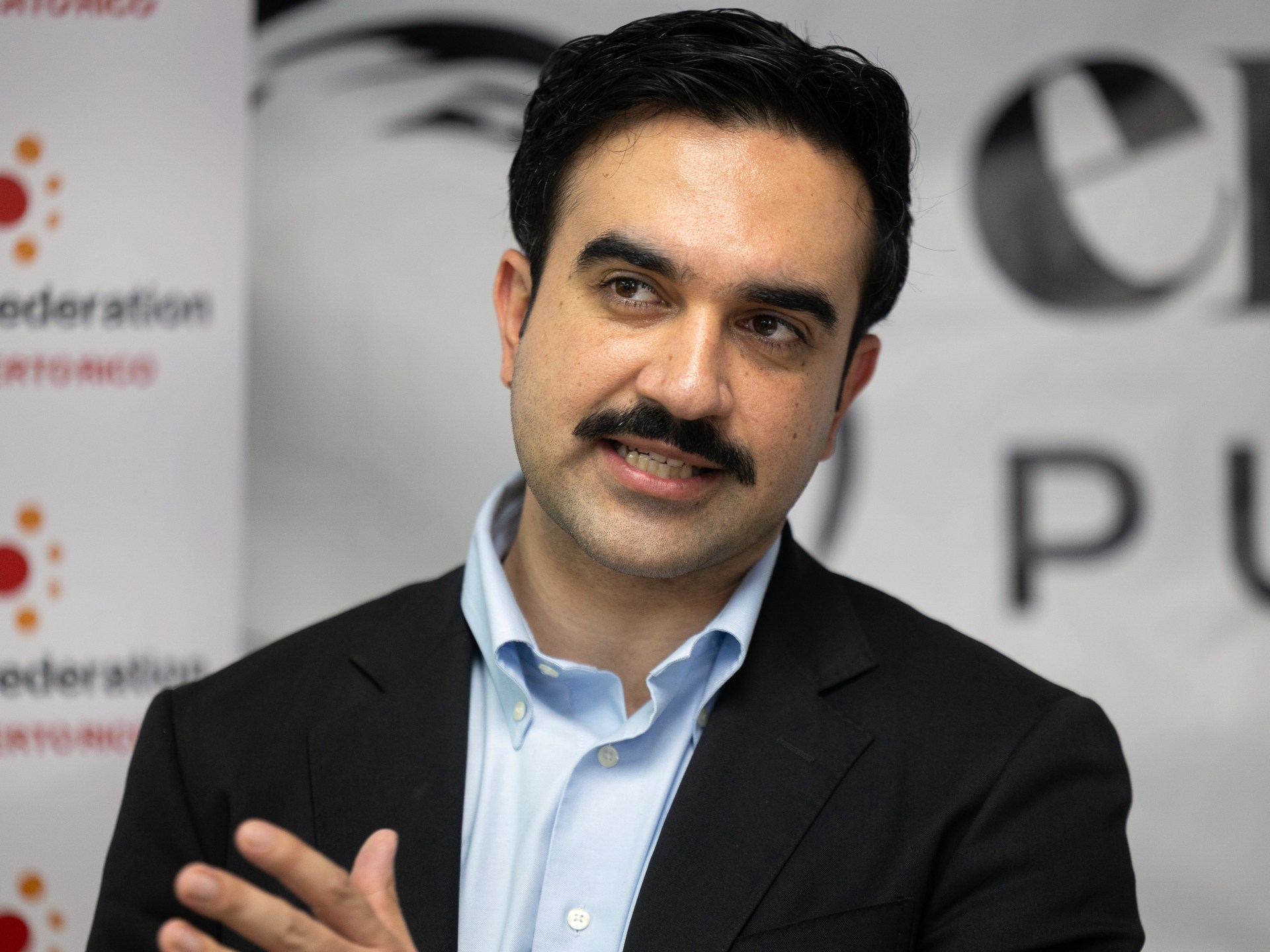
Mayor Mamdani, thank you for taking the time.
Very welcome, thank you for being here.
Thank you for having me. [Zohran laughs]
So it was almost exactly this time last year that WIRED
and I interviewed you in your campaign office.
And I remember that for two reasons.
One, it was just before the election,
And I was remembering this this weekend
because I was in Sunset Park on Saturday on a walk.
Sunset Park, for those who don't know,
is the best park in Brooklyn and actually all of New York.
And I saw you being serenaded with happy birthday.
So you have just now turned a year older, I did not join.
I kept walking, I was like, I'm going to see this guy.
I was wondering, like, Who's that woman
With the really excited nine-year-old who was trying to...
And she was like, No, we're going to keep going.
Do you feel a year older or older than that?
How has the last year of your life been?
It's been a pretty incredible year.
the most transformative year that I've lived in my life
in terms of what my life was versus what it is now.
And much of that year has been having the privilege
of having the greatest job in the world.
And to lead the city and now to be 35.
It's a funny thing because in the world of my friends,
of existential questions that come with it.
In the work that I do, most people are
it doesn't really live in a professional setting.
When I met Lula and we met during the UN General Assembly,
that I was young, he kept coming back, So young.
that has also illuminated both the promises
the housing crisis, you grew up through the Iraq war,
what has shaped our country's politics
have been these kind of formative moments in mine
And I think that too often politics is shaped
that simply just affect other people,
not ones that have been all consuming.
We spent quite a bit of time last year talking about
social media and your campaign's use of it.
WIRED declared you the internet's mayor.
That was before you even won the election, it was a gamble.
We felt pretty good about your odds.
Now you told us then that you wanted your campaign
to not just do social media better than other candidates,
but you said to really quote, Own the medium,
How are you thinking about social media as a tool now
for governance versus a tool for campaigning?
What are the differences? What are the similarities?
I think the similarity is that you have to continue
to recognize the fact that for many New Yorkers,
this is how they engage with the world.
It is yet another medium that has to be treated
with the same legitimacy and respect as traditional mediums.
And I say that because if your goal is to reach
as many New Yorkers as possible to tell them about a policy
that you are unveiling that they could stand
to benefit from, your responsibility is then to communicate
So social media means that we can make a video
almost every video will reach more than a million people.
And that's just on one specific medium.
And also it means that you have to continue
how are New Yorkers consuming media?
It's not that we have the right answer,
So for example, with a lot of our Spanish language outreach,
we heard from a number of Spanish speaking New Yorkers that
that you're not reaching right now,
you need to make a WhatsApp channel.
So we made a WhatsApp channel, El Chisme,
and on that channel we will share directly
with Spanish speaking New Yorkers information
that we're putting out, and you will hear voice notes
of me speaking in incredibly halting Spanish
And I think for too long there's been a sense of
pat myself on the back in government where it's like,
I put out the paper press release, people should just know.
that people could find if they were looking for it.
that reach people wherever they already are as opposed
to the condescension that comes with,
If you're not reading this, then it's not meant for you.
You also talked last year about your time campaigning
and feeling like you needed to put yourself out there
on social media in different ways, quote,
What does it look like to be less embarrassing
on social media now that you're the mayor?
You're asking the wrong guy. Have you tried
I feel like I'm equally embarrassing.
of social media which is all about the presentation
of cool and mystery, and that's not a part-
I don't know that that's so much what you're delivering.
We're not living in mystery. I live in the world
where you will know everything about me
what we're doing and why we're doing it.
And I think that in some ways means abandoning any fear
of embarrassment or what it means for perception
that you can learn about the rent guidelines board is me
jumping into freezing cold water, then so be it.
And that's what it was when I was running for office.
And I think today we're still taking the same approach of,
how can we communicate with as many people as possible?
How can we not veer into a place of complacency that, oh,
now that we're the mayor, it means that everything has
to conform to a traditional outreach.
And the reality is that part of the reason why
so many people feel so ambivalent at best about politics
is that there's a sense of irrelevance.
And some of that irrelevance comes from the focus
of it also comes from the methods of politics.
If politics continues to present itself in a way
that it did 20 years ago, that is ignoring the fact
that we are living in a very different world today.
And that's the world that we should be speaking to
and that's the world whose concerns we should be reflecting.
And I would just say that in the years since we sat down
together, there's been a lot of focus on our use
of the medium as if that is more important than the message.
And I think that it's important to focus on the use
of medium, the respect for the medium,
putting tired old ideas into a short form version
in a vertical video does not answer
the critical issue with politics today.
It's not just the presentation, it's also the substance.
And I want to ask you a little bit about that.
So the New York Times published a story in September
about your office's work with creators,
some of whom receive talking points around initiatives.
They're invited to cover events, sometimes events
where maybe traditional journalists,
people like myself would not be present.
So among the concerns raised in that piece is the idea
of this distinction between journalist and creator.
So if your office sent me talking points
before this interview, I would've shredded them
and then I would've come and just done the interview anyway.
I understand wanting to leverage social media
But how do you think about that distinction
between quote unquote, Professional journalism,
Because I think for the average person,
and people are very smart, New Yorkers are smart people,
but that line has become incredibly blurry.
They don't necessarily know when they open TikTok
who is a journalist at the New York Times
or someone who is a creator who doesn't have
that same background, how do you think about that?
Push, push away. In that talking points
are essentially the basis of a press release, right?
And then there'll also be a description as to
because we're looking to demystify politics.
And some policies are pretty self-explanatory,
and other policies are ones that frankly,
then I wouldn't even be able to formulate what that is.
So earlier this week, we announced that we were going to
to lower the water levels in three key water bodies
to ensure that we would do so in advance of a storm
and then prevent the typical storm water runoff.
You need to be able to explain that
before you have a conversation about it.
So that's where I would push a little bit on the idea of
what talking points are and what they serve.
I think to your question, you have to be able to treat
all of these different mediums with respect
and understand the differences of them.
So if we were administration that exclusively engaged
with digital first creators, then that would be an issue.
But what I see as important is we have to speak
to journalists for whom their medium is television,
newspaper, radio, digital, magazine, as well as those
for whom their only medium might be TikTok or Instagram
or Twitter or Blue Sky or whatever it may be.
because I think as you've said, for many New Yorkers,
there is a sense that all of this is media.
And I think that we have to have a respect for that
a political condescension about which media is legitimate
And to me, if a New Yorker spends a minute
or reading something, I need to know what that is
and I need to make sure we're engaging with that too.
How do you separate audiences in your mind when you think
about maybe what you would say on TikTok
or Instagram, what you would say to a journalist,
what you would say behind a podium?
Do you think about those distinctions?
I think if you try to calibrate yourself
you are losing sight of why people will want to listen.
It starts to veer into an imitation as opposed to
And I think there's a difference in that, you know,
for 48 minutes, is it going to do well?
that I should speak like this over there
and that I should speak like this over here, you're going
to end up kind of twisting and turning yourself into knots.
Now, last question on this. Please.
I want to move to the midterms, but last year we spent
about Eric Adams' social media campaign.
He did incredible things on those platforms, remarkable.
His life has been changed by that one video.
Who is the Eric Adams of the midterms on social?
We all need someone to follow and have a laugh at.
Is that of the departing Congressman Shri Thanedar.
I just never fully... [Interviewer laughs]
I never fully understand what I'm looking at.
Sometimes it's even just still images.
Are we in carousel mode or is it just a single photo?
to take a look and I would say that I'm very excited
as well about the incoming congressman.
There is some remarkable AI-generated
social media content from some candidates,
some of which includes AI-generated versions of you
talking about, I think it was a delusion pill.
[Interviewer] You and Governor Hochul,
you're talking about taking the delusion pill
where you think that having higher taxes
and less money is a good thing, you should check this out.
[Zohran] Was this from Bruce Blakeman?
It looks just like you. Yeah, yeah.
for the midterms this November, but this is a big one.
This episode will come out the day of the midterms.
And in the last year, you have become one
of the most influential people in politics.
Whether you agree with me saying that
or not, I think there is consensus.
You've been described repeatedly as something
of a power broker within the Democratic Party.
I'm curious to start about your decision to endorse
and campaign for Governor Hochul, she's seeking reelection.
You were critical of her before taking office.
Can you talk us through that calculus
I think the key thing that my endorsement
is a reflection of, is just how productive
And frankly, it is a stark contrast to that
of the typical working relationship between the mayor
of New York City and the governor of New York State.
You look through the years, frankly,
and you will find mayor and governor after mayor
and governor who are seemingly forever at loggerheads.
And what I've found in working with Governor Hochul
is that we can deliver on material wins
And to me, the single most exciting one of those
On the eighth day of our administration,
to make universal childcare a reality
And the two of us spent a morning, maybe about a week
or two ago with a family whose child was enrolled in 2K,
and they told us that before that, they had
to send their child to a different state.
That his grandmother had to drive him at 4:00 AM for him
to get to a childcare that they could afford.
And they were still paying $2,300 a month.
And so that partnership delivered this family
that they can now save to put towards a house.
And that to me is what politics has to be.
It has to mean something for working people.
You don't have to translate to them
And that's what I'm excited to build on.
And to me, it's her track record, it's her commitment
to this city, one that continued in the budget that we had
where we were facing a significant fiscal deficit,
and she was a real partner in ensuring
that we could deliver a balanced budget.
And then also there's the stark contrast
with her opponent who's a little more busy
with AI generated videos of the two of us.
He's been very busy. He's been very busy.
that I think most New Yorkers would not want
to universal childcare was to say this was a delivery
And I have yet to meet a lazy parent in New York City.
I meet people who are exhausted by the fact that our city
and our country has made parenthood something
that is incredibly difficult to do,
and seen as if it's purely an individual responsibility
when it's the benefit of our whole city
He said he would cut Medicaid in half.
I mean, times are tough as they are,
and to have a gubernatorial candidate running on an agenda
of, I'm going to make working people's lives harder
and more expensive, I want to find the consultant
'cause they must have had an incredible pitch
Now, if Governor Hochul is reelected,
where do you hope to take that partnership?
Where do you want to see that collaboration focus next?
I would say continuing on childcare.
What we have delivered funding for is enough
to take a program for 2,000 two-year olds.
Next year we're taking it to 12,000 two-year olds.
for every single two-year old in New York City.
And as of now, we're scheduled to expand to all
of the Bronx, all of Staten Island.
We want it to be every single borough,
And the governor has said she's committed
And to me, when we're talking about a cost of living crisis,
we're talking about the most expensive city in America,
childcare is the second leading expense
If we can deliver that, what we are really delivering
to New Yorkers is a more affordable life.
Now, your name has become synonymous in many ways
It has been one of the dominant political stories
DSA candidates winning races across the country.
Why do you think now is the time for that organization?
Why in this moment do you think that that movement
and those candidates are seeing so much traction?
I think precisely because the movement is built
around delivering dignity to working class people.
And today's politics is an illustration of
And so never before has there been such an urgent demand
And here in New York City, the problems
that working class people are facing
that working class people are facing across the country,
an inability to afford their rent, their childcare,
their groceries, their electricity bills.
And so that message of fighting for working class Americans,
And that's what drew me to DSA in the first place,
was that this was an entire organization built
around an understanding that this had to be the focus
of our politics, that politics had to mean material wins
and that we had to be willing to fight for it.
And that's one of the things that I really love
so much about what it means to be a DSA member,
The organization does what its members decide to do.
And I think a lot of politics, a lot of organizations now,
it feels like there's the set of people
who make the decisions and there's everybody
else who has to go along with them.
And the whole point of this is democracy,
that people should be able to choose their own future.
People should be able to not just choose their own leaders,
but also take that democracy and extend it
from the ballot box to the rest of their lives.
On that note, we've been doing a lot of coverage at WIRED
of Data Centers, and there is something so interesting
to me about how that has become such a bipartisan issue.
And how, yes, it is a national issue,
This is about people in their communities reacting
to something happening very much on the ground,
very adjacent to where they live, to where they work.
I would be so curious to hear your point of view on
and why you think that specific issue has become
such a flashpoint, such an issue in this election.
Where do you think that comes from?
I think the movement to oppose data centers is one
that gives me a real sense of hope.
cutting across the typical lines that separate Americans.
As you've said, it's a bipartisan fight.
Me and Ron DeSantis don't have much in common,
and yet there is a similar opposition
to the development of these kinds of data centers.
And so what you're seeing in opposition
from Americans across the country is an opposition for what
these data centers would mean in their day-to-day lives,
what it would mean in their electricity rates,
what it means in terms of the impact on their environment.
for the last few years when it comes to AI,
And I think you're seeing it whether you're in Florida,
whether you're in New York, across the entire country.
And even in California, we've seen municipalities
that have started to ban the construction
Now, you've supported New York State setting
a one-year pause on data center construction.
I mean, what to you is the solve for this?
I think one of the solves is a recognition
So much of what we are talking about
And that is by design, because when we're talking
about these incredibly powerful companies,
we also are talking about a level of opacity
that renders it almost impossible for us
to make an informed conclusion as to
how much this query is actually costing us as a society.
of data about energy use and things like that?
Or do you mean the idea that this technology is
sort of mythical rather than infrastructure?
I mean the former, and I think that frankly,
there's an attempt to make this technology seem
There is a real investment. Unknowable.
Exactly, there's an investment in the idea that this is
so complicated that the only rational response should be
that we trust those who created it.
And in many ways, it's what Facebook was arguing in 2008,
that they should be able to regulate themselves.
And yet what we need to see is a response that
grasps the scale of the adoption of this technology
and the incentives that are driving a lot
and the fact that we are now at a point
where there are far too many similarities
and the state of AI in our economy today.
You worry that bubble's going to pop?
Do you trust the Sam Altmans of the world?
Do you trust the Sam Altmans of the world?
I'm curious about, in the context of AI,
What is your role in shaping how AI affects New Yorkers?
I think it's a role on a practical level,
that reckons with the enormity of AI's impact.
Now, on the practical level, it means formulating one
of the most comprehensive AI moratoriums
which we put forward that would ban the use
of generative AI for students from 2K through eighth grade.
Ban it because we need students to be given the room
to be students, students to be able to try and fail
and learn, and also to bring an end to the use
of our students as guinea pigs for the profit motives
There's been this strange thing over the last few years,
maybe last few decades, where while we would not be willing
to have a pharmaceutical company help
to write the curriculum of a science class,
we have been all too willing to partner
with technology companies to not just inform the products
And then to the second point, the fact that the impact
of AI is not purely an economic impact
or an ecological impact, it is also an emotional impact.
For all of the focus on job numbers
and what jobs will be replaced by AI, there also has
to be a reckoning with job satisfaction.
There are a lot of jobs where the very purpose of the job
is starting to be stripped away by artificial intelligence.
There was recently an interview that The Daily conducted
Oh, in tears. In tears, speaking about
AI's newfound ability to solve this age old problem
and for other mathematicians as to what were they doing now?
And I think that that is a question
that should be at the forefront of how we respond to AI.
Because for too long we've treated it in your language
as a mythical thing, as an unknowable thing.
And in fact, it is a thing very much within human control.
answer these questions also thinking about humanity
You've said that citywide AI policy has been guided
by the question of quote, What we can do in the face
of a complete abdication of federal law.
to reign in the technology on a municipal level?
Like, what does that dynamic look like,
and where are you held back from being able
handling this technology right now?
I would like to see them reckon with the questions
of the similarities between the housing bubble
and the nature of AI in the economy today.
I would like to see them reckon with the
wildly varying estimates of actual profitability
of these companies and the ways in which so much
of their business dealings are attempts at continuing
to prop up a completely artificial valuation of themselves
that they're spending on a daily basis.
And I would like to see them reckon with the fact
that the application of AI has already been seen
When we're talking about AI hallucinations,
this is not just of intellectual interest.
It's also something that almost led us to war with China.
When we're talking about AI's use of outdated information,
bombing an Iranian children's school.
This is right now, this is not a hypothetical in the future.
And what we're doing here in New York City is we're looking
Some of those tools are very practical.
It's the implementation of a new rule by our Department
that realtors cannot use AI generated images of apartments.
Ah, those images did look incredible.
They looked incredible, but they were not real.
No, they were not. They were not real.
And yet the housing market is tough enough.
You don't need to wonder if your dream
You should know that it is something that exists.
Similarly, a lot of New Yorkers have been trapped
These are the kinds of day-to-day actions that we can take.
However, what we are talking about is something
and yet all too often when it is raised at that level,
Everything that we're doing is critically important
because we are in a race with China.
And that kind of an arms race terminology is used
to justify every abdication of duty in this country.
We've had conversations about a lot
of different topics that affect the city.
Do you feel confident in his administration's ability
to get a handle on that technology?
I think that federal policy has been
And I think that the critiques that I've just leveled,
those are, that is how I honestly feel about
what federal policy has been thus far.
WIRED has reported extensively this year on the surveillance
We've described it as a panopticon, among other things.
We've published several stories about this.
by James Dolan over that reporting.
I want to know what you think about what is happening there.
whether someone like James Dolan should be able to wield
that kind of surveillance power over everyday New Yorkers.
No, I don't think that that should be allowed.
I think that it is indicative of much that is wrong
in our country today in terms of the use of technology.
How does one, say, the mayor of New York City
I think first they would do it in a WIRED interview,
that council member Shahana Hanif has introduced.
And I think that that's an important
And I think it's an issue that has frankly been true,
I think also at Radio City Music Hall.
Or I think there was at one time reporting
of a mother taking her child to see a show
and then being barred from entering.
So last year I asked you if technology was making
You told me weaker in its current use, what about today?
I have family members sending AI videos of me
I mean, it's not funny. I have a family member
who complimented me on a 45-minute debate that I had
with a European member of parliament.
How'd you do? And I watched the video.
Apparently I did well, defeated my European AI counterpart.
And I think that there is a real crisis of faith
And some of the application of it is, you know,
but it is quite terrifying to think
that in an age of such little faith
how even that could be diminished further by
the application of this technology in that way.
We need to close by talking about the future.
going through a lot of change right now.
that party looks like and who's running it?
that realizes the only majority in this country
is the working class and that it fights for it,
and that it understands that no longer can
an ambitious version of the party only be one
There's too many monuments in this city,
two incredible figures who showcase what it could look like
We need that to be a living, breathing politic.
Hopefully I will have finished a second term,
but can never take that for granted.
Mayor Mamdani, thank you so much for your time.
It's a real pleasure, thank you so much.