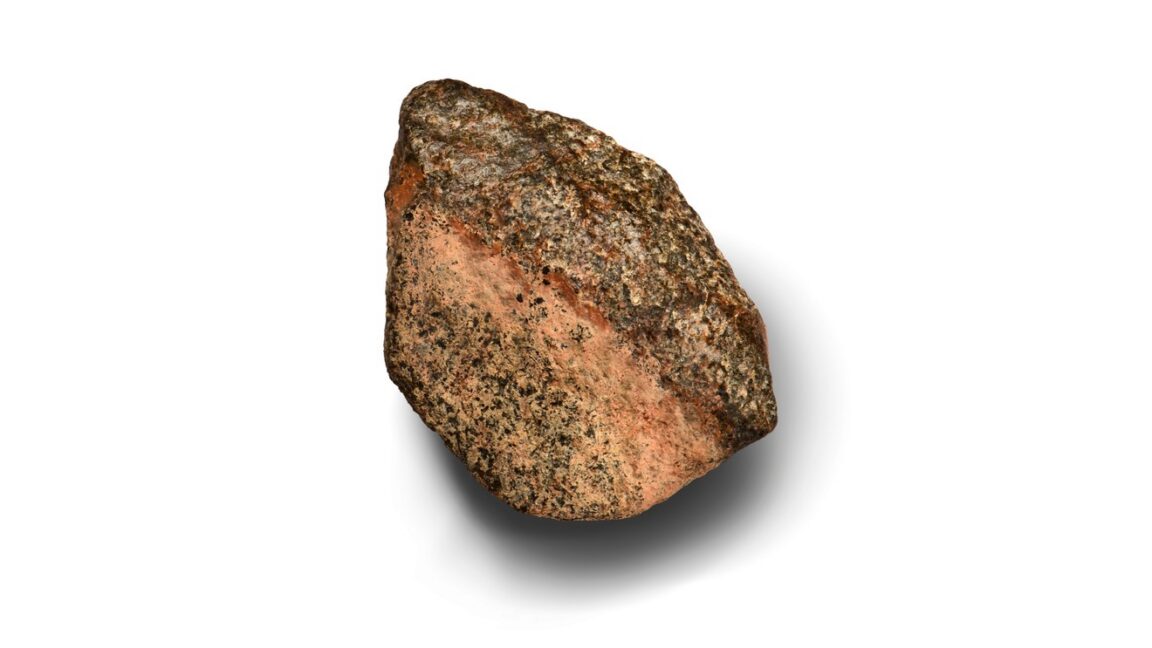
In 2022, a strange rock was found in the Sahara Desert, and now a new analysis reveals that it’s even more valuable to science than it first appeared. This fragment, weighing about two pounds, came from Mars’ crust . It was likely ejected by an impact, flying through space until it eventually reached Earth . The rock is one of the oldest known samples from our neighboring planet, estimated to be at least 4.1 billion years old. At that time, Earth was a young planet with intense geological activity , likely with oceans but no animals, plants, or any other complex life.
The location is not what makes this finding surprising. The Sahara has long been a kind of natural archive of the history of Earth and the solar system . Among its sands, scientists have found 40-million-year-old fossils and other meteorites. In 2019, for example, a 4.5-billion-year-old fragment was recovered that, according to recent research, may have come from an ancient, now-vanished protoplanet , possibly as large as the moon.
The meteorite, named Teghaza 001, might have remained just another entry in the collection of Martian fragments found on Earth. Although these rocks are extraordinarily useful for studying Mars’ composition and geological history, they often provide limited information about the environmental conditions of its distant past. However, a series of studies published in the journals Science and Science Advances revealed that Teghaza 001 is not like other samples. In addition to being exceptionally old, it has preserved chemical traces of the interaction between materials in the Martian crust and its ancient hydrosphere.
“One of the paper’s reviewers called it a Rosetta Stone for Mars,” Yang Liu of NASA’s Jet Propulsion Laboratory said in a press release .
Tiny crystals of a mineral called apatite preserves signatures of two sources of hydrogen: one originating from the interior of Mars and the other related to its ancient hydrosphere. In other words, the meteorite contains material that was altered by a water-rich environment. For years, there has been considerable evidence that Mars once harbored liquid water on its surface. Today, some of the big questions about the planet are whether that water allowed microscopic life to emerge and what happened to change this once hospitable environment .
This meteorite reveals that there was an exchange of materials between the magma deep within Mars and a watery surface. Since the rock comes from just about 500 million years after Mars and the rest of our solar system formed , this volatility occurred very early in the planet’s existence.
“This is really our first piece of Martian crust from a part of Mars we’ve never had a sample of before,” added Lee Saper, another NASA scientist who contributed to the research. “It records interactions of water and rock and maybe even an imprint of the Martian atmosphere as it was losing water.”
Today, Mars is a cold and barren planet, but it was not always that way. Evidence gathered by space missions suggests that it once had rivers, lakes, and possibly large bodies of water. But how that transformation happened over billions of years has remained a mystery. Answering that question is part of the reasoning behind sending probes, rovers , and perhaps, one day, crewed missions to Mars. But sometimes science is about serendipity, and answers arrive in the form of extraordinarily unlikely meteorites.
This story originally appeared on WIRED en Español and has been translated from Spanish.
In your inbox: Inside WIRED’s newsroom with Katie Drummond
They war-gamed dimming the sun —it went worse than you think
The Big Interview: Nathan Fielder tells us everything
Live tracker: Elon Musk’s America PAC is spending big on the midterms
Introducing the app: More ways to make the most of WIRED