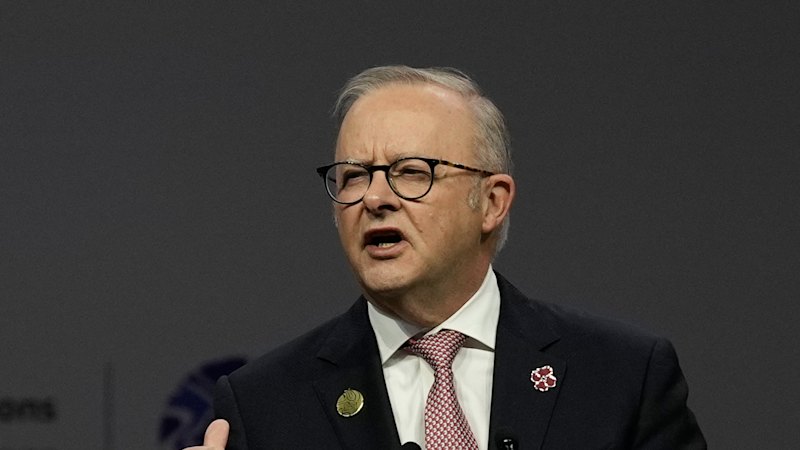
The Albanese government as well as state and even council leadership are facing a rebuke over struggling housing approvals. Picture: NewsWire / Martin Ollman.
Australia is approving almost 32,000 fewer new homes today than it was a decade ago, with grim new data prompting a warning for the future of the nation’s housing crisis.
And governments across every state and territory, as well as Anthony Albanese, are under fire over the continued lacklustre approval numbers that industry groups are warning will ultimately leave more Australians facing homelessness.
Australian Bureau of Statistics figures released yesterday showed a 5.1 per cent uptick in housing approvals across the country, with 17,948 given the green light in September.
RELATED: Albanese government 1.2 million homes target to fail twice over
National housing target falters as home approvals fall across Australia
Australians spend record $100bn on new homes amid tradie shortage
But with privately funded house approvals tumbling anywhere from 4.6 per cent to 7.8 per cent in every major state, and the national figure declining 5.3 per cent it was only volatile apartment approvals that led to an overall increase.
More concerningly, when approvals are tallied for the past 12 months the nation gave the go ahead to add just 208,318 new residences.
It’s almost 32,000 homes short of the Albanese Government’s 240,000 new homes a year target under the National Housing Accord.
Worse, that data shows that the 12 months to September, 2016, was the last time Australia actually reached the National Housing Accord target with 242,119 homes approved.
September 2026 building approvals data from the Australian Bureau of Statistics shows how each state performed in September compared to August.
While South Australia and Western Australia have both notched subsequent increases, the nation’s biggest building states have all gone backwards in the past decade.
NSW has approved 53,270 in the most recent 12 month period, down from 77,942 in 2016. In Victoria the numbers have plunged from 69,462 to just 55,303, while Queenslands efforts have diminished from 50,357 to 48,250.
Housing Industry Association senior economist Tom Devitt said the comparison from 2016 to today was noteworthy as it reflected the end of the nation’s last major apartment boom when vast numbers of approvals were coming from high-density housing.
“It’s the kind of comparison we need to do,” Mr Devitt said.
“That’s the target the Australian government has set for us, and it shows how much more heavy lifting the medium and high-density sector needs to be doing.”
The economist noted that there had been a capacity limit of about 120,000-140,000 new house builds in Australia since the 1980s, and that was limited by land releases and infrastructure, that was unlikely to be increased.
New house approvals fell in every major state in September, and numbers are below where they were a decade ago in NSW, Victoria and Queensland.
With almost 125,000 new houses approved in the past year, in order to reach the Accord goal, a vast increase in attached homes from units and townhouses to high-rise apartments is now needed.
Mr Devitt also warned the nation would shortly lose what momentum it had for approval numbers with impacts from rising oil costs earlier this year, as well as interest rate hikes and the federal government’s May budget all only expected to start impacting approvals from early 2027.
“It was heading in the right direction, but these numbers are still rearward looking to the momentum in the market earlier in the year.”
He added that HIA was currently revising its outlook for housing construction, and despite having already revised it down in August were not convinced it would get a further cut later this month.
When they last reviewed the data, they estimated Australia would build a little over a million new homes in the five-year timeline of the Accord — well short of the 1.2 million homes goal.
High rise construction is expected to take on an increasingly heavy load if targets are to be reached, but it is struggling in a number of key states, including Victoria.
Oxford Economics Australia lead economist Maree Kilroy said while current approvals looked bad against 2016 levels, it was worth remembering interest rates today were at the highest level since 2011 and that a decade ago they had been in a downward trend.
Ms Kilroy added that it was worth noting many apartments being approved around the country today where luxury or ultra luxury builds, and that the mass market was not seeing significant numbers coming online.
Real Estate Industry Association of Australia president Jacob Caine said with Australia continuing to remain in a “structural housing deficit” it was governments across the country that needed to be looking inward to address the issue.
“Governments across the country at the state and territory and the federal level continue to fail to deliver on promised housing delivery targets,” Mr Caine said.
“What that translates into for the average Australian out there looking for somewhere to live is a scarcity of choice, unaffordable prices and greater risk of housing insecurity or homelessness.”
More Australians facing homelessness is a risk if the nation does not begin to increase its housing construction volumes.
While there had been a range of economic factors change from 2016 to 2026, he said it was hard to ignore that 40 per cent of the cost of new build was now tied to government taxes or levies at some level.
“When we consider the average dwelling price, across houses and apartments, is effectively around $1m, it means $400,000of that is going to the government, be it local council, the state or the Commonwealth government,” Mr Caine said.
“When the government talks about housing affordability, they should be thinking about that 40 per cent that goes into their coffers and how to reduce that amount to make Australian homes more affordable for those who want to buy and more cost-effective for those who want to deliver them.” The Property Council of Australia chief executive Mike Zorbas said while an improving trend in the past month was welcome, turning approvals into action would come with challenges.
Turning new home approvals into actual homes being built comes with added challenges, which also need state and federal governments to address.
“Right now borrowing, materials and labour costs are running away from us,” Mr Zorbas said
“Worse, the May budget changes to taxes on housing investment and discretionary trusts are eroding market confidence and support for new projects.”
With realestate.com.au data also showing the housing market “under serious pressure” as values fall and buyer activity becomes subdued, he said more needed to be done to improve the feasibility of new builds.
“Tomorrow’s Reserve Bank of Australia decision could turn the dial again, while parliament is considering major changes to the way housing investment is taxed,” Mr Zorbas said.
“The government needs to fix the unintended consequences of its CGT and negative gearing changes and ditch the poorly designed discretionary trust tax grab.”
Sign up to the Herald Sun Weekly Real Estate Update. Click here to get the latest Victorian property market news delivered direct to your inbox.
MORE: ‘Nuts’: Secret Block meeting that decided win
‘Gone bust’: Block’s $152m black hole exposed
The new future on the cards for Mushroom Records home
Help us improve your reading experience
Got a minute? Your feedback will help us build a better experience for you.