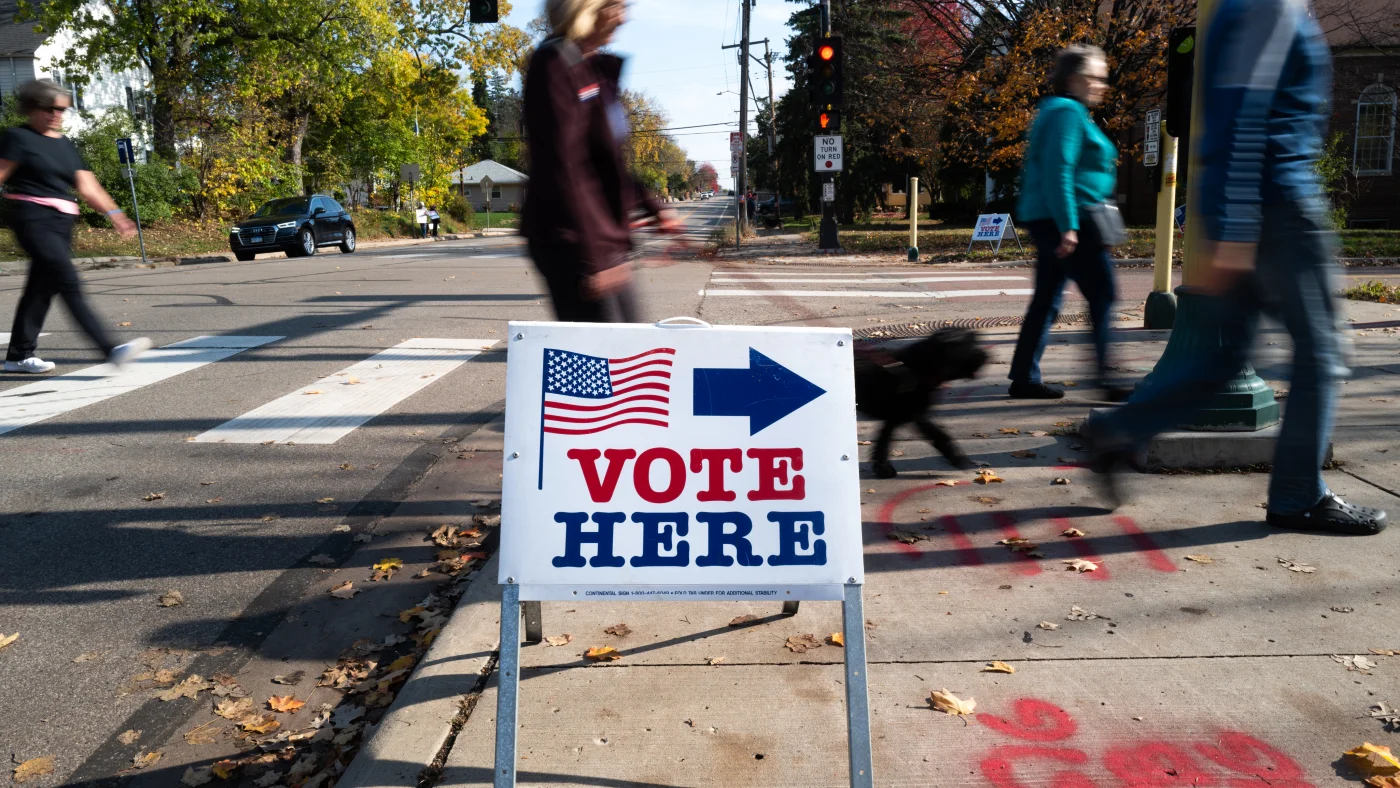
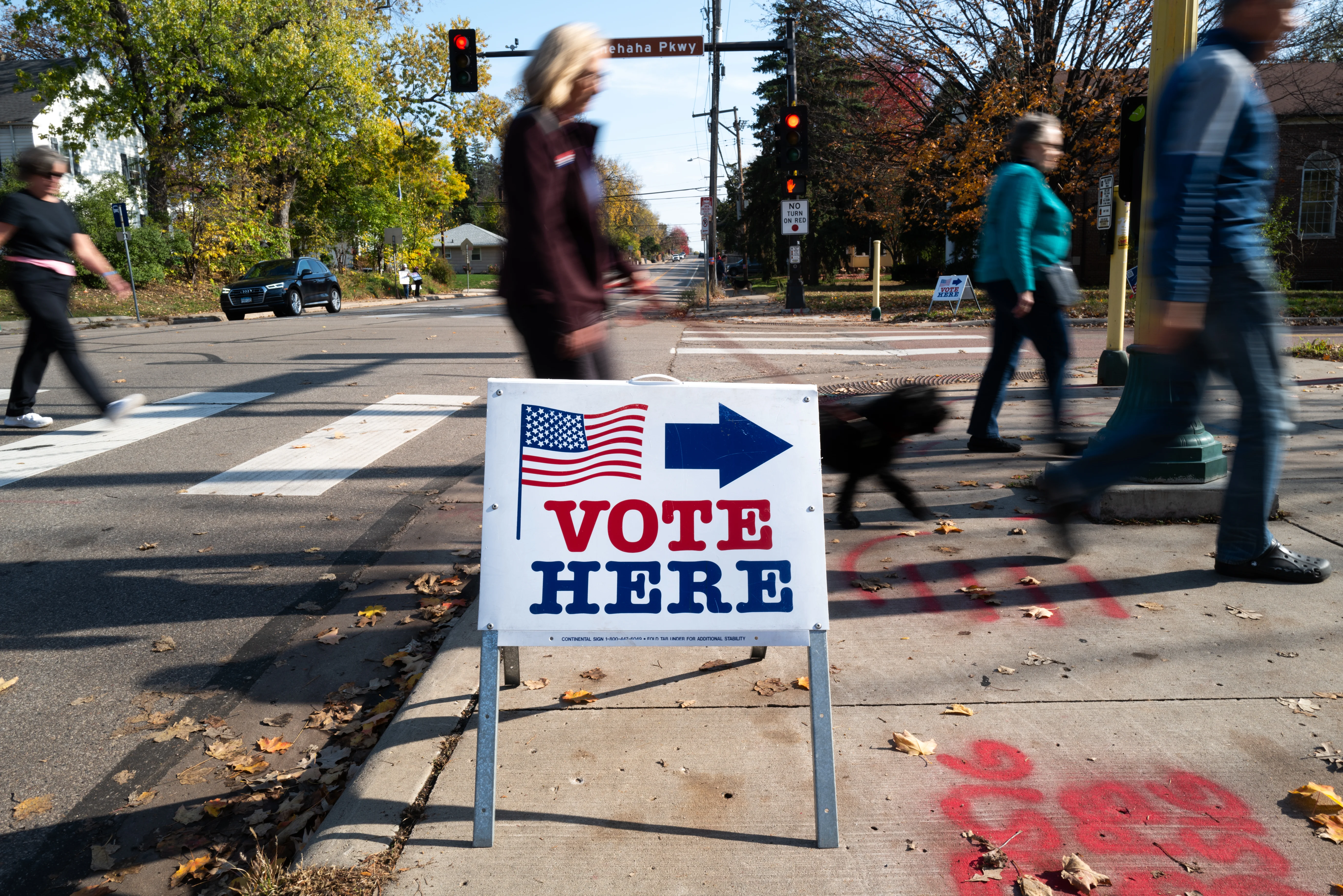

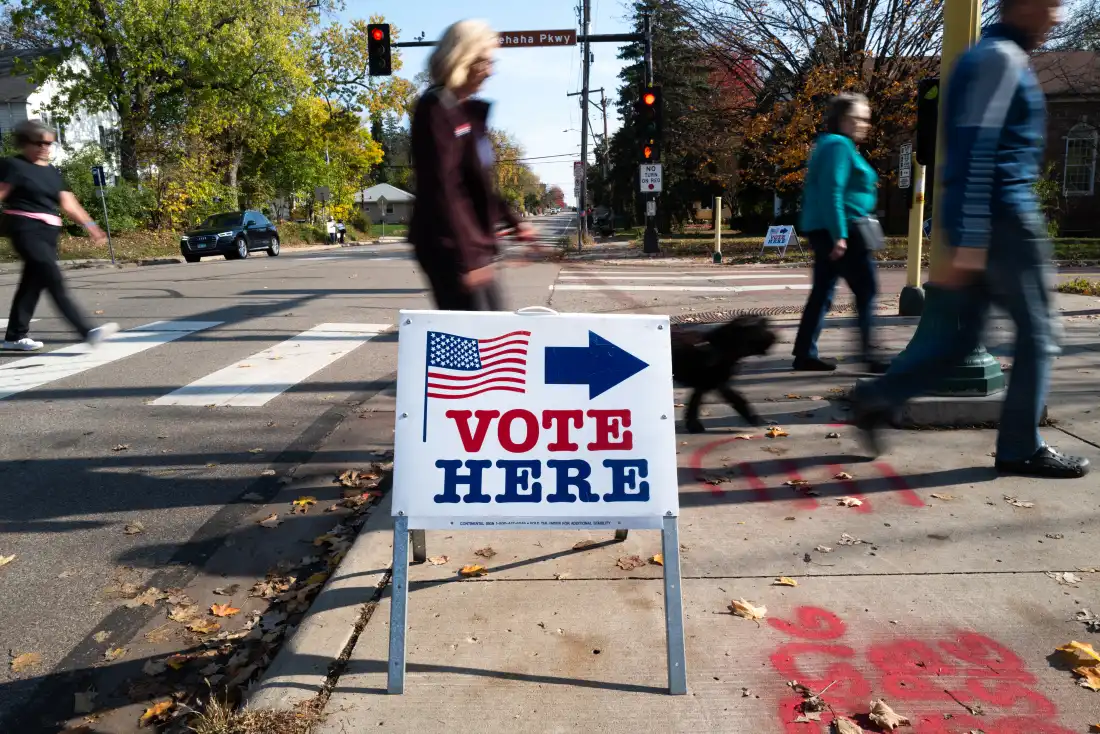
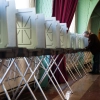


Signage directs people outside an early voting polling place on Oct. 28, in Minneapolis, Minn. America is deeply polarized politically, but research show the problem is not as extreme as people think. Stephen Maturen/Getty Images hide caption
HOUSTON and EDGEWATER, Md. — Shanna Berry and Alma Ong are friends, and one way they keep it that way is not talking politics.
In January, the pair was asked what they thought of the U.S. capture of Venezuela's then-president Nicolas Maduro. Sitting in a cafe, they initially declined to speak, citing their friendship.
Berry is a Christian, a retired hairdresser and an Air Force veteran who has supported President Trump. When pressed, she relented and offered her take on Venezuela.
"I feel like the end of the regime was necessary," said Berry, who is in her early 50s and wore a bright yellow cardigan. "I'm not sure of the legalities of how it was done and I'm a little jaded by the notion that it also had a very strong leaning towards having access to the oil in Venezuela, but I know that there are a lot of Venezuelan people who are really happy."
As Berry spoke, Ong's eyes widened. Ong, also in her early 50s, is more liberal and a Buddhist. She grew up in London, came to the US in the 90s and does not like the president.
She was surprised by Berry's answer.
"I agree with absolutely everything she just said," Ong said in astonishment. "That was amazing!"
Political researchers say America is deeply polarized politically , but that the problem is not as extreme as people think. Surveys show there is a messy majority in the middle who share views that cross partisan lines.
Kristin Laurin , a professor of psychology at the University of British Columbia, said Berry's and Ong's exchange matches a lot of research on political polarization.
"That was just such a perfect example of two things that I see in the literature," Laurin said.
One is that people don't want to talk about politics , because they're concerned about conflict. And that failure to talk can lead people to overestimate their political differences .
"These two friends were making assumptions about each other that turned out to be totally wrong," said Laurin. "It turned out, actually, they kind of believed the same thing."
Laurin said politicians and political elites try to paint their opponents as extreme to frighten and fire up their voters.
Meanwhile, social media amplifies political rage bait to drive engagement.
"Our perceived polarization far outstrips the actual polarization," Laurin said.
Researchers also have found that despite legitimate political differences, many people share similar values .
For example, in April, former FBI director James Comey was indicted for posting a photo of seashells on a beach that the Department of Justice said constituted a death threat against the president. Not only were Democrats appalled, so were many conservatives inside the beltway and beyond.
"I must be in a parallel universe to be talking about the shell art of James Comey," Jonathan Turley, a constitutional law professor at George Washington University Law School, told Fox News.
Shortly after the indictment, at a riverside restaurant near the Chesapeake Bay in Maryland, both Republicans and Democrats sided with Comey and the first amendment.
"Comey has always been an opinionated guy," said Stan Fletcher, a restaurateur who voted for Trump all three times. "But no one should be indicted for their opinion, ever."
While people may think of the left and right as two warring camps, Fletcher sees something different.
"I believe that 95% of America falls under a bell curve where we are all moderates," Fletcher said. But "what you hear is the wackos on the left and the wackos on the right."
The non-partisan Pew Research Center suggests that Fletcher is onto something. Pew says the political landscape is more diverse than many appreciate. It classifies Americans into nine separate groups based on values and attitudes.
Pew calls one group, the "Pragmatic and Polite Right." Among that group, 56 % are Republicans or Republican-leaning and 37% are Democrats or Democratic-leaning. The group, which has the oldest average age, places a high value on civility in politics, are conservative on economic issues and more moderate on race and immigration.
"Once you look beneath Republican and Democratic labels you see a lot of variation within the parties and a lot of overlap," said Jocelyn Kiley, who leads politics research at Pew. "Actually, this kind of messy political middle is larger than those groups on the ideological right and the ideological left."
In fact, Pew estimates the messy middle makes up about 60 % of the electorate. While the groups farthest to the right, which Pew calls the "No Apologies Right" and the "Faith First Conservatives," make up just 21 % of the population.
Pew offers a quiz for people to find out to which group they belong.
Kiley said political division in America is real, but people agree on more than they may think.
"We are a highly polarized country and there's also a lot of nuance underneath that," she said.
NPR does not offer or accept money for coverage or interviews. Anyone who makes such an offer or request is not an NPR employee and does not represent NPR.