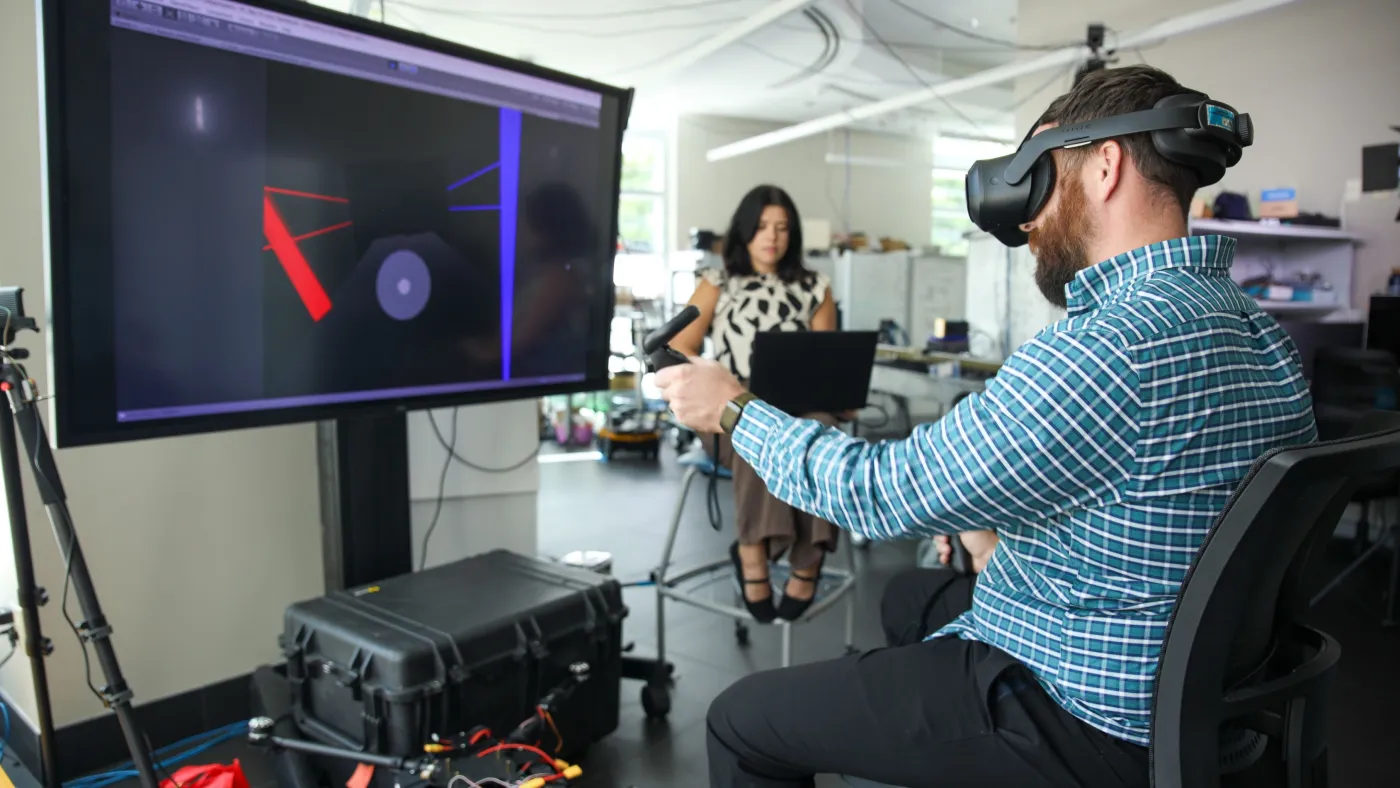


Luke Rosedahl, Ph.D., and Isabella Cabaleiro, research lab specialist, participate in a virtual reality experiment examining how movement affects learning. Florida Atlantic University, College of Engineering and Computer Science hide caption
Does swinging a lightsaber help us learn?
A new study from Florida Atlantic University and Brown University found that movement dramatically helps with certain kinds of complex learning. Luke Rosedahl , assistant professor of Biomedical Engineering at Florida Atlantic University, explored this question through VR gaming technology.
Under laboratory conditions, Rosedahl and his colleagues invited participants to don VR goggles. On the VR screen, participants were then shown a variety of striped objects. As the game went along, participants learned how to categorize the stripes into one bucket or another.
While some participants pressed buttons to learn, others did MUCH bigger motions – like swinging a lightsaber to hit the stripes, or punching a response box in front of them. The difference in learning outcomes was dramatic.
"With the larger movements like punching people learned somewhere between 4 and 6 times faster, which is just absolutely incredible," Rosedahl told NPR's Emily Kwong.
Interested in more science involving video games? Email us your question at [email protected] .
Support public media with NPR+ and enjoy perks for over 25 podcasts like this one. This show's perks include sponsor-free listening. Learn more at plus.npr.org .
Listen to Short Wave on Spotify and Apple Podcasts .
This episode was produced by Berly McCoy and Jason Fuller. It was edited by Rebecca Ramirez and Christopher Intagliata. Tyler Jones checked the facts. Hannah Gluvna and Robert Rodriguez were the audio engineers.
NPR does not offer or accept money for coverage or interviews. Anyone who makes such an offer or request is not an NPR employee and does not represent NPR.