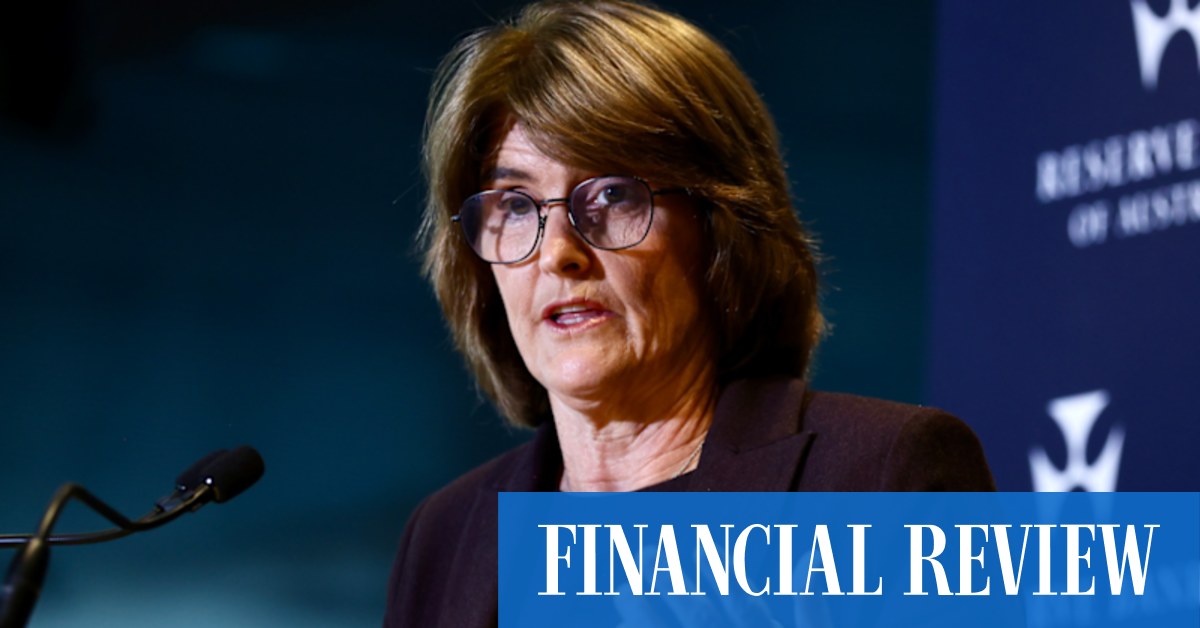
The RBA has been playing down the importance of the cashflow channel as mortgage holders brace for another interest rate rise. ( ABC News: Matt Roberts )
The Reserve Bank has been waging a public relations battle to convince Australians that interest rate policy doesn't primarily work to lower inflation by punishing borrowers.
This is known by economists as "the cash flow channel", whereby rising interest rates reduce the amount of free cash households have available to spend.
Less spending means less demand for goods and services, which in turn should mean less pressure for prices to rise.
It's the most visible channel by which interest rates affect households, at least for the third who have mortgages.
RBA governor Michele Bullock is defending policy around inflation. ( ABC News: John Gunn )
It's also the most obviously painful one for those households, which is why we've had statements like this from RBA governor Michele Bullock .
"Those who have mortgages, yes, this clearly impacts them and it hurts them. They've got less cash flow, and they've got less money to spend on things," she said at her last press conference.
"But that's not the only way monetary policy works through the system."
And deputy governor Andrew Hauser went even further in playing down the importance of the cash flow channel at the Citi Investment Conference a couple of weeks ago , drawing on recent research by the RBA's boffins.
"The cash flow effect, probably, in terms of our models, comes last," he said.
"It is first in the public discussion because obviously it's a thing people notice, and we are very sensitive to that."
But there's something the RBA officials talking about the cashflow channel generally neglect to mention.
There is a key reason it has a smaller effect, which is that it is a two-sided coin.
On one side are the borrowers, forking out substantially higher interest payments on their loans.
But on the other are savers, raking in much higher interest payments on their deposits.
To some extent, the two cancel each other out, reducing the overall impact of the cashflow channel on consumer demand.
That effectively understates the extent to which borrowers are lent on to dampen demand and, ultimately, inflation.
Calculations done by economists at the Centre for Policy Development, using National Accounts data, show that since rates started rising in 2022, for every extra dollar households paid in interest on their mortgages and other debt, households as a whole received about 72 cents more in interest income.
That number isn't a pure reflection of how the cashflow channel is diluted by savers.
It also captures part of a second transmission mechanism of monetary policy, the intertemporal substitution channel, which as Andrew Hauser said, "is a long-winded way of saying if interest rates go up, [people] actually have an incentive to save more or borrow less".
RBA deputy governor Andrew Hauser acknowledges cash flow is affecting households but says other more important factors play into policy around inflation. ( ABC News: John Gunn )
That's born out in APRA banking data, which shows the total value of outstanding household debt at prudentially regulated banks climbed about 25 per cent between March 2022 and June 2026, while the balance of household deposits jumped 37 per cent.
The latest August banking data shows there are now about 68 cents in household deposits for every dollar of household debt, up from about 61 cents in March 2022, before rates started rising from COVID lows.
A decade-old RBA staff research paper (which doesn't represent official views of the bank) found "the spending of borrowers is at least twice as sensitive as that of lenders to a given change in interest-sensitive cash flows".
That's because a lot more borrowers are living at or very near their financial limits.
There's a lot of disagreement on what's driving inflation and if it can be controlled here given global events. ( ABC News: Alistair Kroie/John Gunn )
Even so, the consumption from the new-found riches of savers blunts the overall cash flow effect, meaning borrowers need to suffer more through even higher rates to make up for it.
This differential also has inter-generational effects.
The RBA's 2016 research paper found the median age of net borrower households was 42, where mortgage debts are often at their peak, while the median age of savers was 58.
A paper by RBA researchers Sarah Jennison and Marcus Miller published last year backs up the earlier findings, showing that over-65s overwhelmingly benefited from rising rates, while most people aged 30-54 lost out. The effect was broadly neutral, on average, for under-30s and those 55-64.
Perhaps no surprise then that Commonwealth Bank data shows Australians aged under 55 have been reducing their spending growth over the past year, while those aged over 55 have accelerated their consumption.
Given that many of these middle-aged households have dependent children and all the expenses associated with them, it is no wonder they are feeling particularly under the pump.
Even within this broad group of borrowers, there are those more affected than others.
I bought my home eight years ago, reduced the principal owed on my mortgage and built up a sizeable buffer of offset savings, much of it over the four years post-COVID when I was on a 1.89 per cent fixed mortgage rate.
Two of the authors of the RBA's 2016 research, Gianni La Cava and Greg Kaplan, were among those who recently published a paper showing how financial buffers significantly altered the spending response of borrowers to interest rate rises, potentially blunting the cash flow channel of monetary policy.
In plain English, people like me who built up a lot of savings in our offset accounts and redraw facilities during the low-rate, big stimulus period of the COVID pandemic aren't yet cutting our spending in response to rate rises, because we don't need to.
When you add us to the group of mainly older Australians benefiting from higher interest rates, it leaves a very narrow group of people carrying the burden of the cash flow channel of monetary policy.
These are generally the younger, more recent home purchasers, with the biggest mortgages, the smallest financial buffers, and often the youngest kids, meaning less flexibility to pick up extra work.
This shows up in that 2025 RBA research, which suggests it is households in the middle of the wealth distribution, and those with mortgages at the lower and middle of the income distribution, who suffer the biggest hit to their cashflows from rising interest rates.
Most households at the lower end of the income scale are either renters or retirees who have already paid off their home, while households at the upper end of incomes are generally able to absorb the cost of higher mortgage repayments and have more options to trim discretionary spending.
When you look through the studies, no amount of central bank spin can sugar-coat the reality that middle-class mortgage borrowers, many with kids, are bearing the financial brunt of the fight against inflation.
"That cash flow channel, it is a blunt tool. And it's really tricky," the RBA's chief economist Sarah Hunter recently acknowledged on a personal finance podcast.
"And we know some people, especially if you're a first-time buyer and you've stretched yourself a bit to get on the ladder in the first place, and then interest rates go up, that's really tough. We know."
Michael Janda is the ABC's business editor.