Treasurer Jim Chalmers is under pressure after inflation figures pushed higher than expected yesterday. ( ABC News: Matt Roberts )
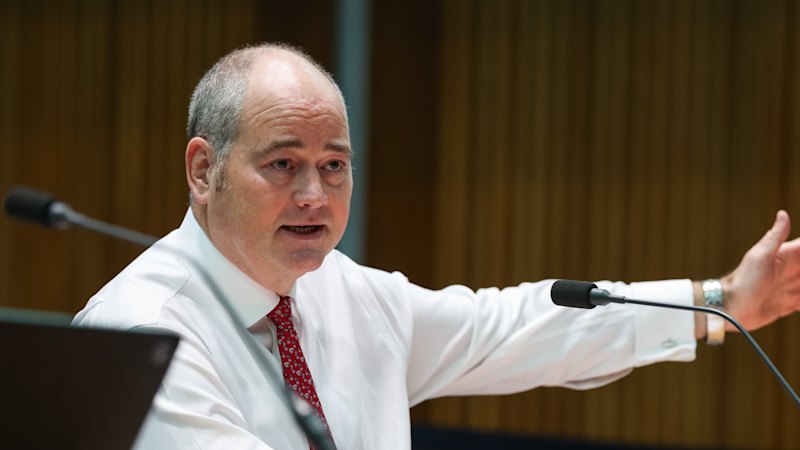
The head of the tax office says he would have consulted more closely with small businesses if he had his time again, conceding the ATO should have had a more open conversation before rolling out the credit card ban.
Meanwhile, households are bracing for the fifth interest rate rise this year, with pressure mounting on the federal government to find solutions.
Follow all the updates in our live blog.
Assistant Treasurer Daniel Mulino is out defending the government's economic management this morning, after inflation figures released yesterday painted a far from rosy picture of the future.
He repeats the line that the PM and treasurer used yesterday that high inflation could mostly be blamed on global factors, in particular the war in the Middle East.
But Radio National Breakfast host Sally Sara pushes him to explain what more the government could be doing to reign in its own spending and make life a little easier for Australians.
"What we're doing as a government is to continue to find savings," Mulino says.
Mulino won't talk specifics, but says "responsible fiscal management" will be at the heart of the next budget update, known as MYEFO. It's something we've heard before from Treasurer Jim Chalmers.
He also pointed to productivity measures, including freezing the National Construction Code, while cautioning there would be "a bit of a lag" before any benefits flowed through to the broader economy.
Allowing assessors to override decisions made by the government's aged care assessment tool could cost up to $11 billion over four years.
This week the Commonwealth Ombudsman released a scathing report on the use of automation in the nation's aged care system, which commenced last November.
The ombudsman's recommendation to introduce legislation to allow override by a human was noted by the government, but not accepted.
Fronting Senate estimates last night, the Department of Health, Disability and Ageing's Robert Day said preliminary modelling had been conducted into the potential cost of implementing the measure.
"There's a degree of uncertainty, both in terms of there are a number of different models and also in terms of some of the assumptions around what practice would be," Day told estimates.
"But our preliminary modelling [shows] if there were ... very few, if any, limitations on assessor's ability to override, that cost could be up to $11 billion over the forward estimates."
Liberal senator Jane Hume stopped for a quick chat with friend of the blog Nicole Asher outside the doors of the Senate this morning.
She says the evidence from the ATO in estimates last night was "telling".
"[They said] they may have bungled that credit card surcharge ban ... and they absolutely did," she says.
"It's a demonstrated understanding that it's not just our agencies, it's also our government who does not understand what small businesses are going through".
Hume says the ball is now in the government's court to find a solution.
Under questioning from Shadow Small Business Minister Jacinta Nampijinpa Price, ATO commissioner Rob Heferen conceded the tax office would handle the rollout differently if given another chance, saying it should have had a "more open conversation" with businesses from the outset.
"To essentially share the problem we faced, rather than coming with a, 'This is what we're going to do and here's a transition period,'" he told Senate estimates.
The Australian Taxation Office boss has conceded the agency could've consulted small businesses better before announcing its controversial credit card ban.
Commissioner of taxation Rob Heferen told Senate estimates last night he realised the Reserve Bank's surcharge ban would be a "real issue" for the ATO after receiving a letter from Assistant Treasurer Daniel Mulino about the RBA's reforms on April 28 this year.
"That brought it to a sharp head," Heferen said.
The commissioner said two options were subsequently formulated by the tax office: continue accepting credit card payments and request government funding or ban credit cards and map out an appropriate transition for those impacted.
He said he first had a discussion with Mulino about the matter on July 20, and a series of meetings followed.
Heferen said that on September 25, based on advice from his senior executive, he personally arrived at the decision to propose the credit card ban, and small businesses were informed on September 30 — a day before it was made public.
And welcome back to the live blog, coming to you bright and early from Parliament House in Canberra.
My name is Holly Tregenza, and I'll be stepping in for Courtney Gould and Josh Boscaini today to take you through all the moments that matter.