Trending
Prev Story
Next Story

China’s snooping around Pacific undersea cables raises risks for Big Tech

Ars Technica •
October 28, 2026 • 11:00 AM
1
1 reads 0 reactions

US-owned trans-Pacific cables face growing risks from sabotage and China.

China’s snooping around Pacific undersea cables raises risks for Big Tech

Subsea cable projects owned by US companies such as Google and Meta face some of the greatest risks from the threat of deep-sea sabotage in the Pacific Ocean, according to a new report. That coincides with Chinese research ships spending an extraordinary amount of time apparently surveying undersea cables—not to mention Chinese commercial ships being investigated for cutting cables in both European and Asian waters.

Most damage to the undersea cables that form the Internet’s backbone is the result of accidents involving bottom-trawling fishing nets and ship anchors dragging on the seabed, with storms and undersea landslides also factoring in. But the recent rise in international tensions and open conflicts have placed new scrutiny on more suspicious instances of cable-cutting damage, with analysts warning about Russia and China in particular engaging in cable sabotage or tampering as “gray zone” tactics that fall short of direct military confrontation.

One of the newest risk assessments of China’s gray zone tactics targeting the Internet’s undersea infrastructure comes from a research report published by the US-China Economic and Security Review Commission , an independent government commission that advises Congress. The report was contracted to the London-based think tank China Strategic Risks Institute and published in September 2026.

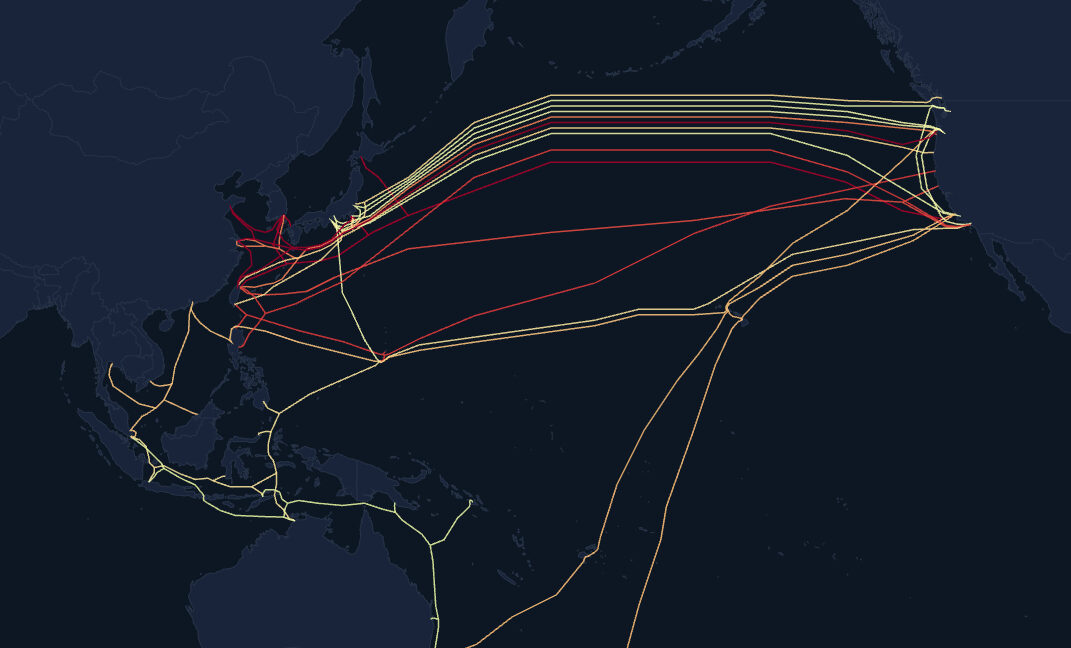
The report authors created an interactive Trans-Pacific Cable Gray Zone Vulnerability Index that ranks the undersea cables considered most at risk and displays a map of their routes spanning the Pacific Ocean. Such an index could help identify which cables should get highest priority in terms of placing underwater sensors or setting up patrols to monitor for threats.

Risk factors used in the vulnerability index include the undersea depth of the cable routes, nearby shipping traffic, cable ownership, China’s exclusive economic zone and broader territorial claims , and whether each cable connects to Taiwan. Taiwan is considered a geopolitical hotspot as a self-governing island democracy that is also claimed by China, with the latter ramping up military maneuvers involving warships and aircraft around Taiwan in recent years.

Prev Swipe Story Next

Same Story from Other Publications

Compare how 6 other independent news outlets reported on this story.

6 Publications
TechCrunch
1h ago
Export-banned Nvidia chips are behind China's most powerful AI models—uh oh, Jensen! | TechCrunch

Export-banned Nvidia chips are behind China's most powerful AI models—uh oh, Jensen! | TechCrunch

New research shows the most advanced AI models from China were trained on banned Nvidia chips.

The Next Web (TNW)
3h ago
Bessent says anyone at Nvidia should answer for chips reaching China

Bessent says anyone at Nvidia should answer for chips reaching China

“Did Nvidia know their client?” Bessent asks, saying anyone at the company should be held accountable for chips leaking to China.

Rest of World
3h ago
How Jensen Huang’s exit from Nvidia impacts China’s AI supply chain

How Jensen Huang’s exit from Nvidia impacts China’s AI supply chain

The founder’s stunning departure removes Beijing’s biggest advocate in Silicon Valley, accelerates chip stockpiling, and leaves Asian suppliers bracing for what comes next.

Hamro Patro News
4h ago
PM Shah directs RSP lawmakers to focus on Nepal-China relations

PM Shah directs RSP lawmakers to focus on Nepal-China relations

Kathmandu, Nov 13: Lawmakers of the Rastriya Swatantra Party (RSP), who are conducting China visit after two days, collectively met Prime Minister Balendra Shah in the Office of the Prime Minister ...

BBC News
4h ago
Bessent blames Lutnick's department for not banning Nvidia chip sales to China-linked firm

Bessent blames Lutnick's department for not banning Nvidia chip sales to China-linked firm

Scott Bessent told CNBC that several government agencies "were in favour of putting Megaspeed on the entity list for months".

CNBC World
8h ago
Nvidia scandal draws in Commerce Secretary Lutnick, who reportedly agrees to testify about China chip sales

Nvidia scandal draws in Commerce Secretary Lutnick, who reportedly agrees to testify about China chip sales

Commerce Secretary Lutnick will testify before the Senate Banking Committee following revelations about Jensen Huang's affair with an alleged Chinese spy.

Related Stories

Technology
Build #2611