You have reached your maximum number of saved items.
Remove items from your saved list to add more.
You've used all of your gift articles. 3 more will become available on the 1st of every month.
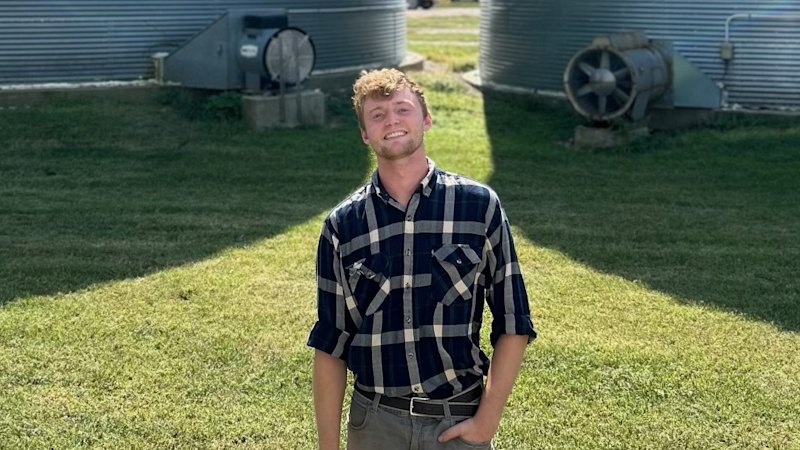
Caleb Renner, a young corn and soybean farmer from north-central Iowa, has voted for Donald Trump twice. A fifth-generation farmer, he comes from a state that has been fiercely loyal to the president, backing him with a growing margin at each election.
But on November 3, Renner will vote for Democrats for the first time. He doesn’t believe he’s alone in breaking from the president and the Republicans.
“I would say Liberation Day was the beginning,” he says, referring to Trump’s announcement of sweeping tariffs on most US trading partners, including Australia.
“How he handles foreign trade is extremely damaging to farmers. It all comes to a critical point with the Iran war. That’s the most in-our-face, anti-campaign promise policy action that he could have taken … I feel very betrayed.”
If there is a blue wave at these midterm elections, it will show up here in the American heartland – farmers and small-town folk hit particularly hard by rising fuel prices , tariffs and trade wars .
Polls suggest something is afoot, but the extent is difficult to gauge, and their record of accuracy is patchy. The Cook Political Report rates four Midwest Senate races as toss-ups: Iowa, Kansas, Michigan and Ohio, along with Alaska, Texas and Maine. Democrats need a net gain of four seats to control the chamber.
The 25-year-old Renner was never a diehard Republican. He grew up in an area where people instinctively voted conservative; in 2024, he supported Trump “with hesitancy”, mostly because Trump was endorsed by Robert F. Kennedy Jr, whom he liked at the time.
But now the president’s policies are having a material impact on his life. Disruption in the Strait of Hormuz has spiked the cost of fertiliser. Trade disputes with China slowed down soybean sales . The price of diesel has risen from below $US4 a gallon to more than $US6 ($8.55).
“Every single step of the harvest process relies on diesel. We’re not running EVs or gas-powered tractors,” Renner says. “You’re basically 2x-ing one of our inputs, which is going to show up on our balance sheets at the end of the year after harvest. Our margins are getting tighter, and the markets are not getting any more favourable.”
At a campaign rally in Kansas last week , Trump announced a $US8 billion aid package for farmers hit by fuel prices. It followed a $US12 billion relief effort late last year to combat the impact of trade disputes. But the money won’t flow until after the election.
Renner scoffs at the idea. “It’s putting a Band-Aid on a bullet hole,” he says. Nor does it work, he argues – the money just ends up with the banks and suppliers. “Then what happens next year is the input companies are going to say, well, farmers afforded that last year, so we can continue rolling out these outrageous prices for fertiliser, for seed, for chemicals. All this does is inflate the farm economy.”
The $US8 billion lifeline was welcomed by the American Farm Bureau Federation, a national agriculture lobby group. But to Renner, the ploy smells of election desperation. “I think he’s under the impression he’s going to buy back farmers’ votes if he throws money at us. It’s honestly disrespectful.”
Renner says he will vote for the Democratic candidate for the US Senate in Iowa, Josh Turek, and Democratic gubernatorial hopeful Rob Sand. But he plans to vote Republican in some local races – “ticket splitting”, as it’s known in the US. “If you are beholden to one party, then you’re not really a voter,” he says. “You’re more just a rubber stamp.”
It’s one thing for a young farmer who is still figuring out their politics to switch sides. But convincing lifelong Republicans to turn blue is another matter. The more likely outcome is that people disappointed by the president and the Republican Party simply stay home.
That’s precisely what Glenn Brunkow, the president of the Kansas Farm Bureau, predicts will happen. The fifth-generation farmer of sheep, cattle, soybeans and corn is also feeling the pinch from higher prices. He meets this masthead at his office in Manhattan, Kansas – a city north of Wichita fondly known as The Little Apple.
“I think there’s some frustration,” he says of the agriculture community. “The volatility is more the frustration than anything. One news cycle, one tweet, one social media post, and it affects the markets greatly … There’s no way to plan what’s going to happen.”
Trump recently tried to settle the consumer price of beef by importing more meat from Argentina , a move that did not go down well with farmers. “It really had no effect on the ground beef price,” says Brunkow. “But it did affect the price we receive for calves.”
The Trump administration doesn’t seem to understand the agriculture business, Brunkow says. He won’t reveal his own voting intentions, but says there is rising apathy in the agriculture community that is likely to result in people choosing not to vote.
“I’ve heard from producers, ‘DC doesn’t get me, they don’t understand, and there’s no point in voting’. Most agriculture producers are staunch Republicans. There probably are some that have changed. But for the most part, I think if there’s a change in the party dynamics in Kansas, it’s because Democrats showed up and Republicans didn’t.”
Many ranchers are not thrilled to vote Republican this year, but will do it anyway. Landrey McGahuey owns a cattle farm on 2000 acres in south-west Iowa, just outside Mount Ayr. He has signs outside his home for several Republican candidates and is clearing dirt with his excavator when this masthead randomly stops by.
McGahuey says he votes Republican because “it’s more logical, their way of thinking”. He has a distaste for liberal politics, although he doesn’t specify the problem. And although he’s hurting from the higher cost of diesel, he doesn’t blame Trump or the Republicans.
“I really just don’t blame anybody for it,” he says. “I don’t follow politics a lot because it just seems like you got two groups of people that are so far apart, and they become further apart every day. Nothing gets accomplished, and it’s tit-for-tat.”
The 44-year-old sometimes sounds like a disgruntled citizen who won’t vote for either side. He knows a few of those people – locals, customers, other farmers – who will stay home rather than show up for the Republicans.
“They’re starting to question what [Trump] is capable of doing or maybe what he said he was gonna do that he hasn’t done,” he says. “But I think … every time he tries to get something done, there’s a roadblock. He has so many people working against him that he doesn’t get to do the things that he wants to do. He has contradicted his timeline on certain things a few times. But I don’t know that it’s his fault.”
That is a common sentiment in this part of the world. Such is the distaste for Democrats and the so-called Washington elite that Trump – who promised 10 years ago to “drain the swamp” – is given a long leash and afforded the benefit of the doubt.
Trump is appearing in the region regularly, trying to mobilise the conservative vote. He rallied in Kansas last Monday and Iowa last Thursday, and will return to Iowa on Sunday, after a swing through Mississippi, Texas, Ohio and Florida. Vice President JD Vance was in Kansas on Monday, too.
A Marist poll of 1100 registered Iowa voters, taken earlier this month, showed Democratic Senate candidate Josh Turek ahead of his Republican rival, Ashley Hinson, 48 per cent to 45. Democrat Adam Hamilton is narrowly leading Republican incumbent Roger Marshall in Kansas, according to most polls, although Kansas has not sent a Democrat to the US Senate in 94 years.
Still, even Caleb Renner, the young Iowa farmer, believes it will be difficult for Democrats to pull off victory in the heartland.
“There’s a lot of dissatisfaction with the Trump administration, and a lot of frustration with how the economy has been handled. But also a lot of hesitancy voting for the Democratic Party,” he says. “I’m worried that that’s going to translate to some upsets.”
Renner argues the Democrats have a branding problem: they are perceived as dominated by social and cultural issues that don’t resonate in rural Iowa.
And he has personally encountered a nasty edge on the left that did not impress him. He recently appeared on The New York Times podcast The Daily , talking about his shift away from the Republican Party. The most negative feedback came from progressives – people telling him he brought the situation on himself by voting for Trump.
“I find it kind of funny,” Renner says. “You’re not going to win elections off of that. It’s going to be a continuous cycle of pointing fingers and making your tent smaller and smaller and smaller. If that’s what people on the left want to do … then sure, I get it. I feel ashamed about it myself. But good luck winning elections.”