You have reached your maximum number of saved items.
Remove items from your saved list to add more.
You've used all of your gift articles. 3 more will become available on the 1st of every month.
I’m immensely proud of my home suburb of Eastwood, incidentally also the home of Ryde Hospital where I was born, but it’s not the most widely known pocket of our city.
Back in the day, answering questions from fellow Sydneysiders about where I was from was a two-step process. “Eastwood,” I’d say, followed swiftly by “have you heard of it?” More often than not, the answer was no, cueing a little dance of triangulating a nearby suburb they’d actually recognise.
Eastwood, about 15 kilometres north-west of the CBD as the cockatoo flies, is more on the map these days, helped along by its current era as one of the best hotspots of Chinese and Korean food in the city. But it has some history.
Originally the land of the Wallumedegal people, bits of what’s now Eastwood eventually ended up in the hands of some local landowners of surprising renown. Gregory Blaxland, part of the first white settler expedition to cross the Blue Mountains, planted one of the continent’s first vineyards, and his original house lives on as Brush Farm House. However, that’s not even the most famous chapter of Eastwood’s horticultural history.
In the 1860s Maria Ann Smith tossed some discarded crab apples out her window and, entirely by chance, propagated the now world-famous Granny Smith apple. This piece of lore is celebrated annually with Eastwood’s Granny Smith Festival, held every October, as well as with a memorial park. Next time you bake tart green apples into a pie, spare a thought for the legendary Maria Ann and her orchard.
Eastwood’s next era arrived with the train station, now on the T9 Northern Line, which let the suburb properly grow up and join the city. Federation-style houses and California bungalows dot its wide, eucalyptus-lined avenues, while shopfronts line Rowe Street, Eastwood’s high street. A former brickyard that I always remembered as an incongruous chasm in the middle of a residential suburb has now been filled and turned into housing, although the historic chimney stacks have been preserved, while my favourite architectural gem has to be the striking Masonic Temple, now surely one of the most unique homes for an appliance store.
That was the Eastwood of my childhood in the late ’80s and ’90s: a Milky Way from the milk bar, then a “quarter chicken and chips” from the “Red Rooster of Eastwood” – not to be mistaken for the national chain. Both institutions, sadly, are long gone.
My family was among the earlier East Asian families to move into the area, arriving from Hong Kong via pit stops in Geelong and Ashfield before I was born. My earliest memories are of our Eastwood home: a chicken coop (until a fox ran riot) and yards packed with fruit trees and vines including bananas, mangoes, passionfruit, lemons, strawberries and the odd bland choko. I would feed one neighbour’s pets each summer and swap gifts with our other neighbours each Christmas: a plate of our curry puffs for a tray of their scones and cakes.
Eastwood’s latest era has continued to be shaped by migration, with many families’ children now two or three generations in. Among the things they’ve brought is their food. The train line splits Eastwood’s high street neatly in two: walk the western end of Rowe Street and you’ll hit Chinese restaurants, bakeries and boba stores, while the eastern end brings Korean barbecue, cafes and grocers.
There’s plenty to choose from but two local favourites are Traditional Cantonese Taste on the western side, famous for its steamed rice-paper rolls, and Jeans Chilli Chicken on the eastern side, serving, you guessed it, spicy Korean chicken out of the Eastwood Hotel, one of the suburb’s watering holes. In a city where everyone (myself included) complains about how early things shut, central Eastwood stays brightly lit and lively well into the night.
The rapid change hasn’t always been smooth, mind you. Parking in Eastwood is infamously dreadful. The same parking lots that used to be so empty on Sundays that I would use them to learn to ride a bike as a kid are now gridlocked by mid-morning. Some parts of the suburb are showing their age, too, none more so than Eastwood Shopping Centre – once a focal point that towered over the rest of the neighbourhood, now on its last legs after losing major tenants including Target over the decades. These days it’s probably best known for being the home of one of the few Woolworths in the city that’s kept its original signage.
That clash of old and new keeps surfacing in town-planning stoushes, too, like the failed, well-meaning but divisive push to turn Eastwood Oval, the suburb’s biggest green space and former lake, into a car park , or the separate (also failed) proposal to heritage-list most of the suburb in the face of the growing replacement of older bungalows with newer, larger but inevitably less charming modern homes.
No suburb stands still, and for all the growing pains there’s a vibrant mix of old and new here that keeps drawing me, and plenty of others, back.
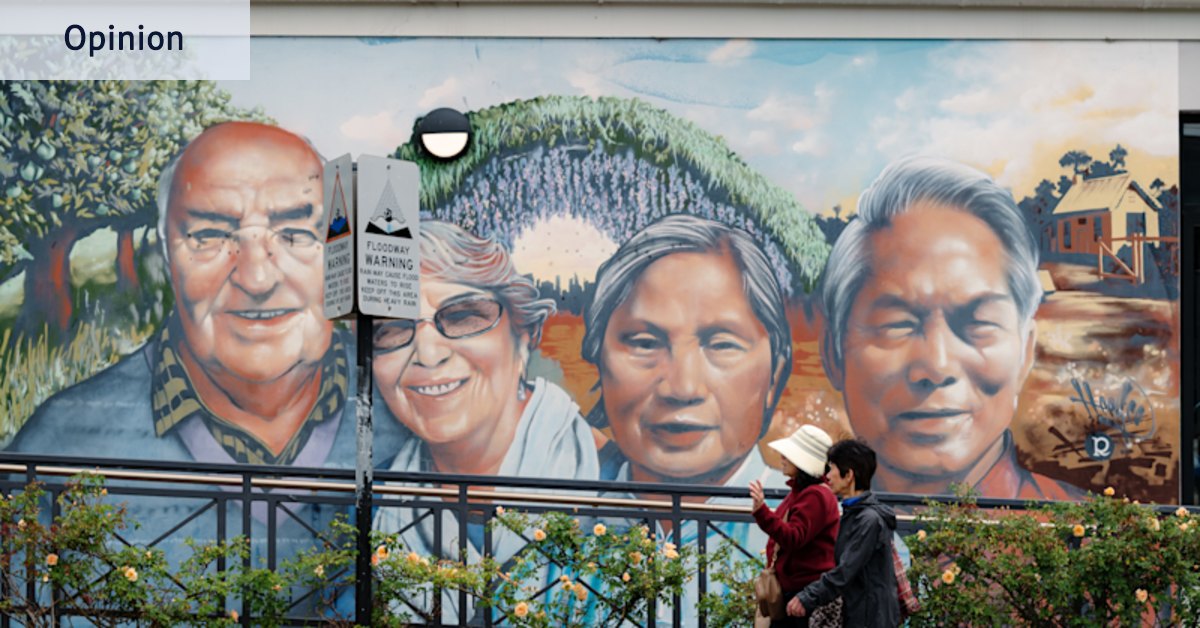
On a recent sunny Sunday I went for a long walk: past the WWI war memorial, the library with its Moon Festival mural , and the Croquet Club (established circa 1935). Then through Darvall Park , a rare surviving fragment of the Blue Gum High Forest that has shrunk as Sydney has grown, with its chattering birds, before picking up some Taiwanese braised pork rice for dinner. It struck me, once again, how hard it’ll be to ever leave the suburb I was born in. I love this current era of Eastwood and I can only wonder what’s coming next.
Ben Au is a lifelong Eastwood resident.
