Prompted by plans for a new tech-city in Uruguay, Elizabeth Farrelly questions whether the concept of urban utopia, rooted in perfectionism, obstructs the fundamental notion of the city as res publica : “a universal welcome to all comers.”
Elizabeth Farrelly questions whether the concept of urban utopia, rooted in perfectionism, obstructs the fundamental notion of the city as res publica : “a universal welcome to all comers.”
“ There’s no going back from this realisation. No returning to smaller dreams.” Thus spake 30-year-old Dryden Brown, former professional surfer turned AI-preneur, in a long speech promoting the new tech-city that his company, Praxis, is founding in Uruguay, known as “+Colonia.”
With $525 million in spending money from “a network of people who’ve founded companies over $400 billion,” Dryden had been scouting for sites. As you do. First, in November 2024 (just before Donald Trump’s re-ascendance) he tried “to buy” Greenland . But then Uruguay popped up, with its favourable tax regime, and Brown chose a site “just across the river from Buenos Aires.” A fancy website promises resort living in a vaguely classical beachside atmosphere replete with stone colonnades, brimming pools and pseudo-Periclean bronzes. The universal style is a kind of stripped classicism that sits somewhere between Mussolini’s Rome and La Mer , the ill-fated Bellevue Hill house James Packer built for Erica in 2013. And yet, weirdly, Praxis promises a city to nurture young writers, musicians and artists, and to hobnob with the tech-bros.
The claims are grand, perhaps exciting – but also, being grand, dangerous. Israeli intellectual and philosopher Dr Micah Goodman argues that utopias are for children. Unrealistic, naive, unachievable, they manifest a yearning for the kiss-it-better parent. But neither the thrill nor the primitive appeal makes such yearnings harmless. Indeed, their power is often more seductive for being subconscious. It’s in the language, as much as the dreams themselves – the subtle shift from argument to polemic.
Brown’s messianic declaration that “we stand at the threshold of the intelligence age, where human work no longer drives the engine of civilization,” is vibrant with echoes of Marinetti’s 1909 polemic on futurism: “We are on the extreme promontory of the centuries! … We are already living in the absolute, since we have already created eternal, omnipresent speed.” 1 Brown’s evangelical insistence that “once you’ve glimpsed this possibility, nothing less will ever be enough,” resounds with half-memories of architect and city planner Daniel Burnham’s famous 1910 enjoinder: “Make no little plans. They have no magic to stir men’s blood .…” 2
And it’s this, the stirring of men’s blood, that makes such polemic dangerous, given how slim the line is between heroism and madness. This is not just about the perfect as enemy of the good. The utopia question pivots on our definition of “city” and whether the very idea of the perfect is inimical to the city as res publica .
Marinetti’s manifesto was an emphatic rejection of history, morality, scholarship and women – and a glorification of speed, war, violence and danger. True, these values were broadened and softened somewhat in being absorbed into international modernism, but both the reckless optimism and the ruthless chauvinism remained. Indeed, the whole modern project can be seen as an experimental utopian dreaming. Within it, many smaller utopias have been attempted – mostly with the kind of historical-nature focus favoured by hippie communities and religious cults, underpinned by unrealistic social reform that drew heavily on St Augustine’s fifth-century City of God and Thomas More’s proto-Marxist Utopia from 1516.
More interesting, in built form terms, are the urban utopias, where people have tried to mould city fabric into a form that will itself inspire its residents with purpose. Formal symbolism is a key tool here. Take Auroville, a city for 50,000 founded in 1968 in Pondicherry, southern India. It was the brainchild of Paris-born Jewish woman and guru Mirra Alfassa (1878–1973) who, interested in the occult and the yogic teachings of philosopher Sri Aurobindo, had lived in an ashram in the area since 1920.
Known to her followers simply as The Mother, Alfassa’s initial 1965 concept for Auroville was based on a pinwheel, or “galaxy-form,” divided into four sectors – cultural, industrial, residential and instructional. The still centre of this whirlpool is marked by the Matrimandir, a sort of large golden golf ball emerging from the ground, and is organised around what its principal architect Roger Anger described in the 1980s as “lines of force.” Regular geometry is consciously avoided since, as noted by current Auroville architect David Nightingale in 2024, that would tend them regrettably towards a formal new city such as Brasilia or Canberra.
Does such explicit symbolism work? Well maybe. Auroville, unlike many spiritual communities from the 1960s, does at least still exist, with residents from 60 different countries (including 18 Australians). Many love it, but the population remains small (currently 3,527 including children), so the sense of a boutique and self-selecting urban tribe is hard to resist.
Almost the inverse of Auroville, formally as well as ideologically, is Saudi Arabia’s much-hyped Line project. Far from welcoming nature, The Line sets itself insistently against her – slicing a 170-kilometre-long, 500-metre-high mirrored double line unswervingly across the desert sands to create, within, a lush high-rise oasis for 9 million. This was the utopia not of symbolism but of self-sufficiency; an Icarus-like determination to prove humans superior to nature. With no cars, no roads, no pollution, everything anyone would ever need stacked vertically into this 100-plus storey space. But, in the end, given a projected build cost of US$8.8 trillion, it’s no surprise that The Line is now on indefinite pause.
Another version of the self-sufficient utopia is the various visions of life on Mars – including Bjarke Ingels’ Mars Science City project for the UAE, and NASA’s Mars Habitat project, featuring designs by Foster and Partners and Hassell. The attempt here is less to create a sense of urban meaning than simply to facilitate survival in a deeply hostile environment without water or oxygen. Turns out it’s not as simple as making a giant bubble and filling it with humid air, assuming you can manage even that. How to grow plants absent water is just part of it; bugs are a problem – we need microbiota, and we need them constantly replenished – and that’s all before you even get to niceties like symbolism, dignified streets or a sense of purpose.
In a way, though, it’s not so different from Dryden Brown’s far-flung tech-bro fantasies of +Colonia. The site exists, Brown has moved there, the tax laws are favourable, and construction has begun. “Visualise the bustling streets, the soaring architecture, the hum of innovation,” he said in 2024.
“Picture the schools where our children will learn to dream audaciously .… the literature that will spring from this soil – the culture that will define an age. This is what we’re building. Not just a city, but an idea powerful enough to fulfil our rightful destiny, with the grace of God.”
Destiny? The idea of the tech-bros in charge of cultural destiny has to ring alarm bells. In Brown’s Praxis, AI has replaced human labour, “ religion monopolises meaning ” and “the state” allocates resources according to moral principles. It’s essential theofascism. What does it look like? The NYT quotes an internal Praxis branding guide that it says extols “traditional, European/Western beauty standards” and denounces dissenters from these as “enemies of vitality.”
What are these Western beauty standards? Well, classicism, in a word. Which of course brings us back to Trump. This whole “ Network State ” movement – centred on the idea that cryptocurrency needs to be given urban form and that a community of tech billionaires is not only plausible but deserves recognition from other states – aligns weirdly with Trump’s pitch for so-called “ Freedom Cities ” that formed part of his 2024 election campaign.
In these utopias, these magically harmonious societies, people are paid to have babies (women stay home), men have bold and lucrative dreams, and architecture is aesthetically controlled. So where does the “freedom” come in? It’s not freedom for the people. Of course not. The freedom is from laws and regulations – taxes, environmental controls, worker protections; the freedom to exploit, pollute and get rich.
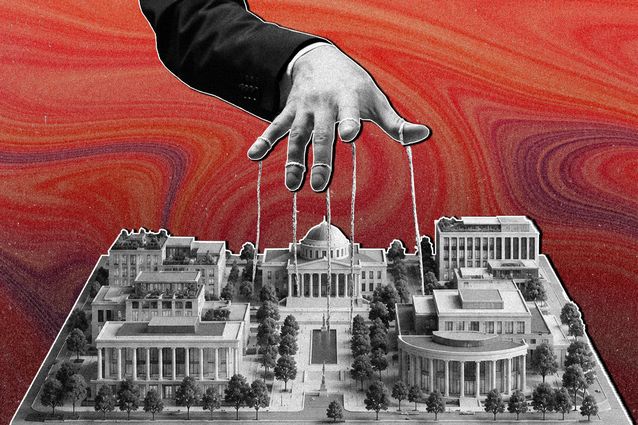
This idea of a new fascist state, federally authorised and exempted from federal laws, should scare the bejesus out of us. Even without the fascist overtones, though, the idea of an urban settlement dreamed up by one person and promoting one section of the populace is profoundly opposed to the very essence of “city” as res publica – that is, a universal welcome to all comers.
Brown’s Substack profile image of an armoured knight suggests that yes, perhaps Goodman is right, utopias are for children. But all the more dangerous for that.
(1) Filippo Tommaso Marinetti, “Futurist Manifesto ,” Le Figaro , February 20 1909.
(2) Burnham’s speech to the London Town Planning Conference , October 1910.
In this extract from Kathryn Franco’s recent book on Sydney homebuilders Pettit and Sevitt, she explores Ironbark Architecture’s contemporary renovation to a 1967 home originally …
Find out more on the topic of Victoria’s Big Housing Build through expert insights, podcasts and more.