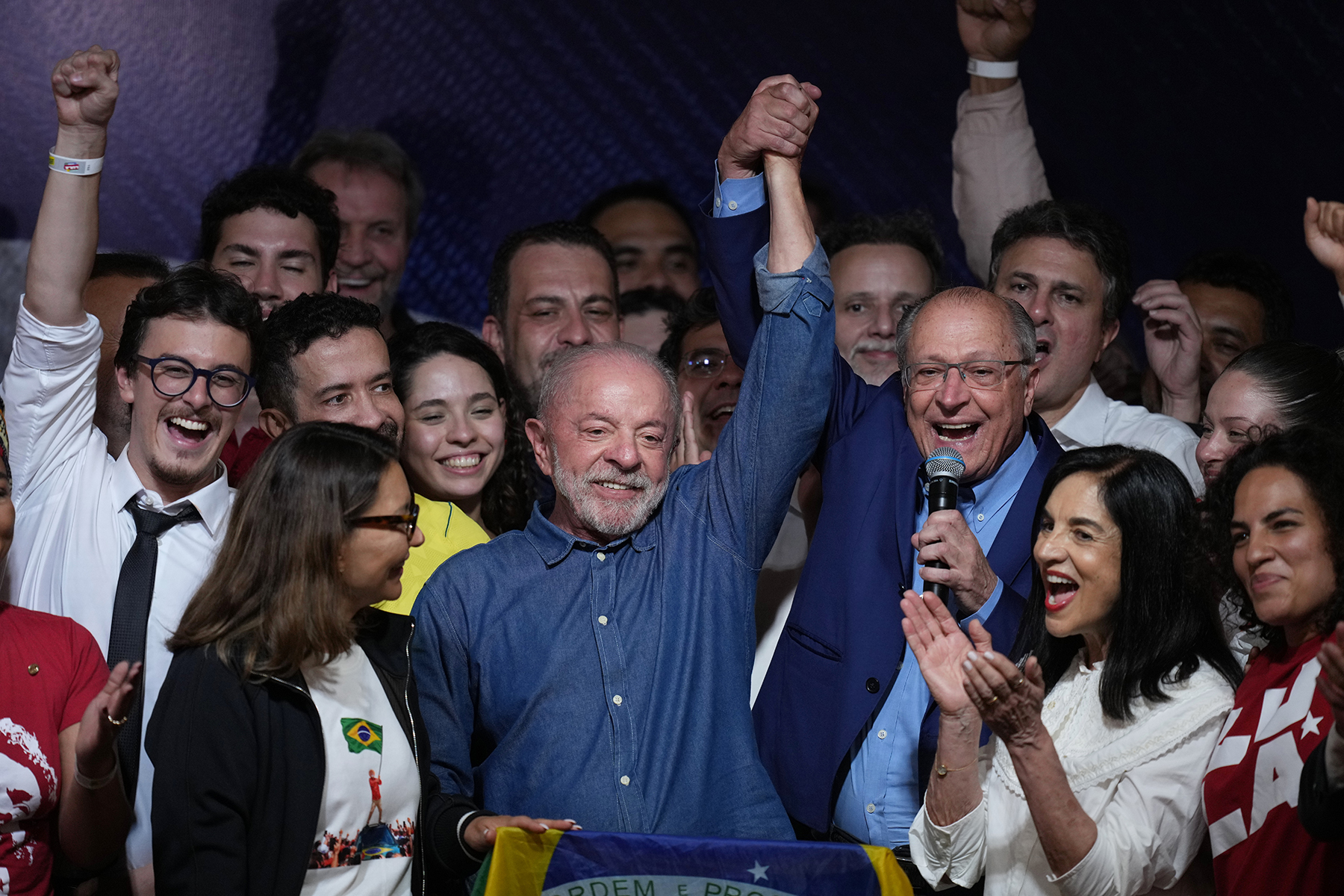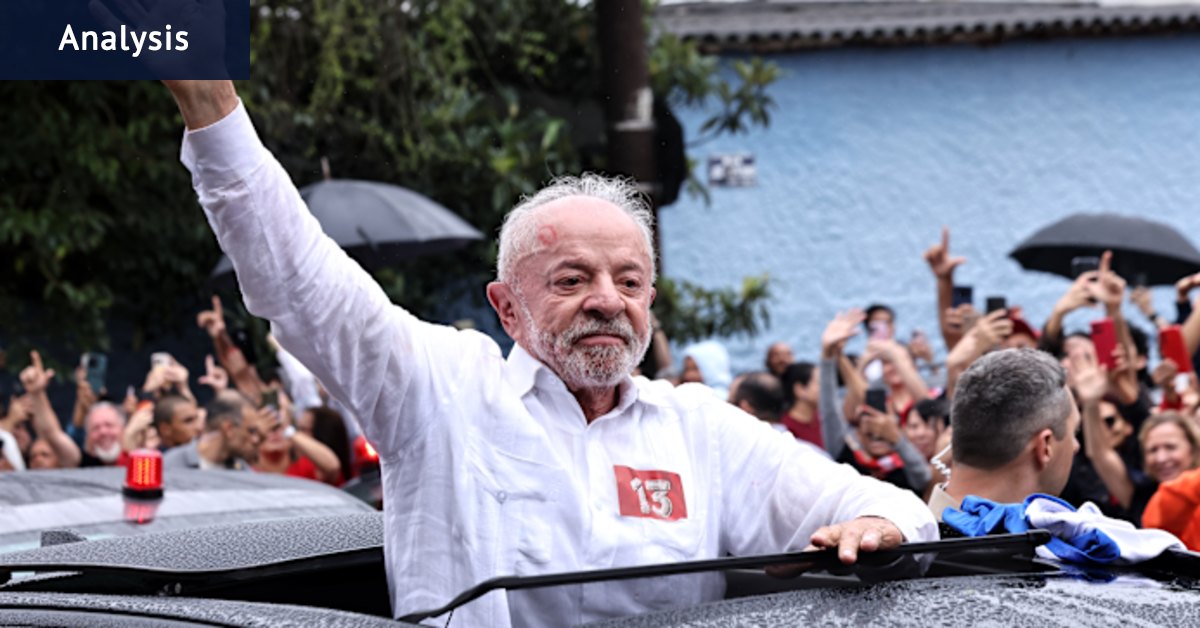
Sunday’s election is a test for incumbent Lula: can he can rally enough support to overturn Bolsonaro’s lead?
Hello and welcome to our live coverage of the Brazilian presidential runoff.
Leftwing president Luiz Inácio Lula da Silva and senator Flávio Bolsonaro faced a second round of voting after neither secured more than 50 per cent of the vote in the first round.
Bolsonaro, the eldest son of disgraced ex-president Jair Bolsonaro, pulled off a surprise first-round victory, signaling a resurgence of the far-right in Brazil. But polls appeared to have narrowed a few days before Sunday’s vote, with a Quaest poll reported by Reuters showing Bolsonaro on 45% of the vote, with Lula on 44%. A week earlier, Bolsonaro had 46% of the vote, compared to Lula’s 44%.
In the first-round election earlier this month, Bolsonaro secured 47% of the vote, compared with Lula’s 45%.
Sunday’s election is a test for incumbent president Lula: can he can rally enough support to overturn Bolsonaro’s lead?
With only a few minutes left before poll closing time, both presidential candidates are asking Brazil’s electoral court to extend voting hours in some cities. The request from president Luiz Inácio Lula da Silva came after issues in nine states with buses that provide transportation to polls. Flávio Bolsonaro ’s is due to heavy rains in the nation’s south. Polls were expected to close nationwide at 5pm.
Brazilian Supreme Court justice Kássio Nunes, who also heads the country’s electoral court, told reporters in capital Brasilia that some cities are indeed experiencing bus shortages, but did not answer whether the voting hours will be extended, according to the AP. He did not address Bolsonaro’s request in his comments.
Brazilian president Luiz Inacio Lula da Silva said that many people had been “barred from voting” after buses were taken out of circulation in Sao Paulo and several other cities.
“We are asking the Supreme Court to extend the electoral process so that those who were effectively barred from voting, due to the dirty tactics of mayors, can still cast their votes,” said Lula.
Lula said 40 percent of buses were pulled from service in Sao Paulo, a problem also taking place in several cities in his native northeastern Brazil.
To Flávio Bolsonaro and his publicists, it must have seemed an ingenious idea that would expose his rival’s supposed crookedness on the eve of Brazil’s presidential election.
But the far-right politician’s decision to attend a primetime television debate against his leftwing opponent, Luiz Inácio Lula da Silva , with the word “corrupto” (corrupt) written on the palm of his hand has backfired.
Rather than drawing attention to the incumbent’s alleged misdeeds, many of the programme’s millions of viewers sarcastically took Bolsonaro’s hand-written message as an admission of his own guilt.
The former Brazilian environment minister Marina Silva has said that if Flávio Bolsonaro becomes president he will seek to finish the “perverse project” of rampant rainforest destruction initiated by his jailed far-right father.
The Amazon was thrown into chaos during Jair Bolsonaro’s 2019-2022 presidency, when Brazil’s environment and Indigenous protection agencies were gutted and environmental criminals ran riot, causing surges in deforestation and violence.
Silva, a world-renowned environmentalist who was Lula’s environment minister until April, says a second Bolsonaro presidency will spell disaster for the globally crucial ecosystem, for its inhabitants and for the climate crisis.
“I’ve no doubt that this time they will try to finish the perverse project they started with [Jair] Bolsonaro. If they are elected – and God, and the Brazilian people, willing they won’t be – they will use their time to try to speed up as much as possible all of the regressions they can, including to keep themselves in power,” says Silva.
“The vision they have for the Amazon is the same vision they have for everything. They are denialists . Their vision is that the forest must be removed for economic activities,” she adds. “They will again encourage illegal mining, the invasion of Indigenous lands, and violence against Indigenous and Quilombola communities.”
Thundering to a crowd of thousands of far-right supporters in São Paulo on 7 September, Brazil’s Independence Day, the senator Flávio Bolsonaro focused less on his opponent in the presidential election , the leftist president Luiz Inácio Lula da Silva, than on someone who is not running at all.
“Whoever votes for Lula is voting for Alexandre de Moraes ,” Bolsonaro shouted, referring to the shaven-headed supreme court justice once described as “Voldemort” by Elon Musk.
Although Lula did not appoint Moraes to the court, Bolsonaro’s supporters have linked the two men ever since the judge oversaw the case in which the senator’s father, the former president Jair Bolsonaro, was sentenced to 27 years in prison for attempting a coup .
Just days before the election runoff, Moraes was once again at the centre of a presidential scandal – one that Lula believes may have helped Flávio Bolsonaro overtake him to emerge as the frontrunner . The justice once hailed as democracy’s “saviour” for containing Jair Bolsonaro may now have helped pave the way for the family’s return to power.
The scandal began with a police investigation, which found that Moraes’s wife’s law firm had a contract worth about £20m with Daniel Vorcaro, the banker accused of orchestrating Brazil’s largest banking fraud . Text messages also emerged suggesting a close relationship between Moraes and Vorcaro, though the judge denies the messages are authentic.
Investigations subsequently revealed that at least four other justices had links to the disgraced banker, meaning half of the court’s 10 current justices have been drawn into the scandal.
Hello and welcome to our live coverage of the Brazilian presidential runoff.
Leftwing president Luiz Inácio Lula da Silva and senator Flávio Bolsonaro faced a second round of voting after neither secured more than 50 per cent of the vote in the first round.
Bolsonaro, the eldest son of disgraced ex-president Jair Bolsonaro, pulled off a surprise first-round victory, signaling a resurgence of the far-right in Brazil. But polls appeared to have narrowed a few days before Sunday’s vote, with a Quaest poll reported by Reuters showing Bolsonaro on 45% of the vote, with Lula on 44%. A week earlier, Bolsonaro had 46% of the vote, compared to Lula’s 44%.
In the first-round election earlier this month, Bolsonaro secured 47% of the vote, compared with Lula’s 45%.
Sunday’s election is a test for incumbent president Lula: can he can rally enough support to overturn Bolsonaro’s lead?